Puppy growth stages from birth to adulthood
Growth is not steady. A puppy’s first two years come in distinct phases, each with its own pace and its own priorities for the person looking after it.
Birth to 2 weeks: the neonatal stage
Puppies are born with eyes and ear canals closed. They cannot regulate their own body temperature and cannot walk. Essentially all they do is feed and sleep.
Weight gain is dramatic in relative terms: most puppies double their birth weight in the first week or so. Breeders weigh daily at this stage because failure to gain is one of the earliest signs that something is wrong.
Eyes open around 10 to 14 days. Ear canals follow shortly after.
2 to 4 weeks: the transitional stage
Everything switches on at once. Puppies start to see and hear properly, teeth begin to appear, and wobbly walking replaces crawling. They begin interacting with littermates rather than simply lying against them.
This is when a puppy starts to become a dog rather than a very small mammal.
4 to 12 weeks: socialisation
The most consequential window in a dog’s life, and the reason a good breeder matters so much.
Puppies learn what is normal during this period. Sights, sounds, surfaces, people, other animals and handling that a puppy meets calmly now are far more likely to be unremarkable to it as an adult. Things it never meets can become frightening later.
Weaning happens across roughly 4 to 7 weeks. Most puppies go to their new homes at 8 weeks, which lands squarely in the middle of the window, so the new owner inherits a share of the responsibility.
Core vaccinations start at 6 to 8 weeks and repeat every 2 to 4 weeks until after 16 weeks, following AAHA guidance. This creates a real tension: full protection is not in place until the series finishes, but the socialisation window is closing at the same time. Discuss the balance with your vet rather than defaulting to keeping a puppy indoors until 16 weeks.
12 weeks to 6 months: the fast phase
This is where most of the growing happens, and where our growth reference begins.
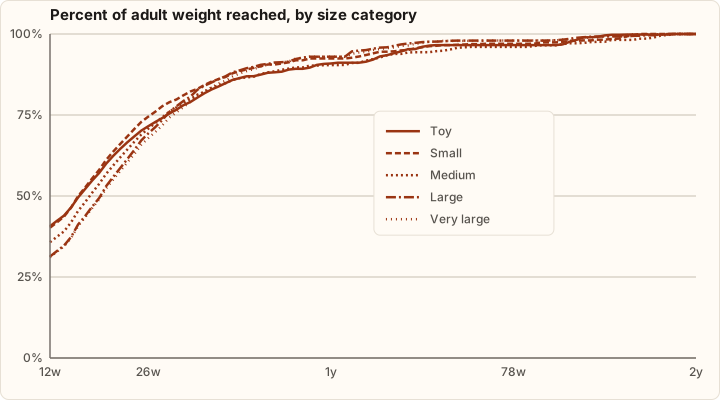
Reading the median curves, puppies reach half their adult weight somewhere between about 3.5 and 4.5 months, later for bigger dogs. By 26 weeks most are around 70 to 80 percent of the way there.
Teething runs through this period. Adult teeth replace baby teeth from roughly 12 to 24 weeks, and chewing peaks accordingly.
This is the stage where weekly weigh-ins are genuinely worth doing. Growth is fast enough that problems show up quickly, and the growth tracker will show you a change in trajectory before it becomes obvious by eye.
6 to 12 months: adolescence
Growth slows noticeably. Behaviour often gets harder.
Physically, most small and medium dogs are close to their adult size by the end of this period. Large breeds are still filling out. Sexual maturity arrives somewhere in here, earlier in small breeds than large ones.
Behaviourally this is the stage that surprises people. Adolescent dogs commonly become less responsive, more independent and more reactive, and it is the age at which many dogs are given up. It is a phase, and it passes, but it needs patience and continued training rather than an assumption that the work is done.
12 to 24 months: finishing
For small and medium dogs, mostly done. For large and giant breeds, still going.
Growth plates close somewhere in this window depending on size, as covered in growth plates and when puppies stop growing. After that, changes are about muscle and condition rather than frame.
The switch from puppy food to adult food usually happens around the point where growth flattens, which is earlier for a small dog than a large one. Your vet can time it to the individual dog.
What the curve looks like
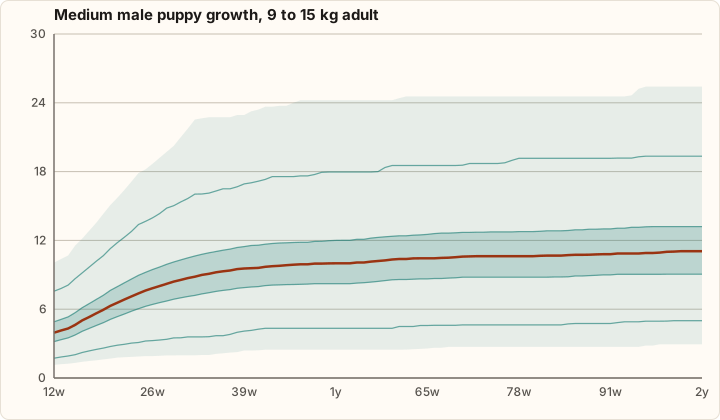
The shape is the same for every size of dog: steep, then bending, then flat. What changes is how long each part lasts. A toy breed is well into the bend by 16 weeks; a very large breed is still climbing.
That is precisely why a single linear formula cannot predict adult weight across sizes, as covered in the AKC puppy weight formula explained.
Stage by stage, at a glance
| Stage | Age | What is happening |
|---|---|---|
| Neonatal | 0 to 2 weeks | Eyes and ears closed, feeding and sleeping, weight doubles |
| Transitional | 2 to 4 weeks | Senses switch on, first teeth, first steps |
| Socialisation | 4 to 12 weeks | Learning what is normal; weaning; vaccinations begin |
| Fast growth | 12 weeks to 6 months | Half adult weight reached; teething; fastest gains |
| Adolescence | 6 to 12 months | Growth slows, behaviour gets harder, sexual maturity |
| Finishing | 12 to 24 months | Plates close, filling out, adult food |
Where is my puppy now?
Plot it rather than guess. The puppy growth chart has reference tables for every size band and sex, and the puppy size calculator will tell you which band your puppy is heading for and when dogs in that band finish growing.
The thing worth remembering through all of it: a puppy tracking steadily along any centile is growing normally. It is a change in the line, not its height, that is worth a phone call.
If your puppy is not born yet, the stages before this one have their own timeline: see why a puppy due date is a range for how gestation is dated, and what happens during whelping for the first few hours.
Related guides
- Growth plates and when puppies stop growing When growth plates close by size, why it matters for exercise and joints, and what our own data says about when growing really ends. Check your puppy's stage.
- How big will my puppy get? What actually predicts your puppy's adult size, which rules of thumb work, and which quietly fail. Read this before you trust any single number.
- Puppy growth chart by week, birth to 24 months Week by week weight expectations for every size of dog, what to record and when, and how to spot a change that matters. Find your puppy's chart here.
Calculators for this
References
Every figure on this page comes from one of these. Full details, including what each source is used for, are on our sources page.
- Salt C, Morris PJ, German AJ, Wilson D, Lund EM, Cole TJ, Butterwick RF. Growth standard charts for monitoring bodyweight in dogs of different sizes. PLOS ONE. 2017;12(9):e0182064. doi:10.1371/journal.pone.0182064
- WALTHAM Petcare Science Institute. Puppy Growth Charts.
- American Animal Hospital Association. AAHA Canine Life Stage Guidelines.
- American Animal Hospital Association. 2022 AAHA Canine Vaccination Guidelines (2024 update).