Puppy growth calculator
Predicting a final weight is the question everyone asks. Whether a puppy is growing steadily is the question that actually matters, and it is the one your vet will ask. Enter your weigh-ins and this plots the line your puppy is tracing.
Track your puppy’s growth
Add each weigh-in as you do it. A single reading tells you where your puppy sits; a series tells you whether it is growing steadily, which is the part that matters.
Growth trajectory
—
| Age | Weight | Centile | Change |
|---|
How to use the tracker
- Set the size category and sex. Choose the adult size band your puppy is expected to finish in, and its sex. Both change the reference curve the weigh-ins are compared against.
- Enter your weigh-ins. Add the age in weeks and the weight for each time you have weighed your puppy. Two is the minimum for a trend; four or five make the picture much clearer.
- Plot the curve. Each weigh-in is placed on the growth chart and converted to a centile, so you can see the line your puppy is tracing rather than a single point.
- Read the direction, not the position. A steady line along any centile is healthy growth. The signal worth acting on is a sustained move across several centile lines.
- Take it to your vet. A growth curve over time is genuinely useful clinical information. Bring these numbers to your next appointment.
What each value means
- Centile
- Your puppy’s position among healthy puppies of the same size category, sex and age. The 40th centile means about 40 percent of healthy puppies weighed less at that age.
- Change
- How many centile points your puppy has moved since the previous weigh-in. Small movements are noise. Sustained movement in one direction is signal.
- Tracking steadily
- Your puppy has stayed within about 15 centile points across the readings. This is what normal growth looks like, on a high line or a low one.
- Climbing or dropping across centiles
- A sustained move of more than 15 centile points. Worth mentioning at your next appointment; worth a call if it is large or sudden.
Why the line matters more than the position
This is borrowed wholesale from paediatrics. Nobody looks at a child’s height once and declares a verdict. They plot it repeatedly and watch the shape of the line, because a child tracking the 10th centile steadily is healthy, while a child falling from the 75th to the 25th needs looking at even though 25 is a perfectly normal number.
Puppies work the same way. Someone has to be on the 10th centile. Being small is not the same as being unwell. But a puppy that was on the 75th and is now on the 25th has changed, and change is the thing worth investigating.
Example calculations
Three sequences, each read out of the same reference the tracker plots against. Read the middle row of each card left to right: that is the line the tracker draws.
A Cocker Spaniel, weighed monthly
3.6 kg at 12w · 4.5 kg at 16w · 5.6 kg at 20w · 6.8 kg at 26w
55th → 54th → 55th → 54th centile
- Medium category, female
- Four weigh-ins, no crossing
- Trajectory: steady
The textbook result. The weight grows 1.9 times across these four readings while the centile stays put, because growing fast is exactly what the reference expects at this age.
A Labrador that slid
12.1 kg at 12w · 14.4 kg at 16w · 16.6 kg at 20w · 19.7 kg at 26w
75th → 59th → 40th → 25th centile
- Very large category, male
- Fell from the 75th to the 25th
- Trajectory: worth a vet visit
Every one of these weights is heavier than the last, and this is still the example to worry about. A single reading would have shown a normal puppy at each visit. Only the sequence shows the slide.
A small puppy who is simply small
2.3 kg at 14w · 3.2 kg at 20w · 3.9 kg at 26w · 4.5 kg at 34w
13th → 12th → 11th → 13th centile
- Small category, male
- Sits below most of the reference
- Trajectory: steady
Someone has to be on the 13th centile. Held steadily over five months, a low centile is a description of this puppy rather than a problem with it.
Reference values
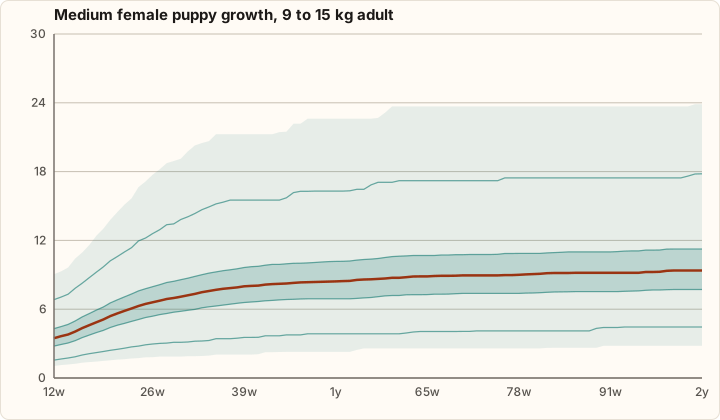
These are the two references the examples above are read from. Find the age in the left column and read across; the bold column is the median, and the columns either side are the centile lines your weigh-ins get placed between.
Medium breeds, female (9 to 15 kg adult)
| Age | 2th | 9th | 25th | 50th | 75th | 91th | 98th |
|---|---|---|---|---|---|---|---|
| 12 weeks | 1.56 | 2.17 | 2.79 | 3.47 | 4.30 | 5.30 | 6.84 |
| 16 weeks | 2.00 | 2.80 | 3.52 | 4.35 | 5.33 | 6.45 | 8.27 |
| 20 weeks | 2.42 | 3.49 | 4.40 | 5.40 | 6.55 | 7.91 | 10.2 |
| 26 weeks | 2.97 | 4.31 | 5.39 | 6.61 | 7.96 | 9.56 | 12.6 |
| 34 weeks | 3.27 | 4.92 | 6.21 | 7.59 | 9.15 | 11.0 | 14.9 |
| 43 weeks | 3.68 | 5.42 | 6.77 | 8.19 | 9.91 | 11.9 | 15.5 |
| 12 months | 3.86 | 5.58 | 6.90 | 8.43 | 10.2 | 12.3 | 16.3 |
| 15 months | 4.05 | 5.93 | 7.27 | 8.86 | 10.7 | 13.0 | 17.2 |
| 18 months | 4.11 | 6.00 | 7.38 | 9.00 | 10.9 | 13.2 | 17.5 |
| 21 months | 4.41 | 6.12 | 7.54 | 9.17 | 11.0 | 13.3 | 17.5 |
| 24 months | 4.45 | 6.34 | 7.72 | 9.37 | 11.2 | 13.5 | 17.8 |
Very large breeds, male (30 to 40 kg adult)
| Age | 2th | 9th | 25th | 50th | 75th | 91th | 98th |
|---|---|---|---|---|---|---|---|
| 12 weeks | 4.91 | 6.79 | 8.68 | 10.5 | 12.1 | 13.9 | 16.1 |
| 16 weeks | 6.98 | 9.43 | 11.7 | 13.7 | 15.7 | 17.8 | 20.2 |
| 20 weeks | 9.31 | 12.4 | 15.1 | 17.6 | 20.1 | 22.6 | 25.6 |
| 26 weeks | 12.2 | 16.3 | 19.7 | 22.9 | 25.9 | 29.0 | 32.4 |
| 34 weeks | 15.0 | 20.2 | 24.1 | 27.7 | 31.3 | 34.8 | 39.0 |
| 43 weeks | 17.0 | 22.5 | 26.7 | 30.5 | 34.1 | 37.9 | 42.4 |
| 12 months | 18.1 | 23.4 | 27.6 | 31.3 | 35.1 | 39.1 | 44.2 |
| 15 months | 19.2 | 24.8 | 28.9 | 32.8 | 36.6 | 41.0 | 46.2 |
| 18 months | 19.5 | 25.1 | 29.2 | 33.0 | 37.0 | 41.5 | 46.8 |
| 21 months | 20.4 | 25.6 | 29.5 | 33.5 | 37.5 | 42.0 | 47.4 |
| 24 months | 20.7 | 25.7 | 29.8 | 33.7 | 37.7 | 42.5 | 48.4 |
All five categories, both sexes, are on the puppy growth chart.
What moves a puppy across centiles
- Measurement error. Check this first. Different scales, a wriggling puppy, or weighing straight after a large meal will all shift a reading.
- Recent illness. A bout of diarrhoea or a few days off food shows up as a dip, then usually a catch-up.
- Wrong size category. The most common reason the numbers look strange from the start.
- A change in food or portion size. Including the switch from puppy food, or a new household member handing out treats. Re-run the feeding calculator if the amount has not been recalculated recently, and remember the calorie multiplier steps down at four months.
- Parasites. A common cause of poor weight gain in young puppies, and a routine thing for a vet to check.
- Genuine growth spurts. Real, normal, and usually short. They show as a step rather than a sustained drift.
Call your vet if your puppy has lost weight, has not gained in two weeks, or has crossed downward through two or more centile lines. Bring your figures.
Accuracy and limits
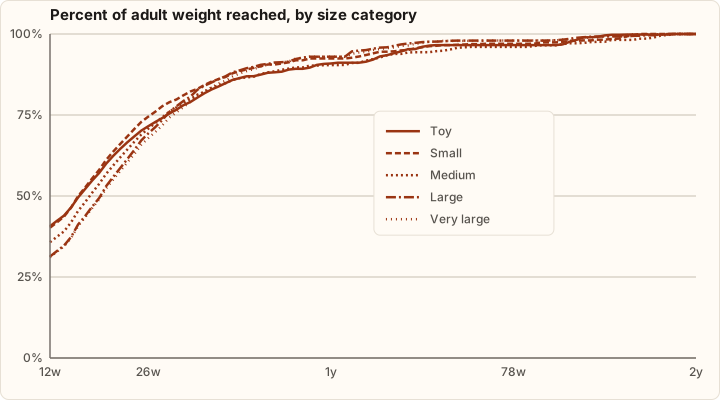
The reference curves run from 12 weeks to two years and cover adult weights up to 40 kg. Weigh-ins outside that window are placed at the nearest edge of the reference and should be treated as indicative only.
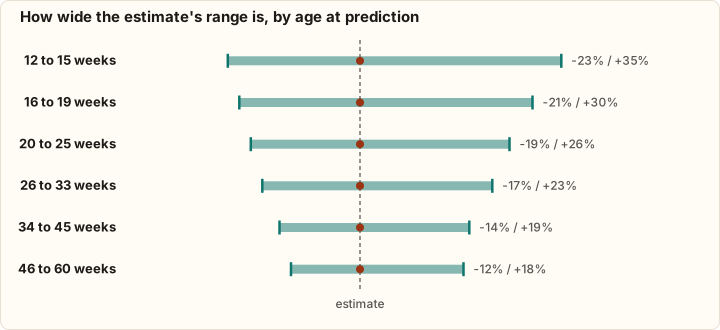
Weight is also not the same as body condition. A dog can sit on a perfectly ordinary centile and still be carrying too much or too little for its frame. That assessment is done by hand, by a vet. Our methodology page sets out how the curves were derived and where they stop being reliable.
Frequently asked questions
What is a puppy growth calculator actually for?
Predicting adult weight is the question everyone asks, but it is not the question a vet cares about. What a vet wants to see is whether a puppy is growing steadily.
This tool plots each of your weigh-ins on a reference curve and converts it to a centile, so you can see the shape of the line rather than one point on it. If you only want the adult weight, use the puppy weight calculator instead.
How many weigh-ins do I need?
Two gives you a direction. Four or five gives you a trend you can trust. Weekly weigh-ins up to about 16 weeks, then every two to four weeks, is a good rhythm.
Weigh at roughly the same time of day and before a big meal, so you are comparing like with like.
My puppy dropped two centile lines. Should I worry?
It is worth a conversation with your vet, yes, even if every individual reading still sits inside the healthy range. Crossing downward through centile lines is a more meaningful signal than being on a low centile in the first place.
Common explanations are benign, including a growth spurt that has not arrived yet, a recent illness, a change of food, or simply a measurement taken on different scales. Your vet can tell the difference by feel in a way no calculator can.
Is a high centile a problem?
Not by itself. Some puppies are simply large. What matters is whether the line is steady.
A puppy climbing steeply across centiles, especially a large breed, is worth watching, because growing too fast is associated with orthopaedic problems in big dogs. That is a body condition and feeding conversation with your vet rather than something a weight alone can answer.
Why does the centile change when I switch size category?
Because the reference curves are different. A 10 kg puppy at 20 weeks is enormous for a toy breed and small for a very large one. The centile is always relative to the category, so picking the wrong one shifts every number.
If you are not sure which category applies, the weight calculator can infer the most likely one from a single weight and age.
Does this work for mixed breeds?
Yes, though you need a reasonable guess at the adult size band. If the parents are known, their weights are the best guide. If not, run one weigh-in through the mixed breed calculator first to get a category, then track from there.
What if my weigh-ins are in pounds?
Switch the unit dropdown to pounds and enter them as they are. Everything is converted internally using the exact factor of 0.45359237 kilograms per pound, and results are shown back in your chosen unit.
Related calculators
References
Every figure on this page comes from one of these. Full details, including what each source is used for, are on our sources page.
- Salt C, Morris PJ, German AJ, Wilson D, Lund EM, Cole TJ, Butterwick RF. Growth standard charts for monitoring bodyweight in dogs of different sizes. PLOS ONE. 2017;12(9):e0182064. doi:10.1371/journal.pone.0182064
- WALTHAM Petcare Science Institute. Puppy Growth Charts.
- American Animal Hospital Association. AAHA Canine Life Stage Guidelines.