Puppy feeding calculator
This uses the same energy formulas a vet would: resting energy requirement from bodyweight, then a growth multiplier that steps down at four months. It converts to cups using the calories per cup on your bag, because two puppy foods can differ by 150 kcal a cup and an average would be worse than no answer.
How much to feed your puppy
Daily energy need
—
- Meals per day
- —
- Per meal
- —
- Resting energy (RER)
- —
- Growth multiplier
- —
| Age | Multiplier | Daily calories | Meals |
|---|
How to use the calculator
- Enter the current weight. Today's weight, not last week's. Energy needs scale with bodyweight, so a stale figure gives a stale answer.
- Enter the age in months. This decides the growth multiplier. It steps down from three times RER to twice at four months, which is the single biggest step change in a puppy's feeding.
- Pick the expected adult size. It sets how many meals a day suit your puppy, and whether a large breed formula is needed.
- Add the calories per cup from your bag. Optional, but it is what turns calories into cups. Foods differ by up to 150 kcal a cup, so we will not substitute an average.
- Adjust against body condition. The number is a starting point. You should feel the ribs easily under a thin layer of fat and see a waist from above.
What each value means
- Daily energy need
- The calories your puppy needs in a day at its current weight and age. This is the headline figure to feed to.
- Resting energy requirement (RER)
- What your puppy would burn doing nothing at all, from
70 x kg^0.75. Everything else is built on top of it. - Growth multiplier
- Three times RER under four months, twice RER after. Growing is expensive, and it gets less expensive quite suddenly.
- Current weight, and why it keeps changing
- Everything here is keyed to today’s weight, so the answer moves as your puppy grows. Tracking that on the growth curve makes it obvious when a recalculation is due.
- Meals per day
- How to split the daily amount. Driven by age and by size, because small breeds need feeding more often.
The formula, shown
Nothing here is proprietary. It is the standard veterinary calculation:
RER = 70 × (bodyweight in kg)0.75
daily calories = RER × 3 (under 4 months)
daily calories = RER × 2 (4 months and over)
A linear form, RER = 30 × kg + 70, also exists but is only valid between 2 and 45 kg. We apply it only inside that range and use the exponential form everywhere else, rather than quietly stretching it.
Example calculations
Produced by the same engine as the calculator, so they cannot drift from it.
A 3-month-old Cocker Spaniel
6 kg at 3 months · food at 380 kcal/cup
805 kcal a day
- RER 268 kcal × 3
- About 2.12 cups a day
- 3 meals of 0.71 cups
A 5-month-old Labrador
17 kg at 5 months · food at 340 kcal/cup
1172 kcal a day
- RER 586 kcal × 2
- About 3.45 cups a day
- 3 meals of 1.15 cups
A 4-month-old Chihuahua
1.6 kg at 4 months · food at 400 kcal/cup
199 kcal a day
- RER 100 kcal × 2
- About 0.50 cups a day
- 3 meals of 0.17 cups
Reference values
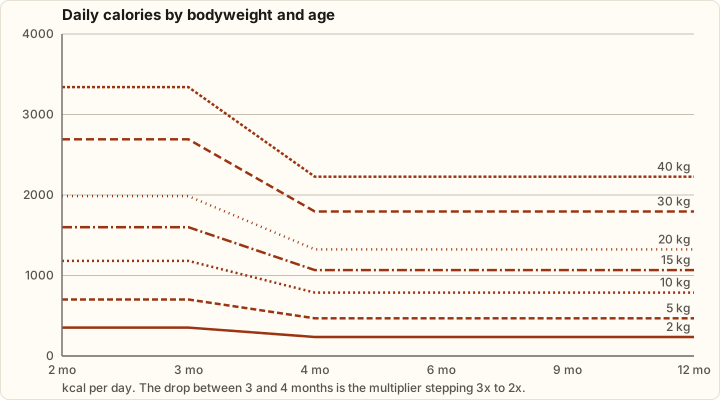
Daily calories by weight and age. Find your puppy’s weight down the left and its age across the top. The step down between the 3 and 4 month columns is the growth multiplier changing.
| Weight | 2 mo | 3 mo | 4 mo | 6 mo | 9 mo | 12 mo |
|---|---|---|---|---|---|---|
| 2 kg | 353 | 353 | 235 | 235 | 235 | 235 |
| 5 kg | 702 | 702 | 468 | 468 | 468 | 468 |
| 10 kg | 1181 | 1181 | 787 | 787 | 787 | 787 |
| 15 kg | 1601 | 1601 | 1067 | 1067 | 1067 | 1067 |
| 20 kg | 1986 | 1986 | 1324 | 1324 | 1324 | 1324 |
| 30 kg | 2692 | 2692 | 1795 | 1795 | 1795 | 1795 |
| 40 kg | 3340 | 3340 | 2227 | 2227 | 2227 | 2227 |
How many meals a day
| Age | Most breeds | Toy and small breeds |
|---|---|---|
| Under 12 weeks | 4 meals | 4 meals |
| 12 weeks to 6 months | 3 meals | 3 meals |
| 6 to 8 months | 2 meals | 3 meals |
| 8 months onwards | 2 meals | 2 meals |
Toy breeds stay on more frequent meals because they are prone to low blood sugar when meals are spaced too far apart. It is a safety point, not a preference.
If you have a large breed puppy
Large and very large breeds should be on a large breed puppy formula. These control energy density and calcium deliberately, because growing too fast is a risk factor rather than an achievement in big dogs.
AAFCO caps calcium in large-breed growth formulas at roughly 4.5 grams per 1,000 kcal, and problems have been reported above about 3.6. Puppies from weaning to around six months absorb calcium passively and cannot down-regulate when intake is high, so adding a calcium supplement on top of a complete food is actively harmful rather than merely wasteful.
Accuracy and limits
- This is a starting point, not a prescription. Published energy requirements carry real individual variation, which is exactly why the guidance is to calculate then adjust.
- Body condition beats arithmetic. Ribs easily felt under a thin layer of fat, waist visible from above.
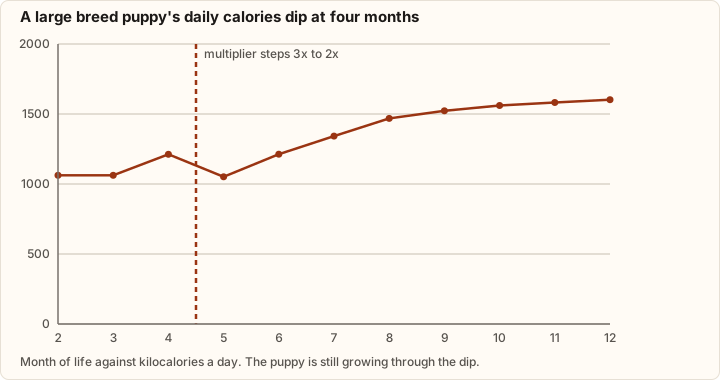
- Recalculate as your puppy grows. The figure rises with weight, then drops sharply at four months.
- We will not guess your food’s energy density. Without it you get a calorie target, not a cup measurement.
- Health conditions change everything. A puppy recovering from illness, or with a digestive condition, needs a vet’s plan rather than a calculator’s.
Frequently asked questions
How much should I feed my puppy?
It depends on weight and age, and the maths is standard veterinary practice rather than anything proprietary. First the resting energy requirement: RER = 70 x (bodyweight in kg)^0.75. Then a growth multiplier on top: three times RER under four months, twice RER from four months.
The calculator does both and converts to cups if you tell it the calories per cup on your bag.
Why does the amount drop so much at four months?
Because the growth multiplier steps from 3 x RER to 2 x RER. That is a real, published step rather than a gradual taper, and it is large.
A puppy still being fed at its three-month rate at seven months is getting roughly a third more food than it needs. This is one of the most common reasons a puppy quietly becomes overweight during adolescence.
How many cups is that?
It depends entirely on your food. Two puppy foods can differ by 150 kcal per cup, which changes the portion by nearly half.
Look for “kcal/cup” or “calorie content” on the bag, usually near the guaranteed analysis. Enter it and the calculator converts. If you leave it blank we give you the calorie target instead of guessing, because a guessed density is worse than no answer.
How many meals a day does a puppy need?
Four a day under 12 weeks, three from 12 weeks to about six months, then two from six months onwards for life.
Toy and small breeds stay on three meals for longer, usually until six to eight months. That is not fussiness: small puppies are prone to low blood sugar when meals are spaced too far apart.
Should I follow the feeding guide on the bag instead?
Use both and expect them to disagree a little. Bag charts are built around a breed-average puppy at a given weight and tend to be generous, partly because underfeeding generates complaints and overfeeding does not.
Neither the bag nor this calculator can see your puppy. Body condition is the tiebreaker, and it is the thing your vet assesses by hand at every visit.
Does my large breed puppy need special food?
Yes, and it matters more than most people realise. Large breed puppy formulas control energy density and calcium specifically to slow growth, because growing too fast is associated with developmental orthopaedic problems in bigger dogs.
AAFCO caps calcium for large-breed growth formulas at roughly 4.5 grams per 1,000 kcal, and concerns have been reported above about 3.6. Crucially, puppies from weaning to around six months absorb calcium passively and cannot down-regulate when intake is high, which is why adding a calcium supplement on top of a complete food is actively harmful rather than merely wasteful.
My puppy always seems hungry. Should I feed more?
Most puppies act hungry regardless of how much they have eaten. Appetite is a poor guide to adequacy.
Judge by body condition and growth instead: ribs easily felt under a thin layer of fat, a visible waist from above, and a steady line on a growth chart. If all three look right, your puppy is being fed enough however convincing the performance at the bowl.
When do I switch from puppy food to adult food?
Around the point where growth flattens, which is earlier for small dogs than large ones. Small breeds are often ready by nine to twelve months; large and giant breeds usually stay on puppy or large-breed-puppy food until twelve to eighteen months.
Switch gradually over about a week, mixing increasing proportions of the new food. Your vet can time it to your individual dog rather than a birthday.
How do treats fit in?
Count them. The usual guidance is that treats should stay under about 10 percent of daily calories, with the rest coming from a complete and balanced food.
Training treats add up faster than people expect. If you are doing a lot of training, take the treat allowance out of the meal portions rather than adding it on top.
Is the calculator accurate for my puppy?
The formulas are the standard veterinary ones and the arithmetic is exact, but every dog has its own metabolism. Published energy requirements carry meaningful individual variation, which is precisely why the guidance is to start from a calculated figure and then adjust.
Treat the number as a starting point, weigh regularly, and let body condition decide the rest. Our methodology page sets out exactly which source each figure comes from.
Related calculators
Not sure what your puppy will grow into? Portion size follows adult weight, so the breed pages are a good place to pin that down before you feed to a guess.
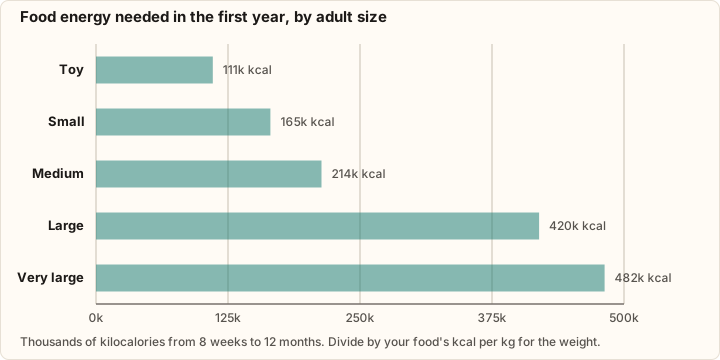
Budgeting rather than portioning? How much food a puppy eats in its first year totals the same arithmetic across twelve months, and the cost calculator turns it into money.
References
Every figure on this page comes from one of these. Full details, including what each source is used for, are on our sources page.
- Merck Veterinary Manual. Nutritional Requirements of Small Animals. Management and Nutrition.
- Association of American Feed Control Officials. Dog and Cat Food Nutrient Profiles, growth and reproduction.
- World Small Animal Veterinary Association. Global Nutrition Guidelines.
- American Animal Hospital Association. AAHA Canine Life Stage Guidelines.