How big will my puppy get?
It is the first question almost every new owner asks, usually within a week of bringing a puppy home. The honest answer has three parts: what genuinely predicts adult size, how confident anyone can reasonably be, and what to do with the answer.
The short version
Your puppy’s weight measured against its age is the single most useful predictor you have. Not paw size, not how big its head looks, not what the breeder said. A weight and an age, plotted on a growth curve for the right size of dog, will get you closer than anything else available without a crystal ball.
Everything else on this page is detail about how to do that well.
Why one formula cannot work for every dog
The rule you will find everywhere is:
adult weight = (current weight ÷ age in weeks) × 52
It is easy to do in your head, and that is genuinely its only virtue. It assumes a puppy gains weight at a constant rate for its whole first year.
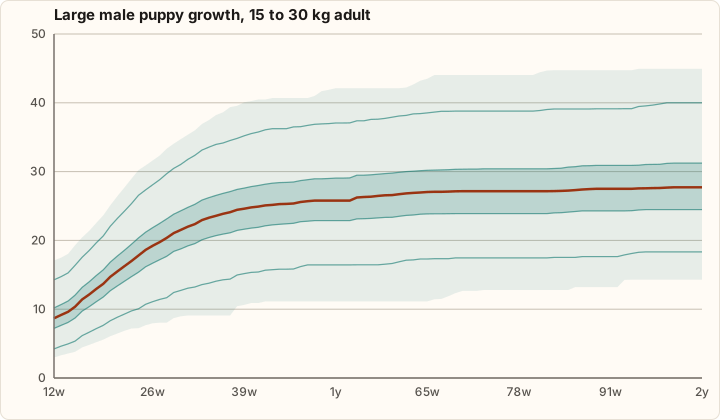
Real growth is an S-curve. It is slow at first, accelerates hard through the middle months, then flattens as the growth plates close. Crucially, the shape of that curve depends on how big the dog will end up.
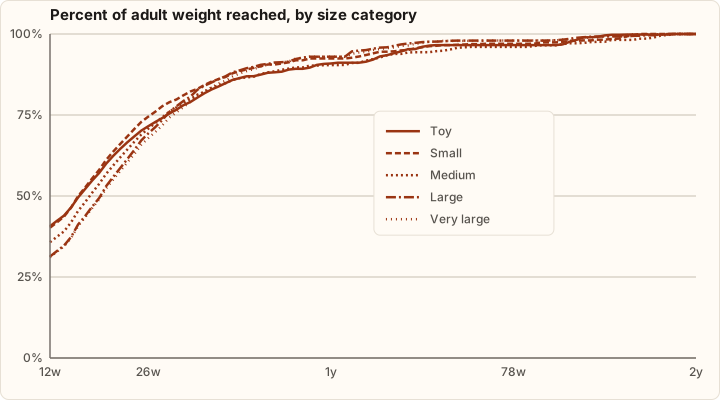
Reading off the growth reference this site is built on, a toy-sized puppy at 16 weeks is already about half its adult weight, while a puppy heading for 30 to 40 kg is only about two fifths of the way there. Apply the same multiplier to both and you will underestimate the bigger dog by roughly a quarter.
That is why our puppy weight calculator asks what size your dog is expected to be. Without that, any answer is a guess dressed up as arithmetic.
What actually predicts adult size, ranked
1. Weight against age, on the right curve
This is the method. Find which growth centile your puppy sits on today, then follow that centile forward. Puppies tend to hold their position on the curve: a puppy on the 60th centile at 16 weeks is usually still near the 60th centile as an adult.
This is borrowed directly from paediatrics, where nobody predicts a child’s adult height from a single measurement and a multiplier.
2. The parents’ adult weights
For a mixed breed with known parents, their measured adult weights provide useful size anchors. Our mixed breed calculator averages them to select a plausible category, then uses the puppy’s own position on that curve for the answer. The average is not a promise that the result stays between the parents.
Two caveats. Sex matters: male medians sit above female medians throughout the reference. And where the parent weights differ greatly, the category anchor is less informative, so the result range and later weigh-ins deserve more attention than the headline.
3. The breed standard
For a purebred, the AKC breed standard gives a published adult weight range. It will not tell you where in that range your individual puppy lands, but it is an excellent sanity check. If a calculator puts your Beagle at 30 kg, something has gone wrong with the inputs.
4. Sex
Consistent and worth accounting for. In the reference behind this site, the male median sits above the female median at every single age from 12 weeks to two years, in every size category. For a large breed the adult gap is several kilograms.
5. Everything else
Paw size, ear size, loose skin, how the puppy looks next to its littermates. These are folk signals. Some carry a grain of truth, most do not, and none of them come close to a weight and an age. We look at the paw claim in detail in does paw size predict adult size.
How confident can anyone actually be?
More confident than most sites admit, and much less than some claim.
We measured it. Taking puppies from the source dataset that had both an early weight and a mature weight, projecting forward from the early measurement, and comparing against what the dog actually weighed, gives a real error distribution across more than half a million predictions.
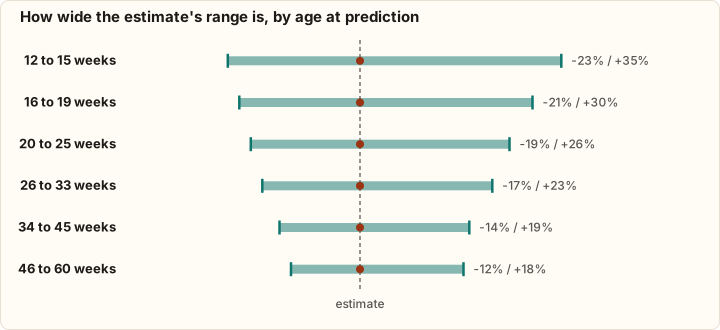
At 12 to 15 weeks, eight puppies in ten land within about 23 percent below to 35 percent above the estimate. By 46 to 60 weeks that tightens to about 12 percent below and 17 percent above.
So a 20 kg estimate made at 13 weeks realistically means “somewhere between 15 and 27 kg”. That is genuinely useful for choosing a crate and planning a budget. It is not precise enough to argue with a breeder about. Anyone quoting you a single confident number to one decimal place is not measuring their own accuracy. There is more on this in are puppy weight calculators accurate.
When is the best time to predict?
From 12 weeks the estimate becomes genuinely useful, and it improves steadily from there.
Before 12 weeks, prediction is much shakier. Our growth reference does not begin until 12 weeks, so we decline to extrapolate backwards and say so rather than inventing a number. Very young puppies also vary enormously depending on litter size and how well they competed for milk.
The sweet spot for most people is 16 to 26 weeks: accurate enough to plan around, early enough that the answer still changes decisions about crates, harnesses and food.
What if my puppy is a mix?
Perfectly workable, with wider error bars. Two routes:
- If you know the parents, use their adult weights. Best single signal available.
- If you do not, work backwards from the puppy. An 8 kg puppy at 16 weeks is far too heavy to be a toy breed and far too light to be a giant one. The mixed breed calculator ranks every size category by how well it fits and shows what each would mean.
A DNA test is interesting for ancestry and can flag health predispositions worth knowing about, but for size alone it is rarely worth the wait. By the time results arrive, another month of weigh-ins will have told you more.
The one thing more useful than a prediction
Predicting the final number is what everyone wants. Watching the trajectory is what your vet cares about.
A puppy tracking steadily along the 20th centile is growing perfectly normally. A puppy that was on the 75th and is now on the 25th has changed, and change is the thing worth investigating, even though both readings sit inside the healthy range.
Weigh weekly to about 16 weeks, then every two to four weeks. Plot it. Take it to appointments. The growth tracker is built for exactly this.
When to stop worrying and call a vet instead
Contact your vet if your puppy has lost weight, has not gained in two weeks, has crossed downward through two or more centile lines, or is lethargic or off its food. A growth chart is a screening tool, not a diagnosis. Your vet assesses body condition by hand, which no calculator can do.
Common questions in one line each
- When do puppies stop growing? Small breeds by around 9 to 12 months, large breeds 12 to 18, giants later still. See growth plates.
- Can a puppy outgrow both parents? Occasionally, yes, though most land between them.
- Does neutering change adult size? The effect on final weight is small compared with individual variation.
- Is my puppy too small? Being on a low centile is not the same as being unwell. A falling centile is the signal.
- Does food change adult size? It changes body condition and how fast a puppy gets there. Skeletal size is mostly genetic.
The bottom line
Weigh your puppy, note its age, pick the right size band, and read a range rather than a number. Re-run it every few weeks and watch the answer tighten on its own.
Start with the puppy weight calculator if you want the adult figure, or the puppy size calculator if what you really want to know is what kind of dog you are raising and what to buy for it.
Related guides
- Are puppy weight calculators accurate? How close puppy weight predictors really get, measured against 579,135 real outcomes, and what the honest margin of error is at each age. See the numbers.
- The AKC puppy weight formula, explained and tested Where the popular puppy weight formula comes from, the maths behind it, and where it breaks down by size. See how it compares against real growth curves.
- Growth plates and when puppies stop growing When growth plates close by size, why it matters for exercise and joints, and what our own data says about when growing really ends. Check your puppy's stage.
- Does paw size predict how big a puppy will get? Whether big paws really mean a big dog, what the claim gets right, and what predicts adult size far better. Check your puppy with a proper growth curve.
Calculators for this
References
Every figure on this page comes from one of these. Full details, including what each source is used for, are on our sources page.
- Salt C, Morris PJ, German AJ, Wilson D, Lund EM, Cole TJ, Butterwick RF. Growth standard charts for monitoring bodyweight in dogs of different sizes. PLOS ONE. 2017;12(9):e0182064. doi:10.1371/journal.pone.0182064
- WALTHAM Petcare Science Institute. Puppy Growth Charts.
- American Kennel Club. Official Breed Standards.
- American Animal Hospital Association. AAHA Canine Life Stage Guidelines.