Puppy weight calculator
Enter your puppy’s weight, age and sex, and this works out how heavy it is likely to be as an adult by finding the growth curve your puppy is tracking and following it to maturity. The reference behind it is derived from 5,843,503 veterinary weight measurements, and its accuracy has been measured against 579,135 real outcomes rather than assumed.
Estimate your puppy’s adult weight
Estimated adult weight
—
- Growth centile today
- —
- Size category
- —
- Percent of adult weight reached
- —
- The old “weight ÷ age × 52” rule says
- —
How to use the calculator
- Weigh your puppy today. Stand on the scales holding your puppy, then weigh yourself alone and subtract. Use a recent weight, not one from last week: puppies change fast enough that a fortnight matters.
- Enter the age in weeks. Count from the date of birth. If you only know months, switch the toggle and we convert using a real calendar month of 4.345 weeks rather than a rough four.
- Choose the sex. Males run heavier than females at every age in every size category, so this genuinely changes the answer rather than being a formality.
- Pick the expected adult size, or let us work it out. If you know the breed, choose its size category. If your puppy is a mix or you are unsure, leave it on "work it out for me" and we infer the most likely category from the weight and age you entered.
- Read the range, not just the number. The headline figure is the central estimate. The range beneath it covers eight in ten puppies measured at that age, and it is the more honest answer.
What each value means
- Estimated adult weight
- The central estimate: where your puppy is most likely to land once it has finished growing. Treat it as the middle of a range, not a promise.
- The likely range
- The band that eight puppies in ten fall into when a prediction is made at your puppy’s age. It is wider for young puppies and narrows as they grow, because that is what the measured data shows. This is the number to plan around.
- Growth centile
- Where your puppy sits among healthy puppies of the same size category, sex and age. The 70th centile means about 70 percent of healthy puppies weighed less at that age. High or low is not good or bad; the trend over time is what matters.
- Size category
- Which of five adult-weight bands your puppy belongs to. Dogs of different breeds that finish at a similar weight grow at close to the same rate, which is why the reference groups by adult size rather than by breed.
- Percent of adult weight reached
- How far along the journey your puppy is today. A useful reality check: a four-month-old very large breed puppy is not even halfway.
- The old “weight ÷ age × 52” rule
- The linear rule of thumb repeated across the internet, shown so you can see how far it drifts from a curve-based estimate. We display it as a contrast, not a recommendation.
Example calculations
These are produced by the same engine that powers the calculator above, so they cannot drift out of step with it.
A 12-week Yorkshire Terrier
1.6 kg at 12 weeks · male · toy category
4.1 kg as an adult
- Likely range 3.1 to 5.5 kg
- Currently on the 39th centile
- About 39% of the way to adult weight
- Linear rule would say 6.9 kg
Toy breeds are already well along at 12 weeks, so the estimate settles early.
A 16-week Beagle
4.6 kg at 16 weeks · female · medium category
9.8 kg as an adult
- Likely range 7.8 to 12.8 kg
- Currently on the 57th centile
- About 47% of the way to adult weight
- Linear rule would say 15 kg
A medium breed at 16 weeks is around halfway to its adult weight.
A 20-week Labrador Retriever
18 kg at 20 weeks · male · very large category
34.1 kg as an adult
- Likely range 27.6 to 43 kg
- Currently on the 54th centile
- About 53% of the way to adult weight
- Linear rule would say 46.8 kg
Large breeds are only about two thirds of the way there at five months.
How the prediction works
The core idea is borrowed from paediatrics. Children are not tracked by predicting a final height from a single measurement; they are plotted on a growth chart and followed along a centile. Puppies behave the same way.
So the calculator does three things. It finds which centile your puppy sits on today for its size category and sex. It follows that same centile forward to two years. Then it applies a calibration factor measured from real outcomes, because projections made at 12 to 15 weeks were found to run about 4.5 percent light.
centile today → follow that centile to 104 weeks → calibrate against measured outcomes
Interpolation between centile curves is done in log-weight against z-score, because weight at a given age is close to log-normal. Interpolating linearly would squash the tails, which matters most for the very puppies owners worry about.
Why one linear formula cannot work
Puppy growth is an S-curve, and the curve’s shape depends on adult size. Read the figures off our reference and the problem with a single formula is obvious.
| Size category | 12 weeks | 16 weeks | 26 weeks | 1 year |
|---|---|---|---|---|
| Toy | 41% | 50% | 72% | 91% |
| Medium | 36% | 45% | 71% | 90% |
| Very large | 31% | 41% | 68% | 93% |
Knowing the adult weight is also what makes feeding tractable. Portions are calculated from current weight and age by the puppy feeding calculator, and the calorie multiplier steps down sharply at four months. If you are unsure how old your puppy is in weeks, the puppy age calculator converts from a birth date.
Put numbers on it. A toy puppy at 16 weeks is around 50 percent of the way to its adult weight, so you would need to multiply its current weight by about2.0 to get there. A very large puppy at the same age is around 41 percent, needing a multiplier of about2.4. Apply the toy multiplier to the large puppy and you underestimate its adult weight by roughly18 percent.
At 12 weeks the gap is wider still: about 2.4 against3.2. One constant cannot serve both, which is the whole problem with the linear rule.
Worth being straight about one thing. The spread between our size categories is real but narrower than figures you will see quoted elsewhere for giant breeds. That is because our reference stops at a 40 kg adult weight, so true giants are not in it. A Great Dane genuinely is much further behind at 16 weeks than our largest category suggests, and we do not have the data to tell you by how much.
Accuracy and limits
Every puppy weight calculator on the internet claims to be accurate. We measured ours.
Using the same open dataset, we found dogs with both an early weight and a mature weight, projected forward from the early measurement, and compared the projection with what the dog actually weighed. That produced 579,135 prediction-versus-outcome pairs.
| Age at prediction | Range around the estimate | Predictions measured |
|---|---|---|
| 12 to 15 weeks | −23% to +35% | 87,457 |
| 16 to 19 weeks | −21% to +30% | 99,006 |
| 20 to 25 weeks | −19% to +26% | 116,149 |
| 26 to 33 weeks | −17% to +23% | 79,281 |
| 34 to 45 weeks | −14% to +19% | 87,389 |
| 46 to 60 weeks | −12% to +18% | 109,853 |
Where this method stops working
- Under 12 weeks. The reference begins at 12 weeks. Younger than that, we treat the puppy as 12 weeks old, widen the range, and label the result rather than extrapolating off the end of the data.
- Above 40 kg predicted adult weight. The data covers adult weights up to 40 kg. Beyond that the estimate is flagged as a rough indication only.
- Mixed breeds carry more spread. There is no breed standard to anchor against, so the range matters more than the central number.
- Illness, malnutrition and obesity all move the curve. The reference was built from puppies who stayed healthy and in ideal body condition. A puppy who is unwell will not follow it, which is precisely why a sharp change in centile is worth a vet visit.
Reference values
The tables below are the reference the calculator reads from. Weights are in kilograms; find your puppy’s age in the left column and read across to see where its weight falls.
Very large breeds, male (30 to 40 kg adult)
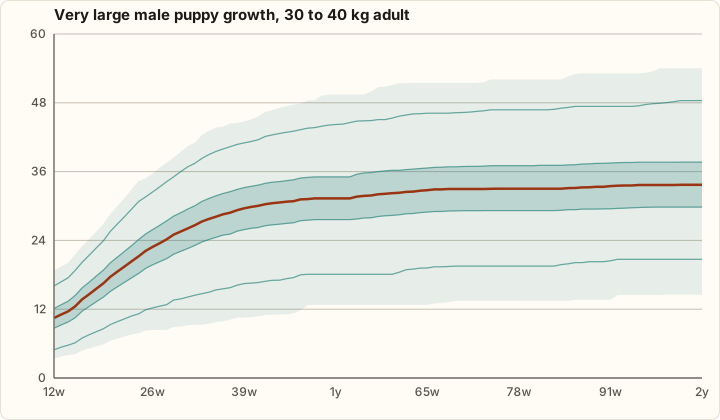
| Age | 2th | 9th | 25th | 50th | 75th | 91th | 98th |
|---|---|---|---|---|---|---|---|
| 12 weeks | 4.91 | 6.79 | 8.68 | 10.5 | 12.1 | 13.9 | 16.1 |
| 16 weeks | 6.98 | 9.43 | 11.7 | 13.7 | 15.7 | 17.8 | 20.2 |
| 20 weeks | 9.31 | 12.4 | 15.1 | 17.6 | 20.1 | 22.6 | 25.6 |
| 26 weeks | 12.2 | 16.3 | 19.7 | 22.9 | 25.9 | 29.0 | 32.4 |
| 34 weeks | 15.0 | 20.2 | 24.1 | 27.7 | 31.3 | 34.8 | 39.0 |
| 43 weeks | 17.0 | 22.5 | 26.7 | 30.5 | 34.1 | 37.9 | 42.4 |
| 12 months | 18.1 | 23.4 | 27.6 | 31.3 | 35.1 | 39.1 | 44.2 |
| 15 months | 19.2 | 24.8 | 28.9 | 32.8 | 36.6 | 41.0 | 46.2 |
| 18 months | 19.5 | 25.1 | 29.2 | 33.0 | 37.0 | 41.5 | 46.8 |
| 21 months | 20.4 | 25.6 | 29.5 | 33.5 | 37.5 | 42.0 | 47.4 |
| 24 months | 20.7 | 25.7 | 29.8 | 33.7 | 37.7 | 42.5 | 48.4 |
Medium breeds, female (9 to 15 kg adult)
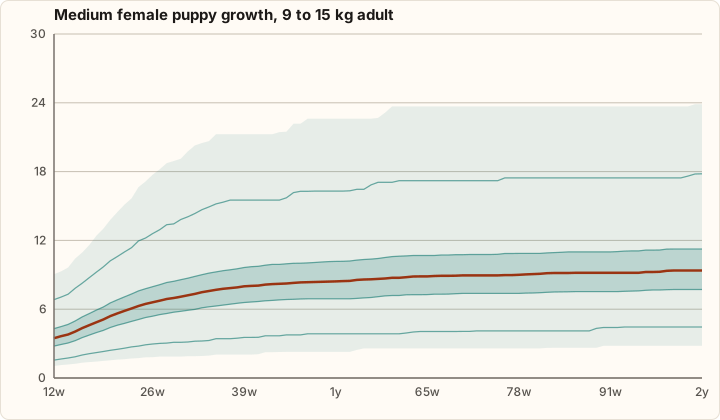
| Age | 2th | 9th | 25th | 50th | 75th | 91th | 98th |
|---|---|---|---|---|---|---|---|
| 12 weeks | 1.56 | 2.17 | 2.79 | 3.47 | 4.30 | 5.30 | 6.84 |
| 16 weeks | 2.00 | 2.80 | 3.52 | 4.35 | 5.33 | 6.45 | 8.27 |
| 20 weeks | 2.42 | 3.49 | 4.40 | 5.40 | 6.55 | 7.91 | 10.2 |
| 26 weeks | 2.97 | 4.31 | 5.39 | 6.61 | 7.96 | 9.56 | 12.6 |
| 34 weeks | 3.27 | 4.92 | 6.21 | 7.59 | 9.15 | 11.0 | 14.9 |
| 43 weeks | 3.68 | 5.42 | 6.77 | 8.19 | 9.91 | 11.9 | 15.5 |
| 12 months | 3.86 | 5.58 | 6.90 | 8.43 | 10.2 | 12.3 | 16.3 |
| 15 months | 4.05 | 5.93 | 7.27 | 8.86 | 10.7 | 13.0 | 17.2 |
| 18 months | 4.11 | 6.00 | 7.38 | 9.00 | 10.9 | 13.2 | 17.5 |
| 21 months | 4.41 | 6.12 | 7.54 | 9.17 | 11.0 | 13.3 | 17.5 |
| 24 months | 4.45 | 6.34 | 7.72 | 9.37 | 11.2 | 13.5 | 17.8 |
Toy breeds, male (under 6.5 kg adult)
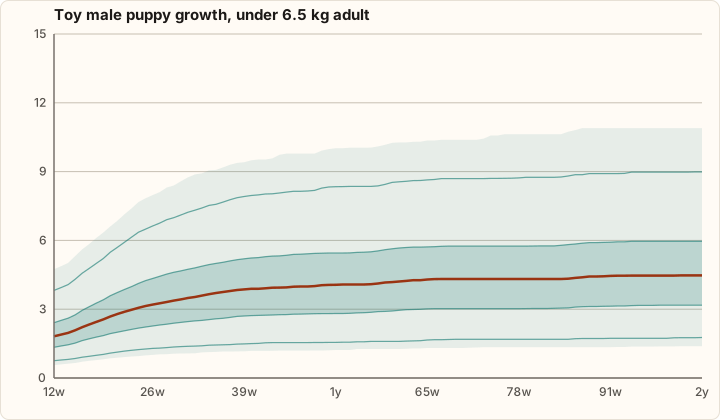
| Age | 2th | 9th | 25th | 50th | 75th | 91th | 98th |
|---|---|---|---|---|---|---|---|
| 12 weeks | 0.76 | 1.02 | 1.34 | 1.82 | 2.41 | 3.04 | 3.82 |
| 16 weeks | 0.91 | 1.22 | 1.63 | 2.22 | 2.95 | 3.69 | 4.57 |
| 20 weeks | 1.08 | 1.45 | 1.94 | 2.68 | 3.59 | 4.46 | 5.49 |
| 26 weeks | 1.29 | 1.70 | 2.27 | 3.20 | 4.34 | 5.38 | 6.63 |
| 34 weeks | 1.43 | 1.90 | 2.55 | 3.65 | 4.95 | 6.17 | 7.53 |
| 43 weeks | 1.54 | 2.04 | 2.75 | 3.94 | 5.32 | 6.60 | 8.03 |
| 12 months | 1.55 | 2.12 | 2.81 | 4.07 | 5.45 | 6.80 | 8.34 |
| 15 months | 1.66 | 2.24 | 3.01 | 4.30 | 5.72 | 7.07 | 8.64 |
| 18 months | 1.69 | 2.25 | 3.02 | 4.32 | 5.75 | 7.11 | 8.73 |
| 21 months | 1.73 | 2.31 | 3.13 | 4.45 | 5.92 | 7.32 | 8.91 |
| 24 months | 1.76 | 2.33 | 3.17 | 4.47 | 5.96 | 7.37 | 8.99 |
Full tables for all five categories and both sexes are on the puppy growth chart page.
If you know the breed
A published breed standard gives you an adult weight range to check the estimate against, which is worth having alongside a centile projection rather than instead of one. We have weight-by-age tables for every breed with a published adult weight, each scaled to that breed’s own standard.
Adult size is also the single biggest driver of what a puppy costs to feed. Once you have an estimate, the puppy cost calculator turns it into kilograms of food across the first year.
Frequently asked questions
How accurate is this puppy weight calculator?
We measured it rather than guessing. Using the same open dataset, we took puppies with an early weight and a later adult weight, projected forward from the early measurement, and compared the projection against what the dog actually weighed. That gives 579,135 prediction-versus-outcome pairs.
At 12 to 15 weeks the estimate lands within 23 percent below to 35 percent above the true adult weight for eight puppies in ten. By 46 to 60 weeks that tightens to 12 percent below and 18 percent above.
Anyone claiming better than that from a weight and an age is not measuring their own accuracy.
At what age is a puppy weight prediction most reliable?
From 12 weeks the estimate becomes genuinely useful, and it keeps improving. Before 12 weeks our growth reference does not apply at all, so we say so rather than extrapolating off the end of the data.
Between roughly 16 and 26 weeks you get the best balance: accurate enough to plan around, and early enough for the answer to still be useful for choosing crate size, harness size, or an adult food.
What does the growth centile actually mean?
It compares your puppy with healthy puppies of the same size category, sex, and age. The 60th centile means around 60 percent of healthy puppies weighed less at that age and 40 percent weighed more.
A high or low centile is not good or bad on its own. A puppy tracking steadily along the 20th centile is growing perfectly normally. What matters is the trajectory: a puppy dropping from the 75th to the 25th over a few weeks is worth a vet visit even though both numbers sit inside the healthy range.
Why does this give a different answer to other puppy weight calculators?
Most of them use one linear formula: current weight divided by age in weeks, multiplied by 52. That assumes growth is a straight line. It is not. Puppy growth is an S-curve that is slow, then fast, then levels off, and the shape differs sharply by size.
At 16 weeks a toy puppy is already around half its adult weight while a very large puppy is only around two fifths of the way there. One formula cannot fit both. We use size-specific centile curves instead, and show you the linear answer alongside ours so you can see the gap.
How big will my puppy get if it is a mixed breed?
Leave the size dropdown on "work it out for me". We infer the most likely size category from your puppy's weight and age, then project from there. No DNA test required.
Mixed breeds carry more uncertainty than purebreds because there is no breed standard to anchor against, so treat the range as genuinely important rather than decoration. Known parent weights can help select the category, but they do not bound the outcome.
Is there an official AKC puppy weight calculator?
No. The American Kennel Club publishes breed standards that include adult height and weight ranges, and it has published the popular linear rule of thumb, but it does not run a weight prediction calculator. We are not affiliated with or endorsed by the AKC.
Breed standards are still useful as a sanity check: if our estimate lands well outside the published range for your breed, the size category is probably wrong.
If you want to see what the rule the AKC popularised actually produces for your puppy, the AKC puppy weight calculator runs all three versions of it and shows the distance from a growth curve.
Does neutering change how big my puppy gets?
The research behind our growth reference looked at exactly this. Neutering before 37 weeks was associated with a slight upward shift in growth trajectory and neutering after 37 weeks with a slight downward shift, but both effects were small compared with the variation between individual dogs. The authors concluded separate curves for neutered dogs were not needed.
Neutering can affect body composition and appetite, which is a weight management question rather than a skeletal size question. That one is worth discussing with your vet.
My puppy is much heavier than the calculator predicted. Should I worry?
Not on one measurement alone. Check the size category first, because choosing the wrong one is the single most common reason an estimate looks off.
What matters more than any single number is the direction of travel. A puppy that has always tracked the 90th centile is probably just a big puppy. A puppy that has climbed steeply across several centile lines in a short time is worth a conversation with your vet, who can assess body condition by feel in a way no calculator can.
When do puppies stop growing?
It depends almost entirely on size. Toy and small breeds are essentially finished by 8 to 10 months. Medium breeds carry on to around 12 to 14 months. Large and giant breeds keep adding bone and muscle until 18 to 24 months, which is why the growth curves in this reference run all the way to two years.
Height finishes before weight. A large-breed dog usually reaches its adult shoulder height months before it fills out to its adult weight.
Can I predict adult size from paw size?
Not reliably. Large paws on a young puppy are a loose hint that there is more growing to come, but they are nothing like as informative as weight and age together. Some breeds are simply built with heavy feet.
Weight measured against age on a proper growth curve is far more predictive, which is what this calculator uses.
What weight should I enter if my puppy will not stand still on the scales?
Weigh yourself, then weigh yourself holding the puppy, and subtract. Bathroom scales are accurate enough for this: a 100 gram error on a 5 kilogram puppy shifts the adult estimate by far less than the natural prediction range.
Weigh at roughly the same time of day and before a big meal, so you are comparing like with like over time.
Does this work in pounds as well as kilograms?
Yes. Switch the unit toggle next to the weight field and every result, including the range and the reference tables, is shown in pounds. The underlying data is metric, so we convert at the boundary using the exact factor of 0.45359237 kilograms to the pound.
What if my puppy will be bigger than 40 kilograms?
The growth reference is validated up to a predicted adult weight of 40 kilograms, which is about 88 pounds. Above that we tell you the estimate is beyond what the data supports rather than quietly reporting a number off the end of the curve.
Giant breeds also grow for longer than two years, so a dog in that range may still be filling out well after our reference stops.
How often should I re-check my puppy's weight?
Weekly until about 16 weeks, then every two to four weeks until growth flattens off. Plotting the same puppy repeatedly is far more informative than a single reading, because it shows the trajectory rather than a snapshot.
Take the numbers to your vet appointments. A growth curve over time is genuinely useful clinical information.
Where does the underlying data come from?
From the open dataset published alongside Salt and colleagues in PLOS ONE in 2017: roughly 15 million bodyweight records from Banfield Pet Hospitals in the United States, collected between 1994 and 2013 and released under a Creative Commons Attribution licence.
We derive our own reference from that data rather than reproducing the published WALTHAM charts, because the fitted parameters behind those charts were never published. Our full method is on the methodology page, and the derivation scripts ship with the site.
Related calculators
References
Every figure on this page comes from one of these. Full details, including what each source is used for, are on our sources page.
- Salt C, Morris PJ, German AJ, Wilson D, Lund EM, Cole TJ, Butterwick RF. Growth standard charts for monitoring bodyweight in dogs of different sizes. PLOS ONE. 2017;12(9):e0182064. doi:10.1371/journal.pone.0182064
- Correction: Growth standard charts for monitoring bodyweight in dogs of different sizes. PLOS ONE. 2024;19(11):e0314711. doi:10.1371/journal.pone.0314711
- WALTHAM Petcare Science Institute. Puppy Growth Charts.
- American Kennel Club. Official Breed Standards.