Puppy age calculator
Converts a birth date into weeks, months and human years, using real calendar arithmetic rather than four-week months, and the modern epigenetic formula rather than multiplying by seven. It also shows which developmental milestones your puppy has already passed.
How old is your puppy?
Your puppy is
—
- In weeks
- —
- In months
- —
- In human years
- —
- Life stage
- —
| Milestone | When | Status |
|---|
How to use the calculator
- Enter the date of birth. If you know it, this gives an exact answer in weeks and days. If you only know the age in weeks, switch the toggle.
- Pick the expected adult size. Life stages depend on size rather than a fixed birthday, because a Great Dane is a senior years before a Chihuahua is.
- Read weeks first. Weeks are the useful unit for a puppy. Vaccination timing, socialisation and growth references are all keyed to weeks, not months.
- Check the milestone list. It shows what your puppy has already passed and what is coming, which is more actionable than the number itself.
Weeks to months, done properly
A calendar month averages 4.348 weeks, not four. Dividing by four is the most common shortcut and it drifts steadily: by the end of the first year the two conventions disagree by more than a week.
| Age in weeks | Actual months | Divide by 4 says |
|---|---|---|
| 4 weeks | 0.9 | 1.0 |
| 6 weeks | 1.4 | 1.5 |
| 8 weeks | 1.8 | 2.0 |
| 10 weeks | 2.3 | 2.5 |
| 12 weeks | 2.8 | 3.0 |
| 14 weeks | 3.2 | 3.5 |
| 16 weeks | 3.7 | 4.0 |
| 20 weeks | 4.6 | 5.0 |
| 24 weeks | 5.5 | 6.0 |
| 26 weeks | 6.0 | 6.5 |
| 32 weeks | 7.4 | 8.0 |
| 39 weeks | 9.0 | 9.8 |
| 45 weeks | 10.3 | 11.3 |
| 52 weeks | 12.0 | 13.0 |
This is why a 12 week old puppy is not quite three months old, and why a "16 week" vaccination appointment is not the same thing as a four month one.
Dog years to human years
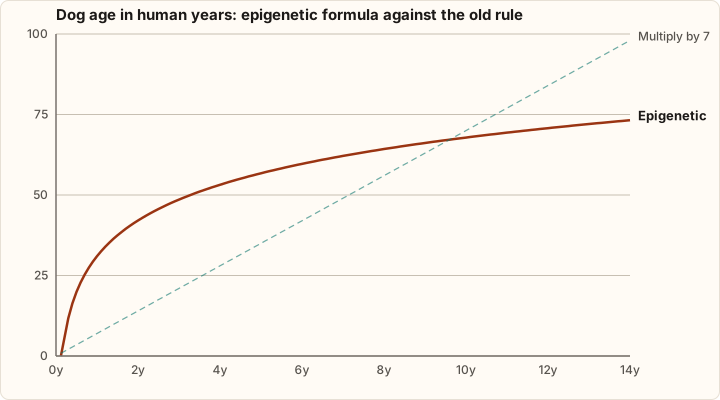
The multiply-by-seven rule was never based on anything. It gets both ends wrong: a one year old dog is not a seven year old child, and a fourteen year old dog is not a ninety-eight year old person.
We use the formula published by Wang and colleagues in Cell Systems in 2020, derived from DNA methylation, the chemical marks on DNA that change measurably with age:
human age = 16 × ln(dog age in years) + 31
| Dog age | Human equivalent | Old rule said |
|---|---|---|
| 6 months | 20 | 4 |
| 1 years | 31 | 7 |
| 2 years | 42 | 14 |
| 3 years | 49 | 21 |
| 5 years | 57 | 35 |
| 7 years | 62 | 49 |
| 10 years | 68 | 70 |
| 13 years | 72 | 91 |
The shape is the point: ageing is fast early and slows down later, which the old rule flattens out entirely.
What each value means
- Weeks, and weeks plus days
- The unit that matters for anything under six months. Vaccination, socialisation and worming are all scheduled in weeks, so this is the number to take to an appointment.
- Months
- A real calendar month, not four weeks. The difference compounds: by a year old, counting in four-week blocks has your puppy a fortnight older than it is.
- Human years
- The epigenetic estimate, from methylation changes measured across the dog and human genomes. It rises steeply then flattens, which is why the first year counts for so much of it. It is a comparison of biological age, not a life expectancy.
- Life stage
- Puppy, adolescent, adult or senior. It depends on size as well as age, because a very large breed is still adolescent at an age a toy breed has been adult for months.
- What it is not
- None of these is a health assessment. A dog ages at its own rate, and the formula describes a population rather than the dog in front of you.
Example calculations
Three dates of birth run through the same calendar arithmetic the calculator uses, all measured on 21 August 2026 so the numbers stay put.
Born 18 June 2026
Date of birth 18 June 2026 · measured on 21 August 2026 · medium breed
9 weeks and 1 day
- 64 days old
- 2.1 months
- Life stage: puppy
Under 12 weeks, and squarely inside the socialisation window. This is the age where weeks are the only unit worth using, because a fortnight either way genuinely changes what you should be doing.
Born 20 January 2026
Date of birth 20 January 2026 · measured on 21 August 2026 · very large breed
7 months and 1 day
- 30 whole weeks
- About 22 in human years
- Life stage: puppy
Still classed a puppy at seven months, because the boundary moves with size and this is a very large breed. Its human-years figure is already 22, which is the part of the epigenetic formula that catches people out.
Born 21 August 2024
Date of birth 21 August 2024 · measured on 21 August 2026 · toy breed
2 years old
- 730 days
- About 42 in human years
- Life stage: adult
Two calendar years, and about 42 in human terms. Multiplying by seven would have said 14, which is the clearest demonstration on this page of why that rule does not survive contact with the data.
Reference values
The conversions people look up most, computed rather than tabulated by hand. Months use a real calendar month of 4.348 weeks and human years use the epigenetic formula.
Read the human years column for its shape, not its precision. A logarithm is at its steepest near zero, so the youngest rows move fastest: the four weeks between 8 and 12 weeks shift the figure from 1 to 7 human years, a jump of 6 for one month of a puppy's life. That is the formula behaving exactly as published rather than misbehaving, but it means a single number at this end carries very little weight. The formula was also fitted on Labrador Retrievers, so it describes a population and not your puppy.
| Age in weeks | Months | Years | Human years |
|---|---|---|---|
| 8 weeks | 1.8 | 0.15 | 1 |
| 12 weeks | 2.8 | 0.23 | 7 |
| 16 weeks | 3.7 | 0.31 | 12 |
| 20 weeks | 4.6 | 0.38 | 16 |
| 26 weeks | 6 | 0.5 | 20 |
| 34 weeks | 7.8 | 0.65 | 24 |
| 43 weeks | 9.9 | 0.82 | 28 |
| 52 weeks | 12 | 1 | 31 |
| 78 weeks | 17.9 | 1.49 | 37 |
| 104 weeks | 23.9 | 1.99 | 42 |
Life stages depend on size
AAHA guidance defines senior status by the proportion of expected lifespan rather than a fixed birthday, which is why size changes the answer so much.
| Size category | Adult weight | Senior from about |
|---|---|---|
| Toy | Under 6.5 kg | 10 years |
| Small | 6.5 to 9 kg | 9.5 years |
| Medium | 9 to 15 kg | 8 years |
| Large | 15 to 30 kg | 7 years |
| Very large | 30 to 40 kg | 6.5 years |
Why weeks matter more than months
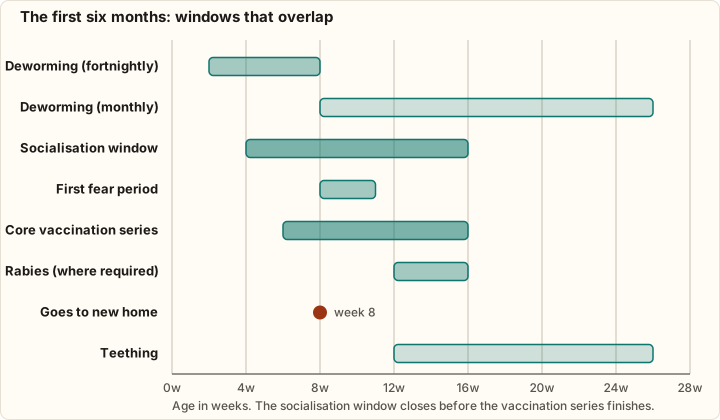
Almost everything clinically important in a puppy’s first year is keyed to weeks:
- 6 to 8 weeks: core vaccination series begins.
- Every 2 to 4 weeks after that: boosters continue until past 16 weeks.
- 4 to 16 weeks: the socialisation window.
- 12 weeks: where veterinary growth references begin.
- 12 to 16 weeks: rabies vaccination, where required.
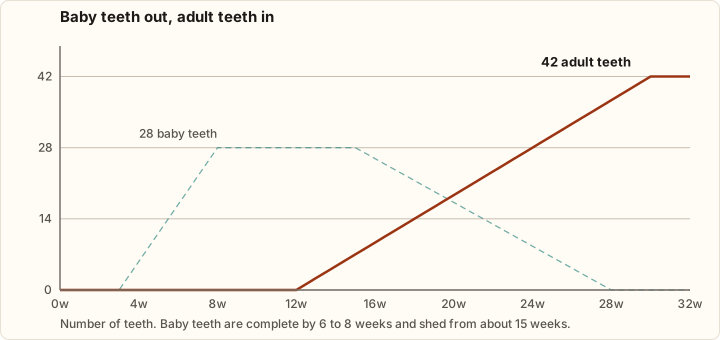
- 12 to 24 weeks: teething, as adult teeth replace baby ones.
- 16 weeks and 4 months are not the same thing, which matters because the feeding multiplier steps down at four months. The feeding calculator uses months for exactly that reason.
Months are simply too coarse a unit for a period where a fortnight makes a visible difference.
Accuracy and limits
- The human-years formula came from Labrador Retrievers. It is a much better rule than multiply-by-seven, not a precise answer for every breed.
- Estimated ages hurt most when a puppy is young. Two weeks of error at 12 weeks matters far more than at 40.
- Life stage boundaries are guidance, not switches. Dogs do not become senior on a birthday.
- Milestone timings are typical ranges, and individual puppies vary considerably around them.
Frequently asked questions
How do I convert my puppy's age from weeks to months?
Divide by 4.348, not by 4. A calendar month averages about 4.35 weeks, so the common shortcut of dividing by four drifts noticeably.
Over a year the two conventions disagree by more than a week: 52 weeks is about 11.96 months by real arithmetic but 13 "months" if you divide by four. That is why a 12 week old puppy is not quite three months old.
Why does everyone measure puppy age in weeks?
Because everything that matters is keyed to weeks. Vaccination series run every two to four weeks until after 16 weeks. The socialisation window closes around 12 to 16 weeks. Growth references start at 12 weeks.
Months are too coarse a unit for a period when a fortnight makes a visible difference.
How old is my puppy in human years?
Not seven times its age. That rule was never based on anything.
We use the formula from Wang and colleagues published in Cell Systems in 2020: human age = 16 x ln(dog age in years) + 31, derived from DNA methylation patterns. It captures the fact that dogs age extremely fast early and then slow down, which the multiply-by-seven rule gets badly wrong at both ends.
How accurate is the human years formula?
It is a much better rule than the old one, not a precise answer for every dog. It was derived from Labrador Retrievers, and breed size affects ageing considerably.
Its strength is the shape rather than any single number: it correctly shows a one year old dog as a young adult rather than a seven year old child, and it correctly slows the ageing down later in life.
When does a dog stop being a puppy?
It depends on size. Small breeds are physically adult by around 9 to 12 months, medium breeds by 12 to 14, and large and giant breeds carry on to 18 to 24 months.
Behaviour lags behind the body. Adolescence typically runs from about 6 months to 18 months or beyond, and it is the stage that surprises people most.
When is a dog considered senior?
By proportion of expected lifespan rather than a fixed age, which is why size matters so much. Following AAHA life stage guidance, a very large dog is entering senior territory around 6.5 years while a toy breed may not until about 10.
That is a gap of several years between two dogs of the same chronological age, which is exactly why a single "dog years" number for all dogs is misleading.
My rescue puppy has an estimated age. How much does that matter?
Quite a lot when the puppy is young, and less as it grows. An error of two weeks at 12 weeks old shifts growth predictions and vaccination timing noticeably; the same error at 40 weeks barely registers.
Vets estimate age reasonably well from teeth, so it is worth asking at your next appointment rather than working from a guess.
What is the socialisation window and have I missed it?
Roughly 4 to 16 weeks, with the most sensitive period earlier in that range. What a puppy meets calmly during it is far more likely to be unremarkable to it as an adult.
If your puppy is past it, you have not ruined anything. Later socialisation is slower and takes more deliberate work, but dogs continue learning throughout life.
Related calculators
Counting forward to a litter instead of back from a birth date? The puppy due date calculator handles gestation, and the cost calculator covers what the first year takes.
References
Every figure on this page comes from one of these. Full details, including what each source is used for, are on our sources page.
- Wang T, Ma J, Hogan AN, Fong S, et al. Quantitative Translation of Dog-to-Human Aging by Conserved Remodeling of the DNA Methylome. Cell Systems. 2020;11(2):176-185.e6. doi:10.1016/j.cels.2020.06.006
- American Animal Hospital Association. AAHA Canine Life Stage Guidelines.
- American Animal Hospital Association. 2022 AAHA Canine Vaccination Guidelines (2024 update).
- Salt C, Morris PJ, German AJ, Wilson D, Lund EM, Cole TJ, Butterwick RF. Growth standard charts for monitoring bodyweight in dogs of different sizes. PLOS ONE. 2017;12(9):e0182064. doi:10.1371/journal.pone.0182064