Puppy due date calculator
There is no single due date. A dog pregnancy is 61 to 64 days from ovulation, but only 58 to 72 days from the day they mated, and that difference is not biology. It is how precisely you know when the pregnancy started. This calculator gives you the window your date actually supports.
When are the puppies due?
Whelping window
—
- Counting from
- —
- Window width
- —
- Day of pregnancy today
- —
- Midpoint
- —
| Milestone | Day of pregnancy | Dates | Status |
|---|
How to use the calculator
- Pick the most precise date you have. A progesterone-timed ovulation date beats an LH surge, which beats the diestrus shift, which beats the day they mated. This single choice moves the answer by up to two weeks, so it matters more than anything else on the page.
- Enter that date. If the pair mated more than once, use the first mating. If your vet timed the season, use the ovulation date from the progesterone results rather than the mating.
- Read the window, not the midpoint. The result is a range of dates because gestation genuinely is a range. A bitch whelping on the first or the last day of her window is entirely normal.
- Work backwards through the timeline. The table shows when a relaxin test, an ultrasound and an X-ray each become worth doing. An X-ray from about day 42 is the only reliable way to know how many puppies to expect.
Reference values: the four dates you might be counting from
Every due date tool asks for a date. Most of them ask for the mating date and then report a single day, which quietly throws away the fact that the same mating date is consistent with two weeks of possible whelping dates.
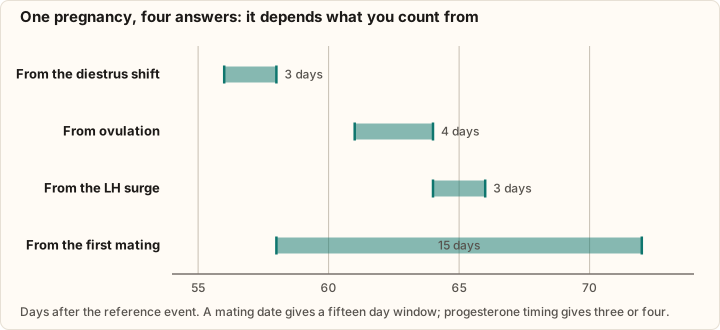
These are the reference points and the gestation length each one gives, taken from the Merck Veterinary Manual:
| Counting from | Gestation | Window | How it is established |
|---|---|---|---|
| Ovulation, timed by progesterone testing (derived) | 61 to 64 days | 4 days | Serial progesterone blood tests through the season. Ovulation is placed where progesterone reaches roughly 4 to 10 ng/mL. |
| LH surge (day zero of the breeding cycle) | 64 to 66 days | 3 days | A dedicated LH assay run daily during proestrus, or the day progesterone first rises above baseline. |
| First rise in progesterone above baseline | 64 to 66 days | 3 days | The first test in the series to read above baseline, generally more than 2 ng/mL. |
| First day of cytological diestrus | 56 to 58 days | 3 days | Vaginal cytology repeated every day or two after the fertile period, watching for the abrupt drop in cornified cells. |
| The day they first mated | 58 to 72 days | 15 days | You watched it happen. |
The ovulation row is the only derived figure on this page. Merck states whelping at 64 to 66 days after the LH peak and ovulation at 2 to 3 days after that peak, so 61 to 64 days after ovulation follows by subtraction. We show the arithmetic rather than publishing the popular “63 days”, which no source we cite states on its own.
A worked example: one date, five answers
Suppose the event you are counting from happened on 1 March 2026. Here is what each reference point gives, run through the same engine as the calculator above:
| If that date was | Whelping window | Width |
|---|---|---|
| ovulation | 1 May 2026 to 4 May 2026 | 4 days |
| the LH surge | 4 May 2026 to 6 May 2026 | 3 days |
| the progesterone rise | 4 May 2026 to 6 May 2026 | 3 days |
| the diestrus shift | 26 April 2026 to 28 April 2026 | 3 days |
| the first mating | 28 April 2026 to 12 May 2026 | 15 days |
From end to end those answers span 16 days, from 26 April 2026 at the earliest to 12 May 2026 at the latest. Same date, same dog, 16 days of difference, entirely because of what the date represents.
This is the practical takeaway: if you want a useful due date, the work happens during the season, not after it. Progesterone testing costs a few appointments and turns a fifteen-day window into a three-day one.
What each value means
- Whelping window
- The range of dates whelping is expected in. Not a prediction of one day. Read it the way a vet reads it: she is due in this window, not on a date.
- Window width
- How many days wide that range is, which is really a measure of how good your reference date is. Three or four days means you know when the pregnancy started. Fifteen means you are guessing from a mating.
- Day of pregnancy
- How many days have passed since ovulation, which is what the diagnostic timings are keyed to. Where ovulation cannot be pinned down it is shown as a range rather than a single number.
- Midpoint
- The centre of the window. It is included because people want a date to write on a calendar, not because it is more likely than the days either side of it.
- Diestrus shift
- The day vaginal cytology changes abruptly as the fertile period ends. It is the one precise reference point that can still be established after the mating is over.
The pregnancy timeline
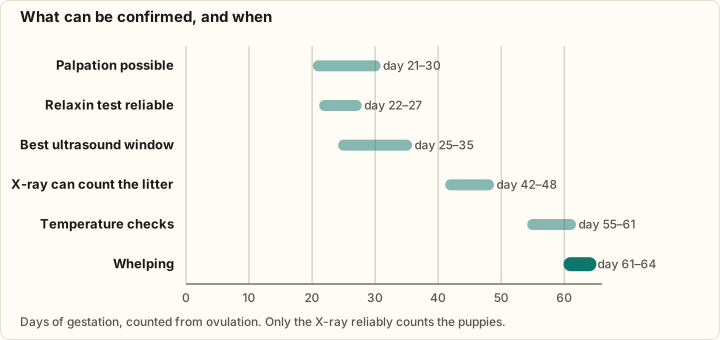
What can actually be confirmed, and when. Days are counted from ovulation, because that is the only reference that gives a fixed-length pregnancy. Merck states these as days of gestation without naming its zero point, so we anchor them to ovulation and say so here rather than leaving the assumption buried in the code.
| Day | Milestone | What it tells you |
|---|---|---|
| 21 to 30 | Abdominal palpation possible | A vet can sometimes feel the swellings around the embryos. It is easy to miss on a tense or heavy bitch, so a negative here means nothing. |
| 22 to 27 | Relaxin blood test reliable | Relaxin is produced by the placenta, so a positive is close to proof of pregnancy. Run before this window it can read falsely negative. |
| 25 to 35 | Best window for ultrasound | Confirms pregnancy, shows heartbeats and gives an idea of viability. Merck notes false negatives before 21 days. Ultrasound is poor at counting puppies. |
| 42 to 48 | X-ray can count the litter | Fetal skeletons take up enough mineral to show on a radiograph from about day 42 to 45, and are prominent by 47 to 48. This is the only reliable way to know how many puppies to expect. |
| 55 to 61 | Twice-daily temperature checks | Start before the window opens so you know her normal. A drop to about 37.1 C, range 36.7 to 37.8 C, happens in most dogs 8 to 24 hours before whelping. |
| 61 to 64 | Whelping | Sixty-one to sixty-four days after ovulation. Everything before this point is preparation for these three days. |
Whelping itself
Her temperature is the signal worth watching. Merck records a drop to a mean of 37.1 °C (range 36.7 to 37.8 °C, or 98.8 °F with a range of 98.1 to 100 °F) in most dogs 8 to 24 hours before whelping. Take it twice daily from a week before the window opens, so you know her baseline.
| Stage | How long | What you see | Call your vet if |
|---|---|---|---|
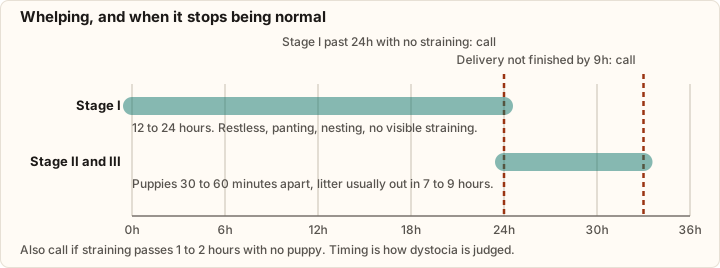
| I. Cervical dilation | 12 to 24 hours | Restlessness, nesting, panting, shivering, refusing food, and often vomiting. Uterine contractions are building but there is nothing visible to push against yet. | Stage I passes 24 hours without visible abdominal straining beginning. |
| II. Delivery of the puppies | 30 to 60 minutes between puppies typically, and about 7 to 9 hours for the whole litter | Visible abdominal straining. Bitches alternate between stage II and stage III until the litter is out. Total delivery time varies enormously, from one hour to more than 24. | Straining goes past 1 to 2 hours without a puppy, or the whole delivery is not finished within 4 to 9 hours. |
| III. Delivery of the placentas | Alternating with stage II until the litter is complete | A placenta follows each puppy, though not always immediately, and the next puppy may arrive first. | You are counting placentas and come up short once whelping has finished, or she seems unwell afterwards. |
Have your vet’s out-of-hours number written down before the window opens. Dystocia is judged partly on elapsed time, so the thing that matters at two in the morning is knowing how long something has been going on and who to call. A calculator is no use at that point.
Read next
- Why a puppy due date is a range, not a date, which works through the reference points in full and shows the subtraction behind the 61 to 64 day figure.
- Whelping: what happens and when to call the vet, for the stage timings and the thresholds that define dystocia.
Accuracy and limits
- This is arithmetic on a published gestation length, not an examination. It cannot tell you whether the pregnancy is progressing normally. Only a vet with an ultrasound can.
- The mating-date window cannot be narrowed by any tool. Fifteen days is the honest answer from that input, and a calculator that gives you one date from a mating is hiding the uncertainty rather than removing it.
- The ovulation figure is derived by subtraction, not quoted directly. The arithmetic is shown above so you can check it.
- We do not estimate litter size. Breed averages say almost nothing about one pregnancy, and knowing the count actually matters, so it is worth the radiograph.
- The timeline assumes gestation is dated from ovulation. Where a source gives a day of gestation without stating its zero point, that is the assumption we have made.
- Prolonged gestation is a veterinary matter, not a calculator one. Past the window from a progesterone-timed date, call your vet the same day.
Frequently asked questions
How long is a dog pregnant?
It depends entirely on what you count from, which is why one number cannot answer the question.
The Merck Veterinary Manual gives three: 56 to 58 days from the first day of cytological diestrus, 64 to 66 days from the LH surge or the first rise in progesterone above baseline, and 58 to 72 days from the first mating.
The true biological pregnancy is remarkably consistent at around 61 to 64 days from ovulation. What varies is not the pregnancy, it is how well you know when it started.
Why does my dog's due date span two weeks?
Because you entered a mating date, and a mating date is a poor marker of conception.
Sperm survive for several days in the bitch, and a mating can happen days before or after ovulation and still produce puppies. Merck puts the range at 58 to 72 days from the first mating, which is a fifteen-day window.
The pregnancy itself is not vague. Your knowledge of when it started is.
Is a puppy due date really 63 days?
Sixty-three days is the folk figure, and it is roughly right if you count from ovulation, but no source we cite states it on its own.
What Merck states is that whelping follows 64 to 66 days after the LH peak, and that ovulation happens 2 to 3 days after that peak. Subtract one from the other and you get 61 to 64 days from ovulation. We publish the derivation rather than the rounded number, so you can check it.
Can I narrow the window after the mating has happened?
Yes, and it is worth doing. Vaginal cytology repeated every day or two after the fertile period catches the diestrus shift, the abrupt drop in cornified cells, and that gives a due date accurate to about three days.
It is the only precise reference point that can still be established once breeding is over. Progesterone timing has to be done during the season itself.
When can a vet confirm my dog is pregnant?
A relaxin blood test is reliable after 22 to 27 days, because relaxin comes from the placenta. Ultrasound is best at 25 to 35 days and can miss pregnancies before 21 days.
Neither counts puppies well. For that you need a radiograph, and fetal skeletons do not take up enough mineral to show until about day 42 to 45, becoming prominent by day 47 to 48.
How will I know whelping is about to start?
Her temperature drops. Merck records a fall to a mean of 37.1 °C (range 36.7 to 37.8 °C) in most dogs 8 to 24 hours before whelping.
Start taking it twice daily about a week before the window opens. The reading only means something if you already know what normal looks like for her.
How many puppies will she have?
We do not estimate litter size, because we cannot cite a figure that would be honest for your dog. Litter size varies with breed, size, age and parity, and a number pulled from a breed average tells you almost nothing about one pregnancy.
A radiograph from about day 42 counts them properly. Knowing the number matters more than most people realise: it is how you know whether whelping has finished.
She is past her due date. Should I worry?
Check which date you counted from before anything else. Past the window from a mating date usually means the mating was earlier than ovulation, and nothing is wrong.
Past the window from a progesterone-timed ovulation date is different, and it is a conversation to have with your vet the same day. Prolonged gestation is one of the recognised reasons to intervene.
How long does whelping itself take?
Stage I labour runs 12 to 24 hours with no visible straining, just restlessness, panting and nesting. Stage II is the delivery: typically 30 to 60 minutes between puppies, with the whole litter usually out in about 7 to 9 hours.
Call your vet if straining goes past 1 to 2 hours with no puppy, if stage I passes 24 hours without straining starting, or if delivery is not finished within 4 to 9 hours.
Related calculators
References
Every figure on this page comes from one of these. Full details, including what each source is used for, are on our sources page.
- Merck Veterinary Manual. Whelping and Queening in Bitches and Queens. Management and Nutrition, Management of Reproduction in Dogs and Cats.
- Merck Veterinary Manual. Breeding Management of Bitches. Management and Nutrition, Management of Reproduction in Dogs and Cats.
- Merck Veterinary Manual. Labor, Delivery, and Postpartum Care in Bitches and Queens. Management and Nutrition, Management of Reproduction in Dogs and Cats.
- Merck Veterinary Manual. Pregnancy Determination in Dogs and Cats. Management and Nutrition, Management of Reproduction in Dogs and Cats.