Why a puppy due date is a range, not a date
Ask when a litter is due and you will get a single confident number back: sixty-three days. It is not wrong exactly, but it answers a question nobody asked, because it quietly assumes you know the day the bitch ovulated. Most people do not. They know the day the dogs mated, and those are very different pieces of information.
The pregnancy is consistent. Your knowledge of it is not
This is the whole idea, so it is worth stating plainly: canine gestation barely varies. What varies is how well you know when it started.
The Merck Veterinary Manual gives three gestation lengths, one for each reference event a vet might have:
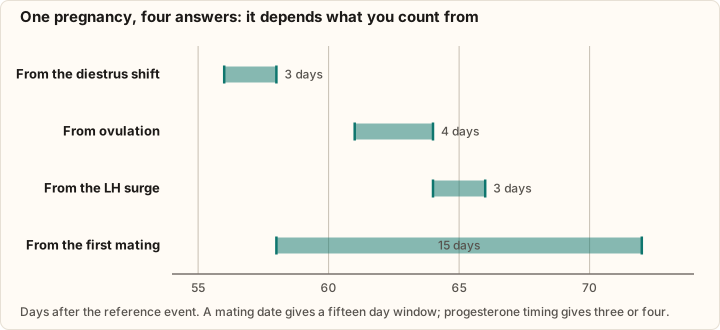
- 56 to 58 days from the first day of cytological diestrus
- 64 to 66 days from the LH surge, or from the first rise in progesterone above baseline
- 58 to 72 days from the first time the female permitted breeding
Look at the last one. Fifteen days. A fortnight of possible whelping dates, from the same event that most owners treat as the definitive marker.
Where the “63 days” figure actually comes from
Merck does not state it. What Merck states is that whelping follows the LH peak by 64 to 66 days, and that ovulation happens 2 to 3 days after that peak. Subtract one from the other:
64 − 3 = 61
66 − 2 = 64
So 61 to 64 days from ovulation, and the popular sixty-three sits comfortably inside that. We publish the subtraction rather than the rounded number, because a figure you can check is worth more than a figure you have to trust. Our puppy due date calculator labels that row as derived for the same reason.
Why a mating date tells you so little
Two things conspire.
Sperm survive for several days in the bitch’s reproductive tract, so a mating that happens before ovulation can still produce a litter. And a bitch will often accept a male across a window of days that straddles ovulation rather than pinpointing it. Put together, a mating could have happened well before conception or shortly after it, and nothing about the mating itself tells you which.
That is why the honest answer from a mating date is a fifteen-day range, and why a tool that returns one date from a mating is not being more precise. It is being less honest.
What to do about it, in order of how much it helps
During the season: progesterone testing. Serial blood tests through the season place ovulation within a day or two, which turns a fifteen-day window into a three or four day one. It costs a few appointments and it is the only intervention that genuinely fixes the problem.
After the fertile period: vaginal cytology. Repeated every day or two, cytology catches the abrupt drop in cornified cells that marks the first day of diestrus. That gives a due date accurate to about three days, and crucially it is the one precise reference point you can still establish after the mating is over. If you missed progesterone timing, this is your second chance.
After that: nothing. No calculator, no app and no rule of thumb can narrow a mating date retrospectively. Anyone who tells you otherwise is generating a number, not measuring one.
What can be confirmed, and when
Precision about the due date is not the only thing worth knowing. The diagnostic timeline matters just as much, and it is fixed:
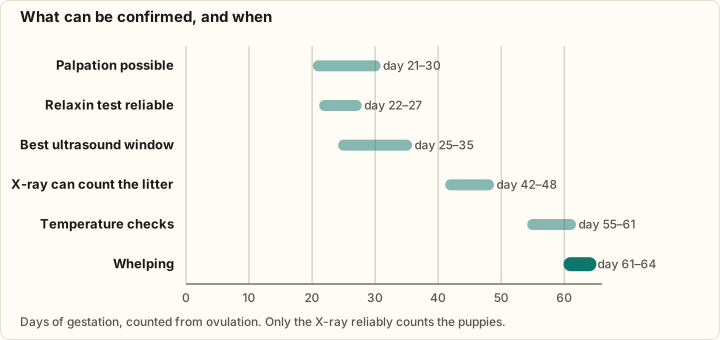
- Day 21 to 30. Abdominal palpation can sometimes find the swellings around the embryos. Easy to miss on a tense or heavy bitch, so a negative here means nothing at all.
- Day 22 to 27. A relaxin blood test becomes reliable. Relaxin comes from the placenta, so a positive is close to proof.
- Day 25 to 35. The best window for ultrasound. Merck notes false negatives before 21 days. It confirms pregnancy and shows heartbeats, but it counts puppies poorly.
- Day 42 to 48. Fetal skeletons take up enough mineral to show on a radiograph from about day 42 to 45, and are prominent by 47 to 48. This is the only reliable way to know how many puppies to expect, and knowing the number is how you know whelping has finished.
The number we will not give you
We do not estimate litter size. Breed averages exist, but the spread within a breed is wide enough that an average tells you almost nothing about one pregnancy, and a wrong number here is actively dangerous: an owner who believes six are coming will stop counting at six.
Get the radiograph. It is the one part of this where a real measurement is available and cheap.
Before the window opens
Take her temperature twice daily from about a week out, so you know her normal. Merck records a drop to a mean of 37.1 °C (range 36.7 to 37.8 °C, or 98.8 °F with a range of 98.1 to 100 °F) in most dogs 8 to 24 hours before whelping. A single reading in isolation tells you nothing; a fall from her own baseline tells you a great deal.
Then read what to expect during whelping, and write your vet’s out-of-hours number somewhere you will find it at two in the morning.
Related guides
- Whelping: what happens, and when to call the vet The three stages of canine labour, how long each should take, and the exact time thresholds that mean dystocia. Know what normal looks like before it starts.
- Puppy growth stages from birth to adulthood What happens at each stage of a puppy's development, when the fast growth really is, and what to expect month by month. See where your puppy is now.
- Puppy vaccination schedule The AAHA core vaccination timeline from 6 weeks, why the series runs past 16 weeks, and how it collides with socialisation. See the schedule.
Calculators for this
References
Every figure on this page comes from one of these. Full details, including what each source is used for, are on our sources page.
- Merck Veterinary Manual. Whelping and Queening in Bitches and Queens. Management and Nutrition, Management of Reproduction in Dogs and Cats.
- Merck Veterinary Manual. Breeding Management of Bitches. Management and Nutrition, Management of Reproduction in Dogs and Cats.
- Merck Veterinary Manual. Pregnancy Determination in Dogs and Cats. Management and Nutrition, Management of Reproduction in Dogs and Cats.