Puppy growth chart by week, birth to 24 months
A growth chart is the single most useful record you can keep for a puppy, and it takes about a minute a week to maintain.
This guide covers what to expect at each stage, how to read the numbers, and the one pattern that is genuinely worth acting on.
Before 12 weeks
Our reference curves begin at 12 weeks, so anything earlier comes with a caveat: we do not extrapolate backwards off the end of the data.
What is broadly true in the early weeks:
- Most puppies double their birth weight within about the first week.
- Daily weighing is standard practice for breeders, because failure to gain is one of the earliest signals that something is wrong.
- Variation between littermates is wide at this stage and narrows later.
If you have a puppy under 12 weeks and want an estimate, the puppy weight calculator will give you one, but it will flag the result and widen the range rather than pretending to a precision it does not have.
12 to 26 weeks: the steep part
This is where growth charts earn their keep, because this is where the fastest changes happen and where a problem shows up soonest.
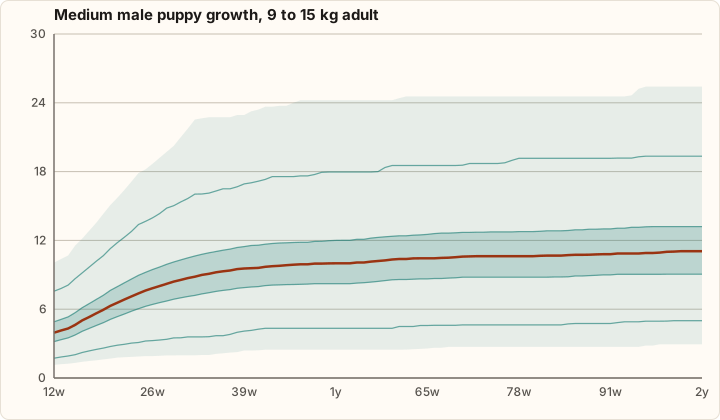
Weigh weekly through this period. Reading the median curves in our reference, puppies pass half their adult weight somewhere between about 3.5 and 4.5 months, with bigger dogs reaching that point later.
By 26 weeks most dogs are around 70 to 80 percent of the way to their adult weight, though a very large breed will be at the lower end of that.
26 to 52 weeks: the bend
Growth slows and the curve starts to flatten. Fortnightly weighing is plenty.
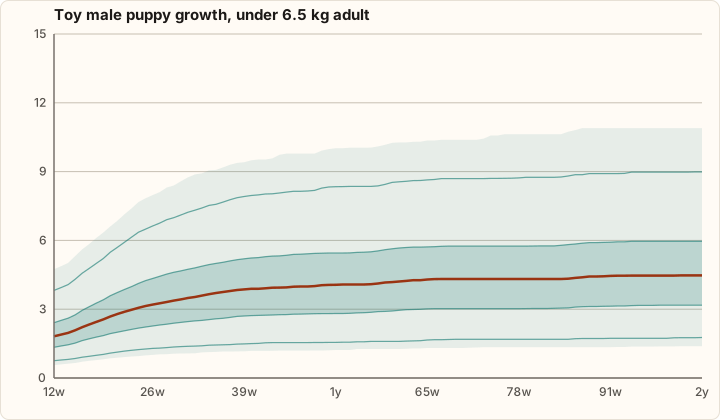
Dogs reach 90 percent of adult weight somewhere between roughly 9.5 and 13 months depending on size band. Small dogs get there first.
This is also the stage where the switch from puppy food to adult food usually happens, timed to where growth flattens rather than to a fixed birthday.
52 to 104 weeks: flattening out
For small and medium dogs, largely finished. For large breeds, still filling out.
Our curves show weight continuing to creep upward until around 20 months in every size band. That last stretch is the dog filling out rather than the skeleton growing, and in adult dogs some of it is simply condition. Monthly weighing is more than enough.
How to read the chart
Find your puppy’s age down the left, read across to the column its weight sits nearest, and note the centile. Then do it again in a fortnight.
Three things to understand:
A centile is a comparison, not a grade. The 30th centile means about 30 percent of healthy puppies weighed less at that age. Someone has to be on the 30th centile.
High or low is not good or bad. A puppy tracking steadily along the 15th centile is growing perfectly normally. Small is not the same as unhealthy.
The direction is the signal. A puppy that was on the 75th and is now on the 25th has changed, and change is worth investigating even though both readings sit inside the healthy range.
The pattern worth acting on
Call your vet if your puppy:
- has lost weight at any point;
- has not gained anything in two weeks during the growth phase;
- has crossed downward through two or more centile lines;
- is climbing steeply across centiles, particularly a large breed;
- is off its food, lethargic, or otherwise not itself.
Bring the numbers with you. A dated list of weights is genuinely useful clinical information and takes seconds to produce if you have been keeping it.
Which chart applies to my puppy?
Pick by expected adult weight and sex, not by breed name. Dogs of different breeds that finish at similar weights grow at close to the same rate, which is why the reference groups by size.
Males run heavier than females at every age in every category, so using the wrong sex chart shifts every number.
The full set of ten charts, five size bands by two sexes, is on the puppy growth chart page. If you are not sure which band applies, the puppy size calculator will work it out from a weight and an age.
What to record
Two columns. Age in weeks, and weight. That is genuinely all.
| Age | Weight | Centile |
|---|---|---|
| 12 weeks | ||
| 14 weeks | ||
| 16 weeks | ||
| 18 weeks | ||
| 20 weeks | ||
| 24 weeks | ||
| 28 weeks | ||
| 32 weeks | ||
| 40 weeks | ||
| 52 weeks |
Print this page and fill it in by hand if that suits you, or put the figures into the growth tracker, which plots them against the reference curves and tells you whether the line is steady.
For how to get a reliable number in the first place, see how to weigh a puppy correctly.
The limits
The reference runs from 12 weeks to 2 years and covers adult weights up to 40 kg. True giant breeds sit outside it, and grow for longer than anything we can measure.
Weight is also not body condition. A dog can be on a perfectly ordinary centile and still be carrying too much or too little for its frame. That assessment is made by hand, by a vet.
Related guides
- Puppy growth stages from birth to adulthood What happens at each stage of a puppy's development, when the fast growth really is, and what to expect month by month. See where your puppy is now.
- How to weigh a puppy correctly at home The bathroom scale method, how often to weigh, and the small mistakes that quietly ruin a growth chart. Get an accurate weight in under a minute.
- Growth plates and when puppies stop growing When growth plates close by size, why it matters for exercise and joints, and what our own data says about when growing really ends. Check your puppy's stage.
Calculators for this
References
Every figure on this page comes from one of these. Full details, including what each source is used for, are on our sources page.
- Salt C, Morris PJ, German AJ, Wilson D, Lund EM, Cole TJ, Butterwick RF. Growth standard charts for monitoring bodyweight in dogs of different sizes. PLOS ONE. 2017;12(9):e0182064. doi:10.1371/journal.pone.0182064
- Correction: Growth standard charts for monitoring bodyweight in dogs of different sizes. PLOS ONE. 2024;19(11):e0314711. doi:10.1371/journal.pone.0314711
- WALTHAM Petcare Science Institute. Puppy Growth Charts.
- American Animal Hospital Association. AAHA Canine Life Stage Guidelines.