Puppy growth chart
Ten charts covering five adult-size categories and both sexes, from 12 weeks to two years. Find your puppy’s age, read across to its weight, and note the centile. Repeat every couple of weeks: the line your puppy traces over time is worth far more than any single reading.
How to read these charts
- Pick your chart by your puppy’s expected adult weight and its sex, not by breed name.
- Find the age row closest to your puppy today.
- Read across to see which centile column your puppy’s weight sits nearest.
- Write it down and repeat in two weeks. You are tracking a line, not taking a snapshot.
Want this done for you? The puppy weight calculator finds the centile, plots your puppy on the curve, and projects the adult weight with a measured accuracy range.
Download and print these charts
Every chart on this page is also a PDF built from the same reference, sized for A4 and laid out to be written on. Each one carries the curve with a blank weigh-in log beside it, then the reference table with its limits and sources on the back, so a chart that leaves this page still says what it does and does not cover. Print at 100 percent rather than fit-to-page, or the gridlines stop lining up with the axis labels.
Or take just the one you need. Each is two pages: the curve with a blank weigh-in log, then the reference table with its limits and sources.
- Toy breeds Toy male Toy female
- Small breeds Small male Small female
- Medium breeds Medium male Medium female
- Large breeds Large male Large female
- Very large breeds Very large male Very large female
What each value means
- The centile
- Where your puppy sits among healthy puppies of the same age, size category and sex. The 30th centile means 30 percent weigh less and 70 percent weigh more. It is a position, not a score, and every centile on the chart is a healthy one.
- The median, or 50th centile
- The middle of the reference, printed in bold in every table. Half of healthy puppies fall either side of it. A puppy is not supposed to be on it.
- The shaded band
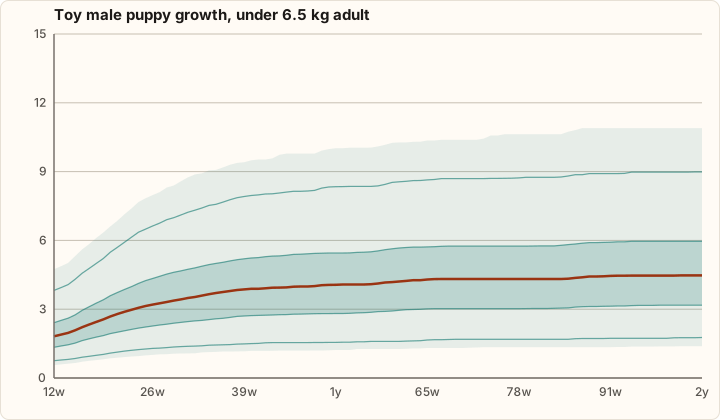
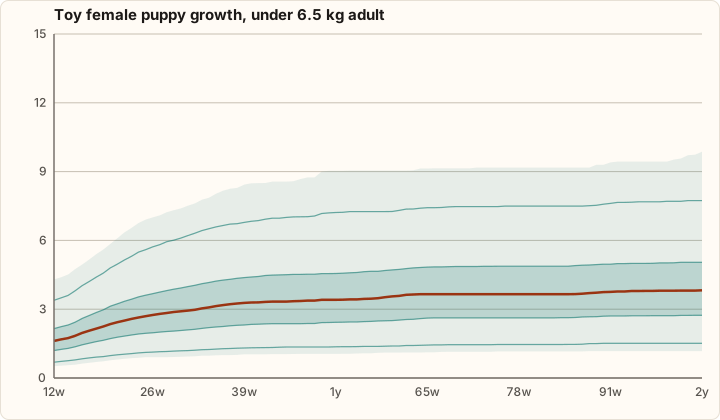
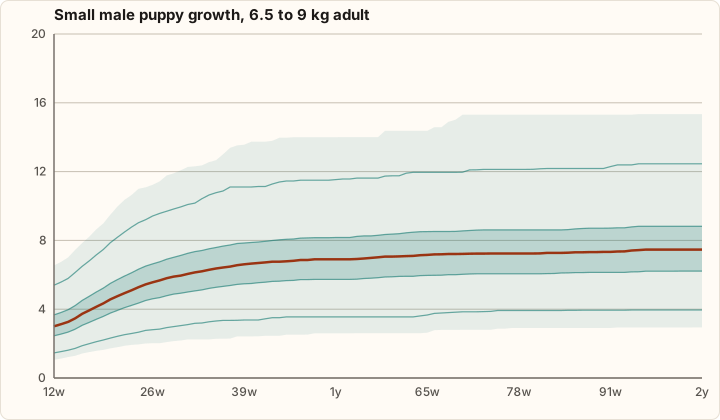
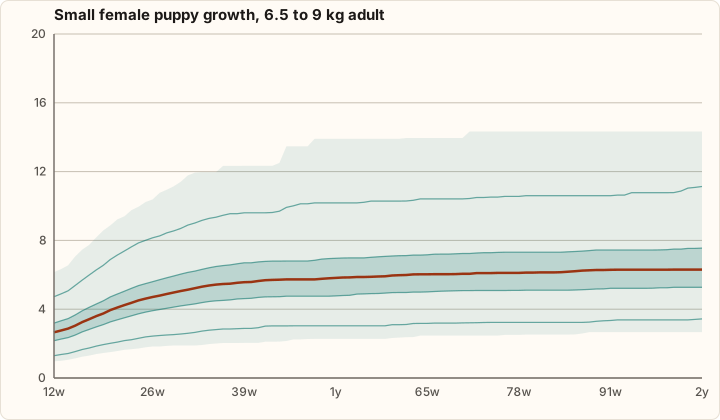
- The middle of the range on the curve figures. The outer shading covers almost every healthy puppy; the inner shading covers the middle of them.
- The rows and columns
- Age in weeks down the side, centiles across the top, weight in kilograms in the cells. Find the age, read across, and see which two columns your puppy's weight falls between.
- What the chart cannot tell you
- Body condition. A dog can sit on an entirely ordinary centile and still be too heavy or too light for its frame, and that judgement is made by hand rather than on a chart.
Example calculations
Three puppies read off these charts, to show what a centile does and does not tell you. Each weight is taken back out of the reference and then re-measured against it.
Toy, male, 16 weeks
2.2 kg at 16 weeks on the toy male chart
49th centile
- Median for this age is 2.2 kg
- About 50% of adult weight reached
- Half grown at 17 weeks on this chart
Bang on the median. Half of toy males this age weigh less than this and half weigh more, which is all "50th centile" means. It is not a target and not a grade.
Large, female, 26 weeks
14.4 kg at 26 weeks on the large female chart
25th centile
- Median for this age is 16.5 kg
- About 71% of adult weight reached
- Half grown at 19 weeks on this chart
Below the middle and perfectly healthy. A quarter of large females this age sit at or below this weight. What would matter is arriving here from the 75th, not being here.
Very large, male, 39 weeks
36.5 kg at 39 weeks on the very large male chart
90th centile
- Median for this age is 29.6 kg
- About 88% of adult weight reached
- Half grown at 20 weeks on this chart
Near the top of the chart. A big puppy for its age is only a concern if it climbed to get here, or if body condition says it is carrying fat rather than frame.
What the curves look like
How much growing is left
The single most useful thing a growth chart tells a new owner is how much is still to come. At 16 weeks a toy puppy is already about half its adult weight, while a very large puppy is only about two fifths of the way there.
Reference values: the charts
All weights in kilograms. The bold column is the median: half of healthy puppies of that age, size and sex weigh less than this.
Toy breeds (under 6.5 kg adult)
Typical breeds: Chihuahua, Yorkshire Terrier, Maltese, Pomeranian.
Toy breeds, male
| Age | 2th | 9th | 25th | 50th | 75th | 91th | 98th |
|---|---|---|---|---|---|---|---|
| 12 weeks | 0.76 | 1.02 | 1.34 | 1.82 | 2.41 | 3.04 | 3.82 |
| 16 weeks | 0.91 | 1.22 | 1.63 | 2.22 | 2.95 | 3.69 | 4.57 |
| 20 weeks | 1.08 | 1.45 | 1.94 | 2.68 | 3.59 | 4.46 | 5.49 |
| 26 weeks | 1.29 | 1.70 | 2.27 | 3.20 | 4.34 | 5.38 | 6.63 |
| 34 weeks | 1.43 | 1.90 | 2.55 | 3.65 | 4.95 | 6.17 | 7.53 |
| 43 weeks | 1.54 | 2.04 | 2.75 | 3.94 | 5.32 | 6.60 | 8.03 |
| 12 months | 1.55 | 2.12 | 2.81 | 4.07 | 5.45 | 6.80 | 8.34 |
| 15 months | 1.66 | 2.24 | 3.01 | 4.30 | 5.72 | 7.07 | 8.64 |
| 18 months | 1.69 | 2.25 | 3.02 | 4.32 | 5.75 | 7.11 | 8.73 |
| 21 months | 1.73 | 2.31 | 3.13 | 4.45 | 5.92 | 7.32 | 8.91 |
| 24 months | 1.76 | 2.33 | 3.17 | 4.47 | 5.96 | 7.37 | 8.99 |
Toy breeds, female
| Age | 2th | 9th | 25th | 50th | 75th | 91th | 98th |
|---|---|---|---|---|---|---|---|
| 12 weeks | 0.69 | 0.92 | 1.20 | 1.62 | 2.15 | 2.68 | 3.39 |
| 16 weeks | 0.84 | 1.10 | 1.45 | 1.97 | 2.60 | 3.23 | 4.03 |
| 20 weeks | 0.98 | 1.30 | 1.72 | 2.35 | 3.13 | 3.89 | 4.80 |
| 26 weeks | 1.13 | 1.49 | 1.97 | 2.75 | 3.68 | 4.61 | 5.72 |
| 34 weeks | 1.24 | 1.63 | 2.20 | 3.08 | 4.17 | 5.22 | 6.51 |
| 43 weeks | 1.33 | 1.76 | 2.37 | 3.33 | 4.49 | 5.62 | 6.97 |
| 12 months | 1.36 | 1.82 | 2.43 | 3.41 | 4.56 | 5.77 | 7.22 |
| 15 months | 1.43 | 1.91 | 2.61 | 3.65 | 4.83 | 6.03 | 7.42 |
| 18 months | 1.46 | 1.92 | 2.62 | 3.65 | 4.87 | 6.08 | 7.50 |
| 21 months | 1.51 | 2.00 | 2.70 | 3.76 | 4.96 | 6.15 | 7.61 |
| 24 months | 1.51 | 2.01 | 2.73 | 3.82 | 5.05 | 6.29 | 7.73 |
Small breeds (6.5 to 9 kg adult)
Typical breeds: Pug, Shih Tzu, Miniature Dachshund, Papillon.
Small breeds, male
| Age | 2th | 9th | 25th | 50th | 75th | 91th | 98th |
|---|---|---|---|---|---|---|---|
| 12 weeks | 1.46 | 1.96 | 2.45 | 3.00 | 3.67 | 4.42 | 5.40 |
| 16 weeks | 1.88 | 2.48 | 3.06 | 3.73 | 4.51 | 5.39 | 6.50 |
| 20 weeks | 2.32 | 3.04 | 3.77 | 4.57 | 5.50 | 6.49 | 7.87 |
| 26 weeks | 2.81 | 3.74 | 4.60 | 5.56 | 6.63 | 7.79 | 9.42 |
| 34 weeks | 3.27 | 4.23 | 5.21 | 6.29 | 7.51 | 8.81 | 10.6 |
| 43 weeks | 3.50 | 4.56 | 5.61 | 6.76 | 8.00 | 9.34 | 11.3 |
| 12 months | 3.56 | 4.64 | 5.73 | 6.90 | 8.17 | 9.57 | 11.5 |
| 15 months | 3.66 | 4.85 | 5.97 | 7.16 | 8.51 | 9.95 | 12.0 |
| 18 months | 3.93 | 4.99 | 6.06 | 7.24 | 8.61 | 10.0 | 12.1 |
| 21 months | 3.94 | 5.09 | 6.14 | 7.33 | 8.72 | 10.2 | 12.3 |
| 24 months | 3.95 | 5.14 | 6.21 | 7.47 | 8.82 | 10.3 | 12.5 |
Small breeds, female
| Age | 2th | 9th | 25th | 50th | 75th | 91th | 98th |
|---|---|---|---|---|---|---|---|
| 12 weeks | 1.30 | 1.72 | 2.17 | 2.66 | 3.19 | 3.87 | 4.73 |
| 16 weeks | 1.66 | 2.17 | 2.68 | 3.25 | 3.91 | 4.67 | 5.69 |
| 20 weeks | 2.02 | 2.66 | 3.26 | 3.95 | 4.72 | 5.61 | 6.89 |
| 26 weeks | 2.44 | 3.19 | 3.91 | 4.71 | 5.60 | 6.65 | 8.15 |
| 34 weeks | 2.78 | 3.62 | 4.45 | 5.38 | 6.41 | 7.52 | 9.28 |
| 43 weeks | 3.03 | 3.85 | 4.72 | 5.71 | 6.79 | 8.01 | 9.62 |
| 12 months | 3.04 | 3.92 | 4.77 | 5.82 | 6.96 | 8.27 | 10.2 |
| 15 months | 3.18 | 4.14 | 5.00 | 6.03 | 7.16 | 8.55 | 10.4 |
| 18 months | 3.23 | 4.22 | 5.09 | 6.11 | 7.31 | 8.61 | 10.6 |
| 21 months | 3.34 | 4.28 | 5.22 | 6.29 | 7.44 | 8.76 | 10.6 |
| 24 months | 3.44 | 4.36 | 5.27 | 6.30 | 7.55 | 9.03 | 11.1 |
Medium breeds (9 to 15 kg adult)
Typical breeds: Beagle, Cocker Spaniel, Miniature Poodle, Corgi.
Medium breeds, male
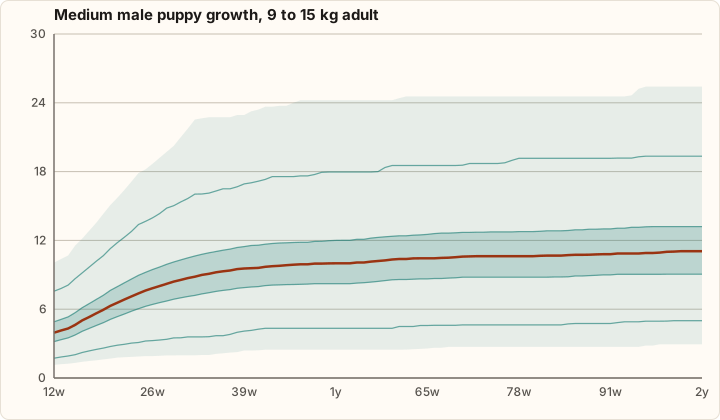
| Age | 2th | 9th | 25th | 50th | 75th | 91th | 98th |
|---|---|---|---|---|---|---|---|
| 12 weeks | 1.73 | 2.48 | 3.18 | 3.95 | 4.90 | 5.98 | 7.57 |
| 16 weeks | 2.22 | 3.24 | 4.07 | 5.02 | 6.13 | 7.38 | 9.17 |
| 20 weeks | 2.75 | 4.08 | 5.11 | 6.29 | 7.64 | 9.11 | 11.3 |
| 26 weeks | 3.26 | 5.05 | 6.42 | 7.83 | 9.47 | 11.3 | 14.0 |
| 34 weeks | 3.60 | 5.91 | 7.44 | 9.08 | 10.9 | 13.0 | 16.1 |
| 43 weeks | 4.33 | 6.54 | 8.10 | 9.75 | 11.7 | 14.0 | 17.6 |
| 12 months | 4.33 | 6.65 | 8.22 | 10.0 | 12.0 | 14.4 | 18.0 |
| 15 months | 4.58 | 7.02 | 8.64 | 10.4 | 12.5 | 14.8 | 18.5 |
| 18 months | 4.63 | 7.13 | 8.79 | 10.6 | 12.8 | 15.2 | 19.2 |
| 21 months | 4.75 | 7.29 | 8.99 | 10.8 | 13.0 | 15.5 | 19.2 |
| 24 months | 5.00 | 7.40 | 9.05 | 11.1 | 13.2 | 15.7 | 19.3 |
Medium breeds, female
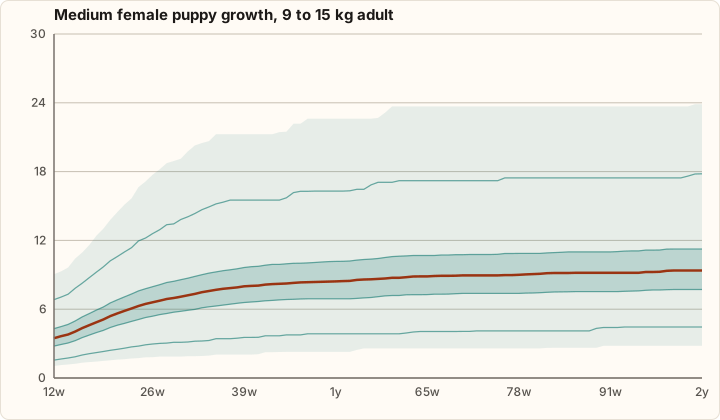
| Age | 2th | 9th | 25th | 50th | 75th | 91th | 98th |
|---|---|---|---|---|---|---|---|
| 12 weeks | 1.56 | 2.17 | 2.79 | 3.47 | 4.30 | 5.30 | 6.84 |
| 16 weeks | 2.00 | 2.80 | 3.52 | 4.35 | 5.33 | 6.45 | 8.27 |
| 20 weeks | 2.42 | 3.49 | 4.40 | 5.40 | 6.55 | 7.91 | 10.2 |
| 26 weeks | 2.97 | 4.31 | 5.39 | 6.61 | 7.96 | 9.56 | 12.6 |
| 34 weeks | 3.27 | 4.92 | 6.21 | 7.59 | 9.15 | 11.0 | 14.9 |
| 43 weeks | 3.68 | 5.42 | 6.77 | 8.19 | 9.91 | 11.9 | 15.5 |
| 12 months | 3.86 | 5.58 | 6.90 | 8.43 | 10.2 | 12.3 | 16.3 |
| 15 months | 4.05 | 5.93 | 7.27 | 8.86 | 10.7 | 13.0 | 17.2 |
| 18 months | 4.11 | 6.00 | 7.38 | 9.00 | 10.9 | 13.2 | 17.5 |
| 21 months | 4.41 | 6.12 | 7.54 | 9.17 | 11.0 | 13.3 | 17.5 |
| 24 months | 4.45 | 6.34 | 7.72 | 9.37 | 11.2 | 13.5 | 17.8 |
Large breeds (15 to 30 kg adult)
Typical breeds: Border Collie, Boxer, Australian Shepherd, Staffordshire Bull Terrier.
Large breeds, male
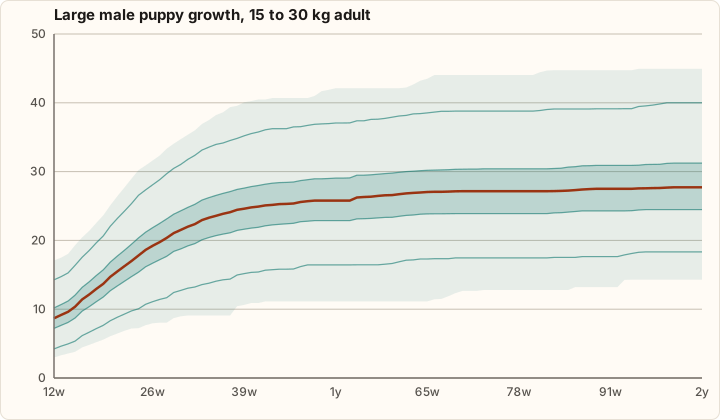
| Age | 2th | 9th | 25th | 50th | 75th | 91th | 98th |
|---|---|---|---|---|---|---|---|
| 12 weeks | 4.23 | 5.75 | 7.20 | 8.68 | 10.2 | 11.9 | 14.3 |
| 16 weeks | 6.17 | 8.05 | 9.72 | 11.4 | 13.2 | 15.1 | 17.6 |
| 20 weeks | 8.33 | 10.7 | 12.7 | 14.7 | 16.9 | 19.2 | 22.1 |
| 26 weeks | 11.1 | 14.1 | 16.7 | 19.2 | 21.9 | 24.7 | 28.1 |
| 34 weeks | 13.8 | 17.5 | 20.4 | 23.3 | 26.2 | 29.4 | 33.6 |
| 43 weeks | 15.7 | 19.2 | 22.3 | 25.2 | 28.3 | 31.7 | 36.2 |
| 12 months | 16.4 | 19.8 | 22.9 | 25.8 | 29.1 | 32.5 | 37.1 |
| 15 months | 17.3 | 20.8 | 23.9 | 27.0 | 30.2 | 33.8 | 38.5 |
| 18 months | 17.5 | 20.8 | 23.9 | 27.2 | 30.4 | 34.1 | 38.8 |
| 21 months | 17.7 | 21.3 | 24.3 | 27.5 | 30.9 | 34.6 | 39.1 |
| 24 months | 18.3 | 21.4 | 24.5 | 27.7 | 31.2 | 34.8 | 40.0 |
Large breeds, female
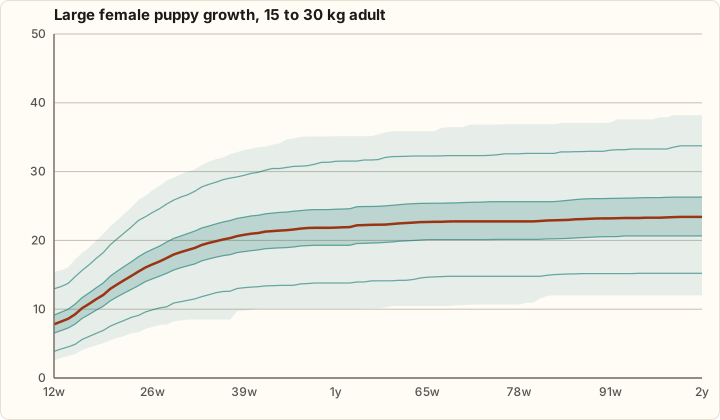
| Age | 2th | 9th | 25th | 50th | 75th | 91th | 98th |
|---|---|---|---|---|---|---|---|
| 12 weeks | 3.87 | 5.22 | 6.53 | 7.80 | 9.14 | 10.8 | 13.0 |
| 16 weeks | 5.61 | 7.22 | 8.68 | 10.2 | 11.7 | 13.4 | 15.7 |
| 20 weeks | 7.54 | 9.50 | 11.2 | 13.0 | 14.8 | 16.8 | 19.4 |
| 26 weeks | 9.92 | 12.4 | 14.4 | 16.5 | 18.7 | 21.1 | 24.1 |
| 34 weeks | 12.1 | 14.9 | 17.3 | 19.6 | 22.1 | 24.9 | 28.2 |
| 43 weeks | 13.4 | 16.4 | 18.9 | 21.4 | 24.0 | 26.9 | 30.4 |
| 12 months | 13.8 | 16.7 | 19.3 | 21.9 | 24.5 | 27.5 | 31.5 |
| 15 months | 14.7 | 17.5 | 20.1 | 22.7 | 25.4 | 28.5 | 32.3 |
| 18 months | 14.8 | 17.5 | 20.1 | 22.8 | 25.6 | 28.7 | 32.6 |
| 21 months | 15.2 | 18.0 | 20.5 | 23.2 | 26.1 | 29.2 | 33.1 |
| 24 months | 15.2 | 18.1 | 20.6 | 23.4 | 26.3 | 29.5 | 33.7 |
Very large breeds (30 to 40 kg adult)
Typical breeds: Labrador Retriever, German Shepherd, Golden Retriever, Doberman.
Very large breeds, male
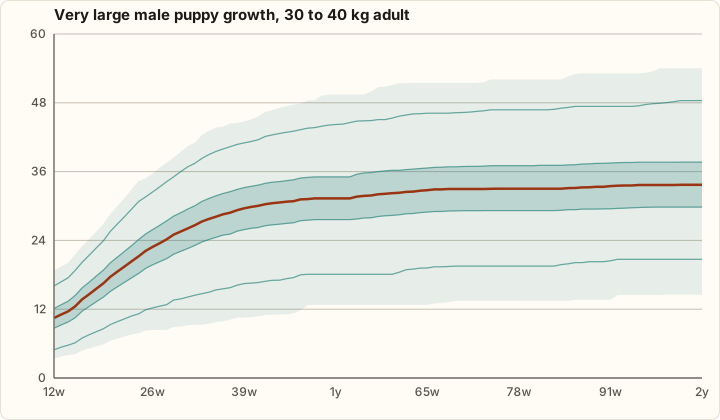
| Age | 2th | 9th | 25th | 50th | 75th | 91th | 98th |
|---|---|---|---|---|---|---|---|
| 12 weeks | 4.91 | 6.79 | 8.68 | 10.5 | 12.1 | 13.9 | 16.1 |
| 16 weeks | 6.98 | 9.43 | 11.7 | 13.7 | 15.7 | 17.8 | 20.2 |
| 20 weeks | 9.31 | 12.4 | 15.1 | 17.6 | 20.1 | 22.6 | 25.6 |
| 26 weeks | 12.2 | 16.3 | 19.7 | 22.9 | 25.9 | 29.0 | 32.4 |
| 34 weeks | 15.0 | 20.2 | 24.1 | 27.7 | 31.3 | 34.8 | 39.0 |
| 43 weeks | 17.0 | 22.5 | 26.7 | 30.5 | 34.1 | 37.9 | 42.4 |
| 12 months | 18.1 | 23.4 | 27.6 | 31.3 | 35.1 | 39.1 | 44.2 |
| 15 months | 19.2 | 24.8 | 28.9 | 32.8 | 36.6 | 41.0 | 46.2 |
| 18 months | 19.5 | 25.1 | 29.2 | 33.0 | 37.0 | 41.5 | 46.8 |
| 21 months | 20.4 | 25.6 | 29.5 | 33.5 | 37.5 | 42.0 | 47.4 |
| 24 months | 20.7 | 25.7 | 29.8 | 33.7 | 37.7 | 42.5 | 48.4 |
Very large breeds, female
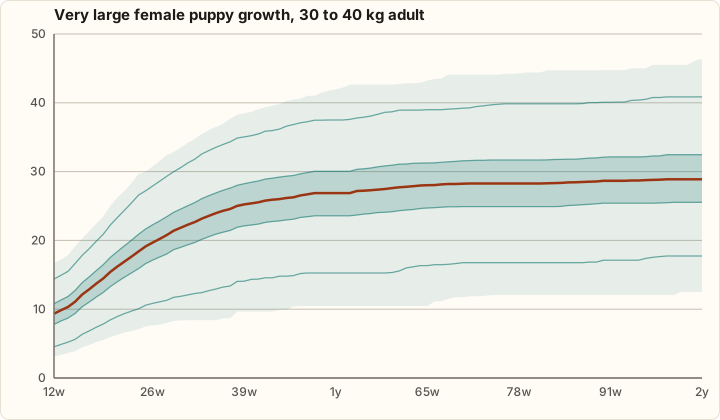
| Age | 2th | 9th | 25th | 50th | 75th | 91th | 98th |
|---|---|---|---|---|---|---|---|
| 12 weeks | 4.54 | 6.17 | 7.79 | 9.34 | 10.8 | 12.4 | 14.4 |
| 16 weeks | 6.35 | 8.48 | 10.4 | 12.1 | 13.9 | 15.6 | 17.8 |
| 20 weeks | 8.44 | 11.1 | 13.3 | 15.4 | 17.5 | 19.7 | 22.2 |
| 26 weeks | 10.8 | 14.3 | 17.1 | 19.7 | 22.3 | 24.9 | 27.9 |
| 34 weeks | 12.7 | 17.1 | 20.6 | 23.6 | 26.5 | 29.5 | 33.1 |
| 43 weeks | 14.6 | 19.2 | 22.7 | 25.9 | 29.0 | 32.2 | 36.0 |
| 12 months | 15.3 | 20.1 | 23.6 | 26.9 | 30.0 | 33.5 | 37.5 |
| 15 months | 16.3 | 21.3 | 24.7 | 28.0 | 31.2 | 34.8 | 39.0 |
| 18 months | 16.8 | 21.5 | 24.9 | 28.3 | 31.7 | 35.2 | 39.9 |
| 21 months | 17.1 | 22.1 | 25.4 | 28.7 | 32.1 | 35.8 | 40.1 |
| 24 months | 17.7 | 22.1 | 25.5 | 28.9 | 32.5 | 36.1 | 40.9 |
Weight drives the feeding amount too
The same weight you plot here is the input to portion size. Daily calories are calculated from current bodyweight and age, so a puppy moving down these tables is also moving through the puppy feeding chart. The feeding calculator converts that into cups using the energy density on your own bag.
What these charts cannot tell you
- They start at 12 weeks. Younger puppies are outside the reference.
- They cover adult weights up to 40 kg. Giant breeds sit beyond them.
- They describe weight, not condition. A dog can be the right weight and still carry it badly. Your vet assesses body condition by feel.
- They are built from puppies who stayed healthy. A puppy who is unwell will not follow them, which is the whole point of noticing when the line changes.
Frequently asked questions
How do I read a puppy growth chart?
Find your puppy’s age down the left, then read across to find which centile column its weight falls nearest. That is the centile it is currently tracking.
Then repeat it in a fortnight. A single reading tells you where your puppy sits; a series of readings tells you whether it is growing steadily, which is the part that actually matters.
Which chart should I use for my puppy?
Pick by expected adult weight, not by breed name. Dogs of different breeds that finish at a similar adult weight grow at close to the same rate, which is why the reference groups by size rather than breed.
Then pick the right sex. Males run heavier than females at every age in every category, so using the wrong one shifts every number.
What if my puppy is between two size categories?
Read both and treat the pair as your range. A puppy expected to finish around 15 kg sits right on the boundary between the medium and large categories, and the honest answer is that it could track either.
The puppy weight calculator handles this for you: leave the size dropdown on “work it out for me” and it infers the most likely category.
Is it bad if my puppy is on a low centile?
No. Someone has to be on the 10th centile, and a puppy tracking steadily along it is growing perfectly normally. Small is not the same as unhealthy.
What warrants a vet visit is a change in trajectory: a puppy crossing downward through several centile lines over a few weeks, or one that stops gaining altogether.
Why do the charts stop at two years?
Because that is where the underlying data stops, and because almost every dog under 40 kg has finished growing by then. Extending the lines further would be drawing beyond the evidence.
Giant breeds can keep filling out past two years, but they also sit above the 40 kg range this reference covers.
Can I print these charts?
Yes, and there is a PDF built for it. Each one is two A4 pages: the curve with a blank weigh-in log beside it, then the reference table with the limits and the sources. Take all ten or just the one for your puppy’s size and sex.
Printing the web page works too. The print stylesheet strips the navigation and shading so the tables come out clean, and expands links so the references survive. A printed chart taped inside a cupboard door, filled in weekly, is genuinely useful to take to vet appointments.
Related calculators
References
Every figure on this page comes from one of these. Full details, including what each source is used for, are on our sources page.