Whelping: what happens, and when to call the vet
Most whelpings go fine without help. The reason to read this beforehand is that dystocia is diagnosed largely on elapsed time, and elapsed time is exactly what nobody tracks well at three in the morning when they are worried and have not slept.
So the useful preparation is not equipment. It is knowing the numbers.
The signal that it is starting
Her temperature drops. Merck records a fall to a mean of 37.1 °C (range 36.7 to 37.8 °C; 98.8 °F, range 98.1 to 100 °F) in most dogs 8 to 24 hours before whelping.
That figure is only useful if you already know her normal, so start taking it twice daily about a week before the window opens. A single reading means nothing on its own. A clear fall from her own baseline means the next day is likely.
Merck also notes that dogs typically enter stage I labour within 24 hours of serum progesterone falling below 2 ng/mL, which is the same event the temperature drop reflects.
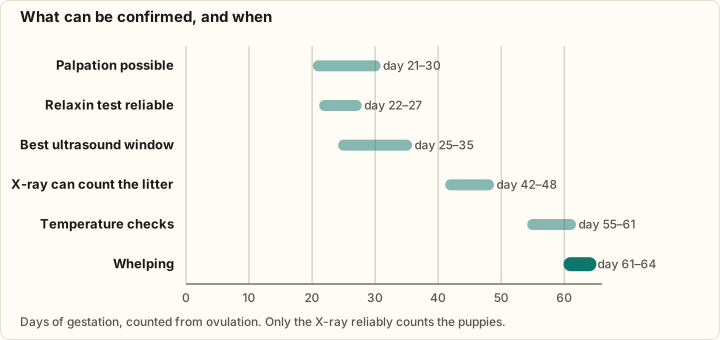
The temperature run-up is the last item on a pregnancy timeline that is otherwise about confirming things earlier on:
The three stages
Stage I: 12 to 24 hours
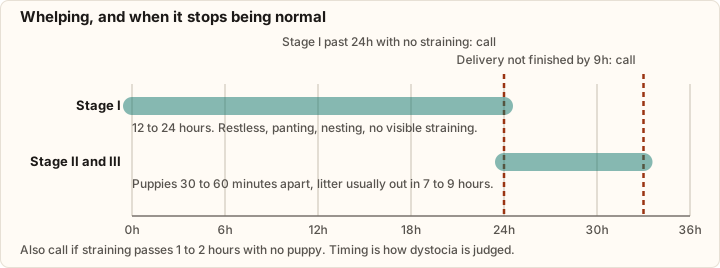
The cervix dilates and uterine contractions build, but there is nothing visible to see. No straining. What you get instead is behaviour: restlessness, nesting, panting, shivering, refusing food, and often vomiting.
This is the stage that worries people most, because it is long and nothing appears to be happening. Something is.
Call your vet if: stage I passes 24 hours without visible abdominal straining starting.
Stage II: the puppies
Visible abdominal straining. Merck puts typical intervals at 30 to 60 minutes between neonates, with the whole litter usually delivered in about 7 to 9 hours, though total delivery time varies enormously — anywhere from one hour to more than 24.
Call your vet if: straining goes past 1 to 2 hours with no puppy, or the whole delivery is not finished within 4 to 9 hours.
Stage III: the placentas
Stage III is delivery of the placenta. Bitches alternate between stages II and III until the litter is complete, so a placenta does not always follow its puppy immediately — the next puppy may arrive first.
Call your vet if: you finish whelping and the placenta count is short, or she seems unwell afterwards.
Why counting matters
Two counts do real work.
The puppy count tells you when whelping has finished. Without it, a bitch who has stopped because she is exhausted looks identical to a bitch who has stopped because she is done. That count comes from a radiograph at day 42 or later, and it is the single most useful thing you can have on the night.
The placenta count should match the puppy count. A retained placenta is a veterinary matter.
What we are deliberately not giving you
No doses. Not for anything. This site publishes no medication dosing, and a whelping page is exactly where that rule earns its keep: oxytocin and calcium both get discussed on forums with confident numbers attached, and both can do real harm given at the wrong time or the wrong amount. Dosing during whelping is a clinical decision made by someone who can examine her.
No home intervention thresholds beyond “call”. Merck is explicit that a predictable and safe way to induce parturition in dogs has not been developed, and it directs owners to a vet rather than to home management. We are doing the same thing.
The practical preparation
- Write your vet’s out-of-hours number somewhere you will find it half asleep, and check before the window opens whether they handle whelping emergencies themselves or refer on.
- Know your puppy count from the radiograph.
- Know her baseline temperature.
- Note the time each puppy arrives. When you ring the vet, “she has been straining for ninety minutes with nothing” is a useful sentence. “She has been at it a while” is not.
- Work out the whelping window properly rather than from the mating date, so you are not caught out by a fortnight of uncertainty.
Afterwards
The first days matter for the puppies in ways that are easy to miss. Weigh them daily: steady gain is the clearest early sign that nursing is working, and a puppy losing ground shows up on the scales before it shows up any other way. Our guide to weighing a puppy correctly covers the method, and the puppy growth calculator picks up from 12 weeks once they are on the reference curves.
Related guides
- Why a puppy due date is a range, not a date A dog pregnancy is 61 to 64 days from ovulation but 58 to 72 from mating. Here is why the date you count from changes everything. Work out your window.
- Puppy growth stages from birth to adulthood What happens at each stage of a puppy's development, when the fast growth really is, and what to expect month by month. See where your puppy is now.
- The puppy socialisation window Why 4 to 16 weeks shapes a dog for life, how to socialise before vaccinations finish, and what to do if you started late. Check your puppy's window.
Calculators for this
References
Every figure on this page comes from one of these. Full details, including what each source is used for, are on our sources page.
- Merck Veterinary Manual. Labor, Delivery, and Postpartum Care in Bitches and Queens. Management and Nutrition, Management of Reproduction in Dogs and Cats.
- Merck Veterinary Manual. Whelping and Queening in Bitches and Queens. Management and Nutrition, Management of Reproduction in Dogs and Cats.
- Merck Veterinary Manual. Breeding Management of Bitches. Management and Nutrition, Management of Reproduction in Dogs and Cats.