Growth plates and when puppies stop growing
“When will my puppy stop growing?” has a more interesting answer than most people expect, because growing turns out to mean two different things that finish at different times.
Two different endings
Skeletal growth ends when the growth plates close. After that the bones cannot get any longer, and the dog’s height and frame are fixed.
Filling out carries on afterwards. Muscle develops, the chest deepens, and body weight keeps creeping up for months after the skeleton is done.
Most confusion about this question comes from people answering about one while asking about the other.
What a growth plate is
Growth plates, or physes, are bands of cartilage near the ends of long bones. New bone is laid down there, which is how a leg gets longer.
While the plate is open it is softer than the bone around it, and that is the practical point: an open growth plate is a weak spot. A knock that a mature dog would shrug off can damage a plate in a young one, and damage there can cause the bone to grow crookedly or stop growing on one side.
As the dog matures the cartilage is replaced with bone and the plate closes. The weak spot is gone.
When plates close, by size
Roughly, and the range is wide because it varies by breed and individual:
| Size | Growth plates typically closed |
|---|---|
| Toy and small | 8 to 11 months |
| Medium | 10 to 14 months |
| Large | 12 to 18 months |
| Giant | 18 to 24 months |
The pattern is consistent: the bigger the dog, the later it finishes. A giant breed has far more bone to lay down and takes proportionally longer to do it.
Only radiographs confirm closure in an individual dog. If the timing matters for a decision you are making, such as when to neuter or when to start real running, that is a conversation with your vet rather than a table on a website.
What our own data says about weight
We can be more specific about the weight side, because the reference behind this site is derived from millions of veterinary weight records.
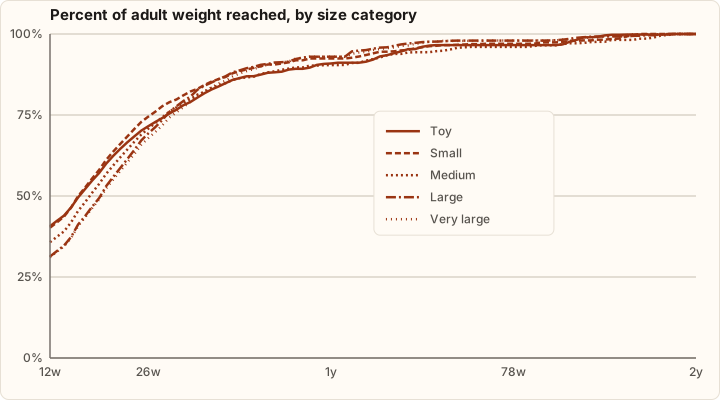
Reading the median curves, dogs reach 90 percent of their adult weight somewhere between about 9.5 and 13 months depending on size band. That is a reasonable definition of “essentially full size”.
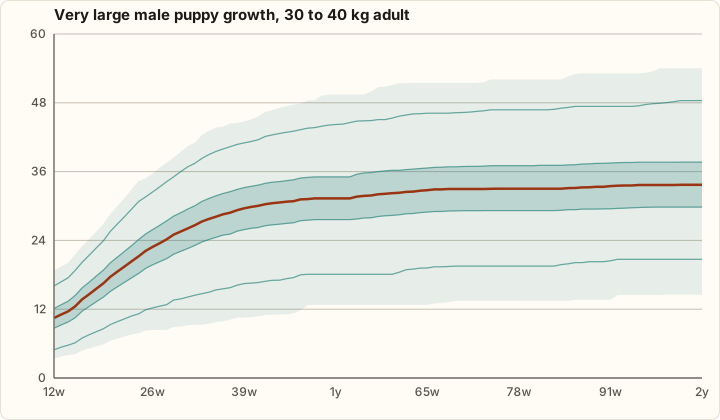
There is a caveat worth stating plainly. Our curves show weight still creeping upward until around 20 months in every band, which is later than the usual rules of thumb. That last stretch is almost certainly the dog filling out and, in some cases, gaining a little condition as an adult, rather than the skeleton continuing to grow. We report what the data shows and flag what it probably means, rather than trimming the number to match the folklore.
Our reference also stops at a 40 kg adult weight, so true giant breeds are not in it. They grow for longer than anything we can measure.
Why this matters for exercise
This is the part with real consequences.
The widely used guideline is five minutes of structured exercise per month of age, twice a day. A three month old puppy gets about 15 minutes twice daily; a six month old about 30.
“Structured” is doing a lot of work in that sentence. It means lead walks, jogging, repetitive fetch, stairs, and anything else you are directing. It does not mean free play in the garden, where a puppy self-regulates, changes pace constantly and stops when tired.
The activities worth being careful about while plates are open:
- Repetitive high-impact work. Long jogs on hard surfaces, or fetch until exhaustion.
- Jumping. Off furniture, out of cars, over agility equipment at full height.
- Stairs, especially descending, and especially repeatedly.
- Forced distance. A puppy will follow you well past the point it should stop.
None of this means keeping a puppy still. Movement builds the muscle that supports joints, and a bored puppy is its own problem. It means favouring varied, self-paced activity over long repetitive sessions.
The rule is stricter for large and giant breeds, whose plates stay open longest while carrying the most weight.
Growing too fast is its own risk
For large breeds especially, fast growth is a risk factor rather than an achievement. Rapid weight gain during the growth phase is associated with orthopaedic problems in bigger dogs.
This is why large breed puppy foods exist as a separate category. They are formulated with controlled energy and calcium specifically to slow growth to a steadier rate rather than maximise it. Overfeeding a large breed puppy, or supplementing calcium on top of a complete food, works against that.
If you have a large or very large breed puppy, this is worth raising with your vet explicitly rather than assuming that a chunky puppy is a thriving one.
How to tell where your puppy is
The puppy size calculator reports which size band your puppy is heading for and, from our own reference, when dogs in that band reach half and then essentially all of their adult weight.
For the trajectory rather than the endpoint, the growth tracker plots successive weigh-ins so you can see the curve flattening for yourself. When the line goes flat, the growing is done.
The short version
- Growth plates close between roughly 8 months and 2 years, later for bigger dogs.
- Height finishes before weight; the leggy adolescent stage is normal.
- Most dogs are essentially full size by 9 to 13 months, with big breeds at the far end.
- Keep structured exercise proportionate while the plates are open, especially for large breeds.
- Slow, steady growth beats fast growth, particularly in big dogs.
Related guides
- How big will my puppy get? What actually predicts your puppy's adult size, which rules of thumb work, and which quietly fail. Read this before you trust any single number.
- Puppy growth stages from birth to adulthood What happens at each stage of a puppy's development, when the fast growth really is, and what to expect month by month. See where your puppy is now.
- Does paw size predict how big a puppy will get? Whether big paws really mean a big dog, what the claim gets right, and what predicts adult size far better. Check your puppy with a proper growth curve.
Calculators for this
References
Every figure on this page comes from one of these. Full details, including what each source is used for, are on our sources page.
- Salt C, Morris PJ, German AJ, Wilson D, Lund EM, Cole TJ, Butterwick RF. Growth standard charts for monitoring bodyweight in dogs of different sizes. PLOS ONE. 2017;12(9):e0182064. doi:10.1371/journal.pone.0182064
- WALTHAM Petcare Science Institute. Puppy Growth Charts.
- American Animal Hospital Association. AAHA Canine Life Stage Guidelines.
- American Kennel Club. Official Breed Standards.