The AKC puppy weight formula, explained and tested
Search for how big a puppy will get and you will meet the same formula within about thirty seconds. It is usually attributed to the American Kennel Club, and it is repeated so widely that most people assume it is authoritative.
It is worth understanding properly: where it comes from, when it works, and exactly where it fails.
We are not affiliated with the American Kennel Club. The AKC publishes breed standards and popularised this rule of thumb. It does not run a weight prediction calculator, and nothing on this site is endorsed by them.
The formula
The version you will see most often is:
adult weight = (current weight in lb ÷ age in weeks) × 52
There is a second common variant for medium breeds:
adult weight = weight at 4 months × 2
And a third for toy breeds:
adult weight = weight at 6 weeks × 4
All three are the same idea wearing different clothes: take a snapshot, multiply by a constant, call it a prediction.
Where the idea comes from
The logic is straightforward. If a puppy has taken n weeks to reach its current weight, and a year has 52 weeks, then scaling up by 52/n projects that rate of gain across the whole first year.
That reasoning is sound only if a puppy gains weight at a constant rate. The formula is a straight line drawn through a curve.
Why it fails, with numbers
Puppy growth is an S-curve: slow at first, fast through the middle months, flattening as the growth plates close. And critically, the curve’s shape depends on how big the dog will be.
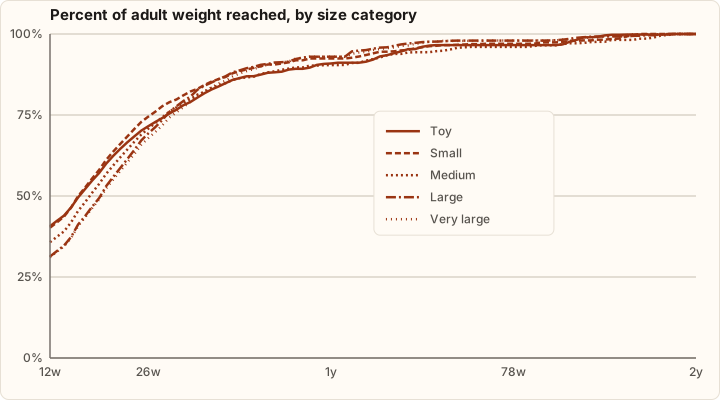
Reading off the reference this site is built on, at 16 weeks a toy-sized puppy has already reached about 51 percent of its adult weight, while a puppy heading for 30 to 40 kg has reached about 41 percent.
Turn those into the multiplier each would need:
| Size at 16 weeks | Share of adult weight | Multiplier actually needed | Linear rule gives |
|---|---|---|---|
| Toy | ~51% | ×2.0 | ×3.25 |
| Medium | ~48% | ×2.1 | ×3.25 |
| Very large | ~41% | ×2.4 | ×3.25 |
At 16 weeks the linear rule multiplies by 52/16, which is 3.25, for every dog regardless of size. The multiplier a real toy puppy needs is about 2.0. The rule overshoots by more than half.
The direction of the error does flip with age, but not where you would expect. Across every age our reference covers, from 12 weeks onward, the rule overshoots, because it projects the steepest part of the curve across an entire year. It does not start undershooting until week 46 at the earliest, once growth has flattened and the 52-week span it assumes has almost elapsed.
You can run this on your own puppy on the AKC puppy weight calculator, which shows the rule’s answer next to a growth-curve estimate and the distance between them.
When it is actually fine
Credit where it is due, but less than this guide originally gave it. We went back and measured the linear rule against our own reference at every age it covers, and the honest answer is narrower than “it works around four months”:
- The four-month doubling variant genuinely does hold up for medium breeds, landing within about 4 percent of a median medium puppy’s adult weight. That one is a decent mental shortcut.
- The 52-week version is not accurate anywhere useful. At 16 to 20 weeks it runs 32 to 68 percent high depending on size. It first stops overshooting between weeks 46 and 49, by which point the dog is already 88 to 93 percent of its adult weight.
- It is still fine for a ballpark in your head, with no tools, in a conversation, provided you treat the answer as an upper bound rather than an estimate.
The “double the weight at four months” version is a genuinely decent mental shortcut for medium breeds, because a medium puppy really is close to half its adult weight at that age. Its problem is that people apply it to Chihuahuas and Great Danes too.
What to use instead
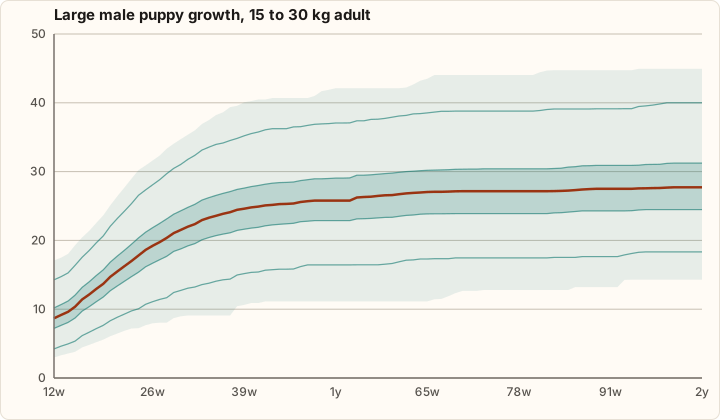
The better approach is the one paediatricians use for children. Rather than multiplying a single measurement, find the growth centile the puppy is currently tracking and follow that curve forward.
A puppy on the 60th centile at 16 weeks is usually still near the 60th centile as an adult. That method automatically accounts for the S-shape and for size, because it is reading a real curve rather than assuming a straight line.
Our puppy weight calculator does exactly that, and deliberately shows the linear rule’s answer alongside its own so you can see the gap for your own puppy.
Is there an official AKC calculator?
No. The AKC publishes breed standards that include adult height and weight ranges, and its expert-advice articles have popularised the rule above. There is no official AKC weight prediction tool, and any site presenting one as such is overstating its connection.
The breed standards themselves are genuinely useful, just for a different job: they are an excellent sanity check. If a prediction lands well outside the published range for your breed, the inputs are probably wrong.
The honest summary
The formula is not a fraud, it is a simplification that escaped into the wild and lost its caveats along the way. It was never meant to be precise, and it is repeated far past the range where it holds up.
If you want a number in your head at the park, double the four-month weight for a medium-sized dog and move on. If you are choosing a crate, budgeting for a year of food, or wondering whether your dog will fit in the car, use a proper growth curve and read the range rather than the number.
We measured how accurate the curve-based method actually is, across more than half a million real outcomes, in are puppy weight calculators accurate.
Related guides
- How big will my puppy get? What actually predicts your puppy's adult size, which rules of thumb work, and which quietly fail. Read this before you trust any single number.
- Are puppy weight calculators accurate? How close puppy weight predictors really get, measured against 579,135 real outcomes, and what the honest margin of error is at each age. See the numbers.
- Growth plates and when puppies stop growing When growth plates close by size, why it matters for exercise and joints, and what our own data says about when growing really ends. Check your puppy's stage.
Calculators for this
References
Every figure on this page comes from one of these. Full details, including what each source is used for, are on our sources page.
- American Kennel Club. Official Breed Standards.
- Salt C, Morris PJ, German AJ, Wilson D, Lund EM, Cole TJ, Butterwick RF. Growth standard charts for monitoring bodyweight in dogs of different sizes. PLOS ONE. 2017;12(9):e0182064. doi:10.1371/journal.pone.0182064
- WALTHAM Petcare Science Institute. Puppy Growth Charts.