Puppy size calculator
A number on its own does not tell you much. What you actually want to know is what kind of dog you are raising: how big it will get, how long it keeps growing, and what to buy. This works all three out from your puppy’s weight and age.
What size dog will my puppy be?
Your puppy is heading for
—
- Half grown by
- —
- Essentially full size by
- —
- Growing still to do
- —
- Crate size to buy
- —
How to use the calculator
- Enter weight, age and sex. A current weight, the age in weeks, and the sex. Males finish heavier than females in every size band, so it changes the answer.
- Pick the expected size, or let us infer it. If you know the breed, choose its band. Otherwise leave it on "work it out for me" and we find the category your puppy fits best.
- Read the size band, not just the number. The category tells you what kind of dog you are raising, which drives crate size, harness size, food choice and how long the growing goes on.
- Use the timings to plan. Half grown and essentially full size are the two dates worth knowing. They are what determine when to size up equipment and when to switch off puppy food.
What each value means
- Size category
- Which of five adult-weight bands your puppy is heading for. This is the thing that drives every practical decision, from crate to food.
- Half grown by
- The age at which the median dog in this band reaches half its adult weight. Computed from our reference, not quoted from a rule of thumb.
- Essentially full size by
- The age at which the median reaches 90 percent of adult weight. Past this point the changes are about filling out rather than growing.
- Crate size to buy
- General sizing guidance based on the adult dog rather than the puppy. This one is industry convention rather than a finding from the veterinary data, and we flag it as such.
Reference values: the five size categories
Dogs of different breeds that finish at a similar adult weight grow at close to the same rate. That single fact is why grouping by adult size works better than grouping by breed, and why these tools work for mixed breeds at all.
| Category | Adult weight band | Median adult (M / F) | Half grown | Full size |
|---|---|---|---|---|
| Toy | Under 6.5 kg | 4.5 / 3.8 kg | 4 months | 11.5 months |
| Small | 6.5 to 9 kg | 7.5 / 6.3 kg | 4 months | 9.5 months |
| Medium | 9 to 15 kg | 11.1 / 9.4 kg | 4 months | 11.5 months |
| Large | 15 to 30 kg | 27.7 / 23.4 kg | 4.5 months | 9.5 months |
| Very large | 30 to 40 kg | 33.7 / 28.9 kg | 4.5 months | 10 months |
A note on these timings. “Full size” here means 90 percent of adult weight, because that is where the curve genuinely flattens. Our reference shows weight still creeping up until roughly 20 months in every band, but that last stretch is the dog filling out rather than its skeleton growing. Published rules of thumb tend to quote earlier figures for small dogs because they are describing skeletal growth alone.
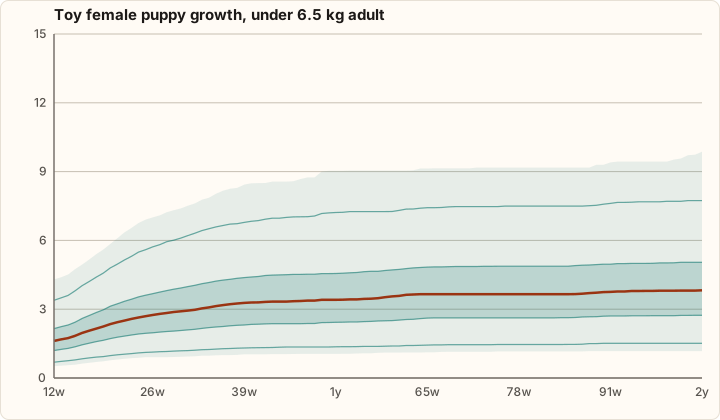
How much growing is left at each age
Example calculations
Three puppies put through the calculator above, including the category re-check it runs after projecting. Every figure here comes back out of that same chain.
2.1 kg at 3 months
2.1 kg at 14 weeks · female · size worked out for you
Toy category
- Adult weight 4.8 kg, likely 3.7 to 6.5 kg
- About 44% of the way there today
- Half grown at 3.5 months, 90% of adult weight by 13
Toy, and settled early. She is 44 percent of the way there at 14 weeks, which is why the smallest category is the one you can call with most confidence from a single weigh-in.
9.4 kg at 4 months
9.4 kg at 18 weeks · male · size worked out for you
Large category
- Adult weight 21.6 kg, likely 17.1 to 28.2 kg
- About 44% of the way there today
- Half grown at 4.5 months, 90% of adult weight by 9.5
Large, and only 44 percent of the way there at four months. The label settles long before the dog does, so buy the crate against the projected adult weight rather than the puppy in front of you.
20.5 kg at 5 months
20.5 kg at 22 weeks · male · size worked out for you
Very large category
- Adult weight 35.1 kg, likely 28.4 to 44.3 kg
- About 58% of the way there today
- Half grown at 4.5 months, 90% of adult weight by 10
Very large, with about 15 kilograms still to come. Note how wide the band is: the gap between its low and high end is 16 kilograms, which is a whole size category on its own.
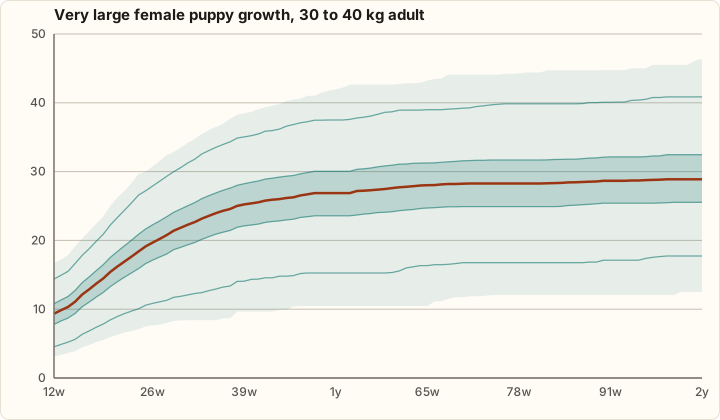
What size actually changes
- Crate and bed. Buy for the adult, divide for the puppy.
- Harness and collar. Expect to replace a harness two or three times for a large breed. Check the fit fortnightly during the fast-growth months.
- Food. Large and very large breeds should be on a large breed puppy formula, which controls energy and calcium to slow growth deliberately. Portions come from weight and age via the puppy feeding calculator, and the reasoning is in calcium and large breed puppies.
- Exercise. The bigger the breed, the longer the growth plates stay open and the more carefully structured exercise should be built up. The puppy exercise calculator works out a safe daily amount by age.
- Neutering timing. Increasingly size-dependent advice, and genuinely a conversation for your vet rather than a calculator.
- Car, home and travel. Worth thinking about before the dog is 30 kg rather than after.
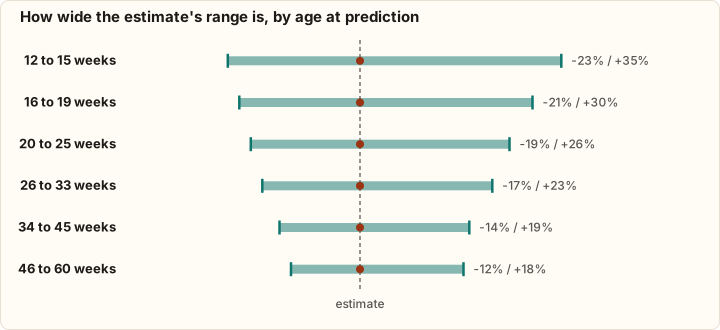
Accuracy and limits
- We do not predict height. The underlying data records weight, not height, so a height calculator would mean inventing numbers.
- The reference runs 12 weeks to 2 years and covers adult weights up to 40 kg.
- Crate sizing is general guidance, not a finding from the veterinary data. It is included because it is useful, and labelled because it is different in kind.
- Boundary cases are genuinely ambiguous. A puppy heading for 15 kg could track either the medium or the large band.
Frequently asked questions
How can I tell what size my puppy will be?
Weight against age is by far the most reliable signal you have. A puppy's position on a growth curve at 12 to 20 weeks already narrows the answer considerably, because dogs that finish at a similar adult weight grow at close to the same rate regardless of breed.
Paw size, parent size and breed guesses all help around the edges, but none of them beat an actual weight plotted against an actual age.
When do puppies stop growing?
It depends on size, and the honest answer has two parts. Reading it off our own reference, a toy dog is essentially full size by around 11.5 months and a very large dog by around 10 months.
After that the weight keeps creeping up slightly for another year, but that is filling out rather than growing. Skeletal growth finishes first; muscle and condition carry on.
What size crate should I buy for a puppy?
Buy for the adult dog and use a divider while your puppy is small. Crates are expensive to replace twice, and a divider costs almost nothing.
Size it so the grown dog can stand up, turn round and lie flat. Too much space during house-training is counterproductive: a puppy will happily soil one end and sleep in the other, which is exactly what you are trying to avoid.
Is my puppy small for its age?
Probably not. Someone has to be at the lower end, and a puppy tracking steadily along a low centile is growing perfectly normally.
What warrants a vet visit is a change: weight loss, no gain over two weeks, or dropping across several centile lines. The growth tracker is built to show exactly that.
Do male and female puppies grow differently?
Yes, consistently and in every size band. In our reference the male median is above the female median at every single age from 12 weeks to two years. For a large dog the adult gap is around 4 kg.
That is why every tool here asks for sex rather than treating it as optional.
Does size category change how I should feed my puppy?
For large and very large breeds, yes, and it matters. Growing too fast is associated with orthopaedic problems in big dogs, which is why large breed puppy foods are formulated with controlled calcium and energy to slow growth rather than maximise it.
For toy and small breeds the bigger risk runs the other way, towards low blood sugar in very young puppies, which is why they need feeding more often. Either way it is worth a conversation with your vet rather than guessing.
How tall will my puppy be?
We do not publish a height prediction, because the dataset behind this site records weight rather than height. Building a height calculator on top of it would mean inventing numbers, which is exactly what this site exists not to do.
The practical answer is that height finishes before weight. A large breed dog usually reaches its adult shoulder height months before it fills out, so a dog that looks leggy and gangly at ten months is normal. Published breed standards give height ranges if you have a purebred.
What if my puppy is between two size categories?
Treat both as your range. A dog heading for around 15 kg sits exactly on the boundary between the medium and large bands, and could reasonably track either.
Re-run the calculator every few weeks. As your puppy grows the ambiguity resolves itself without you needing to guess.
Related calculators
Know the breed? Browse breeds by size category for a weight table anchored to that breed’s published standard rather than to the category average.
References
Every figure on this page comes from one of these. Full details, including what each source is used for, are on our sources page.
- Salt C, Morris PJ, German AJ, Wilson D, Lund EM, Cole TJ, Butterwick RF. Growth standard charts for monitoring bodyweight in dogs of different sizes. PLOS ONE. 2017;12(9):e0182064. doi:10.1371/journal.pone.0182064
- WALTHAM Petcare Science Institute. Puppy Growth Charts.
- American Animal Hospital Association. AAHA Canine Life Stage Guidelines.
- American Kennel Club. Official Breed Standards.