Working out mixed breed size without a DNA test
Mixed breed owners get the worst service from puppy size tools. Most either demand a breed you cannot supply, or shrug and hand you the same linear formula they give everyone else.
You can do considerably better than that without spending anything on a DNA test.
Two routes, depending on what you know
If you know the parents’ adult weights
These are useful size anchors because they measure the two dogs rather than naming their ancestry. Average the two weights to select a plausible size category, then let the puppy’s own weight for its age determine where the projection lands. The average is a heuristic, not a boundary: the answer can sit outside either parent.
Two adjustments worth making:
- Sex. A female from two 25 kg parents will typically finish lighter than her brother from the same litter. Every tool here asks for sex because the difference is consistent.
- Difference between parents. A wide gap makes the category choice less informative. Keep the calculator’s result range visible and update it with later weigh-ins rather than treating the average as a genetic midpoint.
Shelters can often tell you the mother’s size even when the father is unknown. It is always worth asking, because one parent is much better than none.
If you have no idea about the parents
Work backwards from the puppy itself.
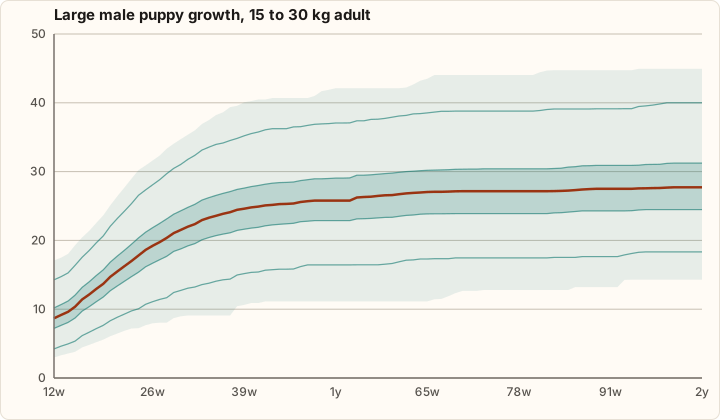
A puppy’s weight at a known age already narrows things considerably. An 8 kg puppy at 16 weeks is far too heavy to be a toy breed and far too light to be heading for 40 kg. There is only so much of the size range it can plausibly belong to.
Our mixed breed calculator does this properly: it ranks every size category by how well your puppy fits it, and shows what each one would mean as an adult weight. For a mixed breed, that spread is the honest answer rather than a hedge.
Why growth curves work for mixes at all
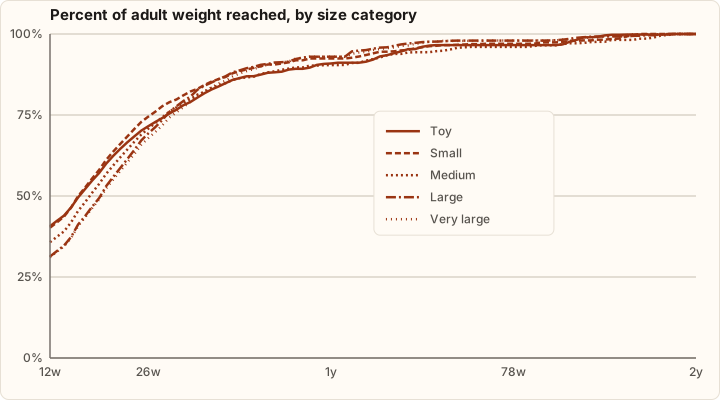
This is the part that surprises people. The reference behind this site does not group dogs by breed. It groups them by adult size, because dogs of different breeds that finish at a similar weight grow at close to the same rate.
That is exactly why the method transfers to mixed breeds. It never needed to know the breed in the first place, only roughly how big the dog is going to end up. A 20 kg mongrel and a 20 kg Border Collie follow much the same curve.
Is a DNA test worth it?
For predicting size specifically, usually not.
A DNA test tells you ancestry. That is genuinely interesting, and it can flag health predispositions worth knowing about, which is a decent reason to do one. What it does not do is measure your individual puppy.
Two practical problems for the size question:
- Results take weeks. In that time another few weigh-ins will have told you more about your puppy’s actual trajectory than the ancestry breakdown will.
- Ancestry is not size. Knowing a dog is “35 percent German Shepherd” still leaves a wide adult weight range, and the mix does not average out neatly.
If you want the test for curiosity or health screening, enjoy it. Just do not wait for it before buying a crate.
Designer crosses are the same problem
Goldendoodles, cockapoos, cavapoos and the rest are mixed breeds, and the same parent-anchor method applies.
What makes doodles unusually unpredictable is that breeders cross with different poodle sizes. The published Toy, Miniature and Standard Poodle ranges sit in different adult-size categories before the other parent is considered at all.
The Goldendoodle calculator, Labradoodle calculator and Cockapoo calculator keep those three Poodle standards separate. Ask which variety was used and what both parents actually weigh; they answer different questions, and both are useful.
What not to rely on
- Paw size. A weak signal, and a breed characteristic in its own right. Covered in does paw size predict adult size.
- What the shelter guessed the breed was. Visual breed identification is notoriously unreliable, and a guessed breed leads to a guessed size band.
- The biggest-in-the-litter rule. Birth weight reflects position in the uterus and competition for milk as much as genetics.
- A single linear formula. Wrong across sizes for the reasons set out in the AKC puppy weight formula explained.
The thing that beats all of it: repetition
Whatever route you take, the estimate improves on its own as your puppy grows.
Run the numbers now, then again in a fortnight, then again a month later. Watch the candidate size categories drop away as the growth curve declares itself. By 26 weeks the ambiguity that felt frustrating at 12 weeks has largely resolved.
The growth tracker is built for this: enter each weigh-in and it plots the line rather than giving you a fresh isolated guess each time.
Rescue puppies and estimated ages
One extra complication worth naming. Rescue puppies often come with an estimated age, and age drives the whole calculation.
An error of two weeks at 12 weeks old moves the answer noticeably. The same error at 40 weeks barely registers. So if the age is a guess, treat the result as a bracket rather than a figure, and re-run it later when a vet has had a look at the teeth.
Start here
Try the mixed breed puppy weight calculator. If you know the parents’ weights it will use them; if you do not, it will show you every size your puppy could plausibly finish at, ranked by fit.
Related guides
- How big will my puppy get? What actually predicts your puppy's adult size, which rules of thumb work, and which quietly fail. Read this before you trust any single number.
- Does paw size predict how big a puppy will get? Whether big paws really mean a big dog, what the claim gets right, and what predicts adult size far better. Check your puppy with a proper growth curve.
- Are puppy weight calculators accurate? How close puppy weight predictors really get, measured against 579,135 real outcomes, and what the honest margin of error is at each age. See the numbers.
Calculators for this
References
Every figure on this page comes from one of these. Full details, including what each source is used for, are on our sources page.
- Salt C, Morris PJ, German AJ, Wilson D, Lund EM, Cole TJ, Butterwick RF. Growth standard charts for monitoring bodyweight in dogs of different sizes. PLOS ONE. 2017;12(9):e0182064. doi:10.1371/journal.pone.0182064
- WALTHAM Petcare Science Institute. Puppy Growth Charts.
- American Kennel Club. Official Breed Standards.