Mixed breed puppy weight calculator
Mixed breed puppies come with no breed standard to check against, so most calculators either guess or refuse. This one does neither: if you know the parents it uses them, and if you do not, it shows you every size your puppy could plausibly finish at, ranked by how well each fits the growth curve your puppy is already on.
Estimate a mixed breed puppy's adult weight
Estimated adult weight
—
| If it turns out to be | Adult weight | Centile today | How likely |
|---|
How to use the calculator
- Say whether you know the parents. If you got the puppy from a breeder or shelter that knew the parents, their adult weights give the estimate a useful size anchor. If not, switch to "No idea" and we work backwards from your puppy instead.
- Enter your puppy's weight, age and sex. Weight today rather than last week, age in weeks from the date of birth, and the sex, which shifts every number because males run heavier at every age.
- Add the parents' adult weights if you have them. One parent is useful; both are better. Their average selects a plausible size category, but it is not a promise that the puppy must finish between them.
- Read the whole table, not just the headline. With unknown parents we show what your puppy would weigh as an adult under every size category, ranked by how likely each one is. For a mixed breed that spread is the honest answer.
What each value means
- Estimated adult weight
- The central estimate under the most likely size category. For a mixed breed this is the middle of a genuinely wide field.
- Likely range
- The band eight puppies in ten fall into when a prediction is made at this age. It narrows as your puppy grows.
- Centile today
- Where your puppy sits relative to healthy puppies of that size category, sex and age. A puppy near the 50th centile of a category is a good fit for it.
- How likely
- How well each size category fits your puppy right now. A category your puppy sits near the middle of is a much better fit than one it sits at the very edge of.
The parent method, and when to trust it
If you know what the parents weighed as adults, that is the single most useful piece of information available to you. Their average selects a plausible size category, while the puppy’s measured position on that curve determines the estimate.
Two caveats are worth holding on to. The parent average is a category-selection heuristic, not a genetic midpoint, so the result may sit outside either parent. And where the parent weights differ greatly, treat any single number with more caution than usual and re-run it after later weigh-ins.
Already know the breed and its typical adult size? The puppy weight calculator will give you a tighter answer. If you want to watch the trajectory over several weigh-ins, use the growth tracker.
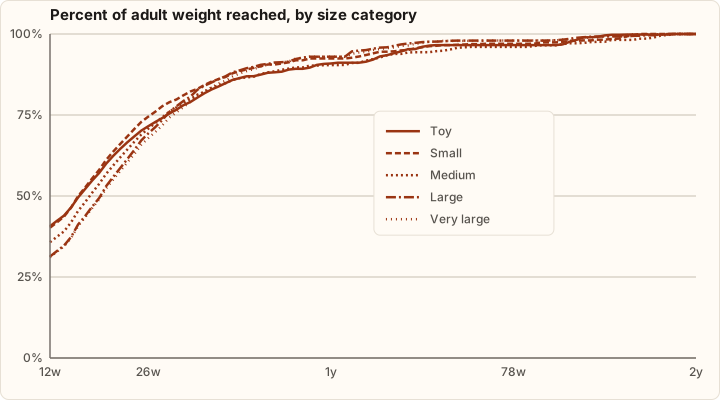
The five size categories
Dogs of different breeds that finish at a similar adult weight grow at close to the same rate. That is why the underlying reference groups by adult size rather than by breed, and it is precisely why it works for mixes at all.
| Category | Adult weight | Roughly comparable breeds |
|---|---|---|
| Toy | Under 6.5 kg | Chihuahua, Yorkshire Terrier, Maltese, Pomeranian |
| Small | 6.5 to 9 kg | Pug, Shih Tzu, Miniature Dachshund, Papillon |
| Medium | 9 to 15 kg | Beagle, Cocker Spaniel, Miniature Poodle, Corgi |
| Large | 15 to 30 kg | Border Collie, Boxer, Australian Shepherd, Staffordshire Bull Terrier |
| Very large | 30 to 40 kg | Labrador Retriever, German Shepherd, Golden Retriever, Doberman |
Example calculations
One puppy for each of the three situations you can be in, run through the calculator above. What changes between them is not the puppy but how much you know about its parents.
Both parents known
12.2 kg at 18 weeks · male · parents 12 kg and 28 kg
26.4 kg as an adult
- Parent average 20 kg, so large category
- Likely range 20.9 to 34.4 kg
- Currently on the 40th centile of that category
The strongest case, and worth reading carefully. The parents differ by 16 kg and average 20 kg, but the answer is 26.4 kg. The average only picks the size band; where the puppy lands inside it is decided by the puppy's own weight for its age.
One parent known
5.2 kg at 20 weeks · female · mother 14 kg, father unknown
9 kg as an adult
- Anchored on one parent at 14 kg
- Likely range 7.3 to 11.4 kg
- Medium category
A single parent is a weaker anchor than two and the calculator says so on the result rather than quietly treating it as equivalent. Shelters can often give you the mother even when the father is a mystery, so it is worth asking.
Neither parent known
5.2 kg at 16 weeks · male · no parent weights
11.4 kg if medium
- Best fit: Medium, 9 to 14.8 kg
- Next best: Small, 7.9 to 13 kg
- Sits on the 55th centile of the best fit
With nothing to anchor to, the honest answer is the spread rather than the headline. Taken together the two most likely categories cover 7.9 to 14.8 kg, and re-running it after a few more weigh-ins is what narrows it.
Reference values for a mid-size mix
Most mixed breed puppies land in the medium or large bands. These are the reference weights the calculator compares against.
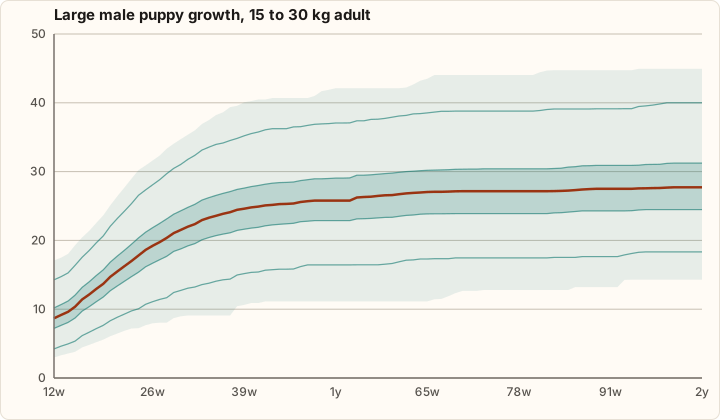
Large, male (15 to 30 kg adult)
| Age | 2th | 9th | 25th | 50th | 75th | 91th | 98th |
|---|---|---|---|---|---|---|---|
| 12 weeks | 4.23 | 5.75 | 7.20 | 8.68 | 10.2 | 11.9 | 14.3 |
| 16 weeks | 6.17 | 8.05 | 9.72 | 11.4 | 13.2 | 15.1 | 17.6 |
| 20 weeks | 8.33 | 10.7 | 12.7 | 14.7 | 16.9 | 19.2 | 22.1 |
| 26 weeks | 11.1 | 14.1 | 16.7 | 19.2 | 21.9 | 24.7 | 28.1 |
| 34 weeks | 13.8 | 17.5 | 20.4 | 23.3 | 26.2 | 29.4 | 33.6 |
| 43 weeks | 15.7 | 19.2 | 22.3 | 25.2 | 28.3 | 31.7 | 36.2 |
| 12 months | 16.4 | 19.8 | 22.9 | 25.8 | 29.1 | 32.5 | 37.1 |
| 15 months | 17.3 | 20.8 | 23.9 | 27.0 | 30.2 | 33.8 | 38.5 |
| 18 months | 17.5 | 20.8 | 23.9 | 27.2 | 30.4 | 34.1 | 38.8 |
| 21 months | 17.7 | 21.3 | 24.3 | 27.5 | 30.9 | 34.6 | 39.1 |
| 24 months | 18.3 | 21.4 | 24.5 | 27.7 | 31.2 | 34.8 | 40.0 |
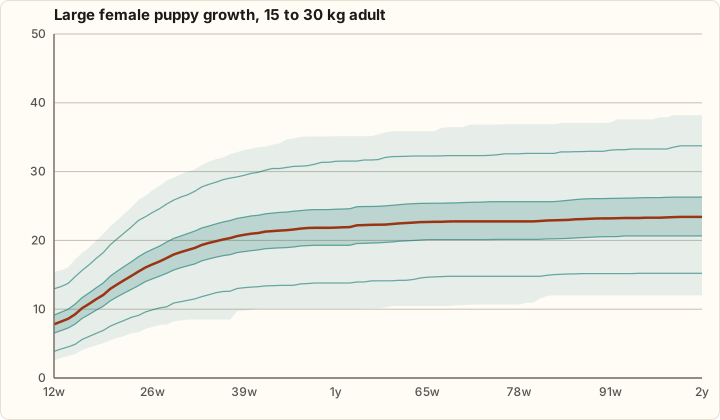
Large, female (15 to 30 kg adult)
| Age | 2th | 9th | 25th | 50th | 75th | 91th | 98th |
|---|---|---|---|---|---|---|---|
| 12 weeks | 3.87 | 5.22 | 6.53 | 7.80 | 9.14 | 10.8 | 13.0 |
| 16 weeks | 5.61 | 7.22 | 8.68 | 10.2 | 11.7 | 13.4 | 15.7 |
| 20 weeks | 7.54 | 9.50 | 11.2 | 13.0 | 14.8 | 16.8 | 19.4 |
| 26 weeks | 9.92 | 12.4 | 14.4 | 16.5 | 18.7 | 21.1 | 24.1 |
| 34 weeks | 12.1 | 14.9 | 17.3 | 19.6 | 22.1 | 24.9 | 28.2 |
| 43 weeks | 13.4 | 16.4 | 18.9 | 21.4 | 24.0 | 26.9 | 30.4 |
| 12 months | 13.8 | 16.7 | 19.3 | 21.9 | 24.5 | 27.5 | 31.5 |
| 15 months | 14.7 | 17.5 | 20.1 | 22.7 | 25.4 | 28.5 | 32.3 |
| 18 months | 14.8 | 17.5 | 20.1 | 22.8 | 25.6 | 28.7 | 32.6 |
| 21 months | 15.2 | 18.0 | 20.5 | 23.2 | 26.1 | 29.2 | 33.1 |
| 24 months | 15.2 | 18.1 | 20.6 | 23.4 | 26.3 | 29.5 | 33.7 |
Take the chart with you
There is no mixed breed chart, and there should not be one. These charts group by the weight a dog finishes at rather than by breed, which is exactly why they work for a puppy with no pedigree: you need an expected adult weight, not a name. Pick the category that estimate lands in, print it, and mark each weigh-in on it. If the estimate moves a category later, print the other one.
Individual charts for each size category and sex are on the puppy growth chart page.
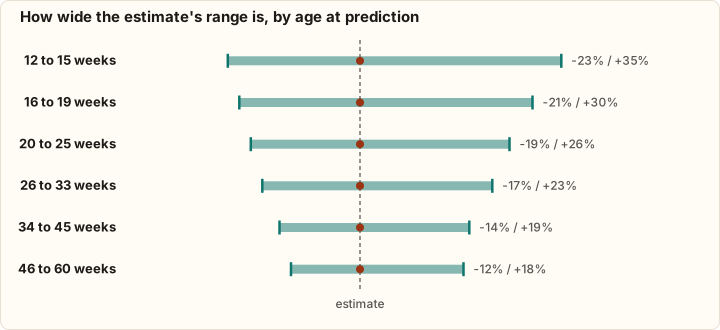
Accuracy and limits
- Mixed breeds carry more spread than purebreds. There is no breed standard to anchor to, so the range matters more than the middle number.
- Estimated ages hurt. Common with rescue puppies, and an error of a couple of weeks moves the answer a lot when the puppy is young.
- Under 12 weeks the reference does not apply. We say so rather than extrapolating.
- Above 40 kg the data runs out. Large mixes can finish beyond what the reference covers.
Frequently asked questions
How do you predict a mixed breed puppy's size without a DNA test?
Two ways, depending on what you know. If the parents' adult weights are known, their average picks a plausible size category and the puppy's own growth curve does the rest. The answer is not forced to stay between the parents.
If the parents are unknown, we work backwards from the puppy's weight at its age. We find the size category it sits closest to the middle of, then show the alternatives so you can see the real spread.
Are mixed breed predictions less accurate than purebred ones?
Yes, and anyone telling you otherwise is overselling. With a purebred you have a breed standard to anchor against. With a mix you do not, so more of the answer rests on the growth curve alone.
That is exactly why this page shows a range and, when the parents are unknown, a whole table of possibilities. The spread is not us hedging, it is the actual state of the evidence.
Will my puppy be bigger than both parents?
Yes. The parent average is used only to choose a plausible size category; it is not a biological boundary. The puppy's own weight for its age can put the projection above or below either parent.
If the parents differ greatly in size, treat the result range as especially important and update the estimate with later weigh-ins.
What if I only know one parent?
Enter the one you know. A single parent is a weaker anchor than two, and the calculator says so rather than pretending otherwise, but it is still much better than nothing.
Shelters can often tell you the mother's size even when the father is unknown, so it is worth asking.
Is a DNA test worth it just to predict size?
Probably not for size alone. A DNA test tells you breed ancestry, which is interesting and can flag health predispositions worth knowing about, but it does not measure your individual puppy.
By the time a test result comes back, another few weeks of weigh-ins will usually have told you more about your puppy's actual growth trajectory than the ancestry breakdown does.
My rescue puppy has an estimated age. Does that matter?
It matters quite a bit, because age drives the whole calculation. An error of two weeks at 12 weeks old shifts the answer noticeably; the same error at 40 weeks barely registers.
If the age is a guess, treat the result as a rough bracket and re-run it in a month. Vets can estimate age reasonably well from teeth, so it is worth asking at your next appointment.
How do I know which size category my mixed breed falls into?
Leave it to the calculator. The table it produces ranks every category by how well it fits your puppy's current weight and age, so you can see not just the best fit but how much better it is than the alternatives.
As your puppy grows the answer narrows on its own. Re-run it every few weeks and watch the possibilities drop away.
Do doodles and other designer crosses work differently?
Not from a growth-curve point of view. A Goldendoodle is a mixed breed, and the same parent-anchor method applies. What changes sharply is the published adult range of the Poodle parent.
Ask which Poodle variety and what both parents actually weigh. The Goldendoodle, Labradoodle and Cockapoo pages compare the published parent standards without pretending those standards belong to the cross.
Related calculators
References
Every figure on this page comes from one of these. Full details, including what each source is used for, are on our sources page.
- Salt C, Morris PJ, German AJ, Wilson D, Lund EM, Cole TJ, Butterwick RF. Growth standard charts for monitoring bodyweight in dogs of different sizes. PLOS ONE. 2017;12(9):e0182064. doi:10.1371/journal.pone.0182064
- WALTHAM Petcare Science Institute. Puppy Growth Charts.
- American Kennel Club. Official Breed Standards.