Goldendoodle puppy weight calculator
A Goldendoodle has no single published adult weight standard. The useful starting point is which Poodle variety was used, followed by what both parents actually weigh. This page keeps those parent standards separate, then lets your puppy’s own weight and age do the estimating.
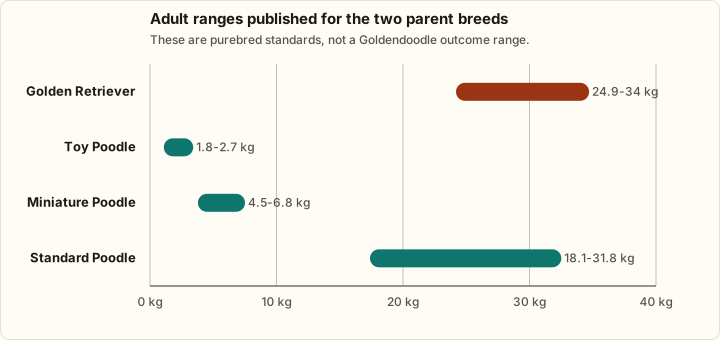
The table is not a promised outcome range. It shows the endpoints of two purebred standards. A cross can finish outside either parent’s published range, and no Goldendoodle-specific growth curve exists in the source data.
Estimate your Goldendoodle puppy's adult weight
Estimated adult weight
—
| If it turns out to be | Adult weight | Centile today | How likely |
|---|
How to use the calculator
- Identify the Poodle parent. Choose Toy, Miniature or Standard from the breeder or rescue record. The published adult ranges are different enough that “Poodle” on its own is not a useful size answer.
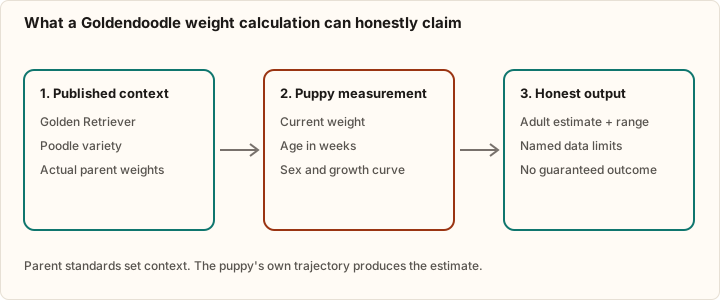
- Use the real parent weights when possible. The table compares purebred standards only. If you know what the Golden Retriever parent and Poodle parent actually weigh, enter those measurements in the calculator instead.
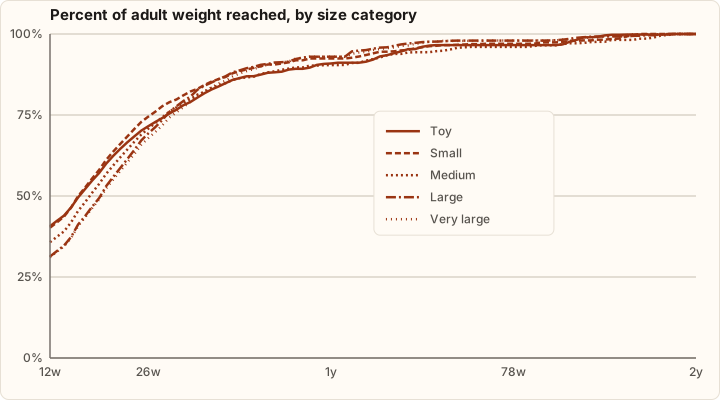
- Enter the puppy's current weight and age. Use a recent weight and age in whole weeks. Those measurements decide where the puppy sits on the selected size-category curve.
- Read the range and update it later. The headline is an estimate, not a target. Repeating the calculation after later weigh-ins is more useful than treating one early result as fixed.
What each value means
- Parent standard
- The published adult range for one purebred parent breed. It describes that breed, not the cross.
- Parent-standard span
- The lower of the two published lower endpoints through the higher upper endpoint. It is a comparison, not a confidence interval.
- Estimated adult weight
- The puppy’s position on an age- and size-specific growth curve carried forward to adulthood.
- Likely range
- The measured prediction interval for a puppy assessed at that age. It narrows as later weigh-ins replace earlier ones.
- Size category
- One of five adult-weight bands in the growth reference. A wide parent comparison can touch several of them.
Example calculations
Each span below is re-derived from the parent standards used by the page. It is a worked comparison, not a prediction for an individual puppy.
Toy Poodle parent
Golden Retriever standard 24.9 to 34 kg · Toy Poodle standard 1.8 to 2.7 kg
1.8 to 34 kg parent-standard span
- Lower endpoint: min(24.9, 1.8) = 1.8 kg
- Upper endpoint: max(34, 2.7) = 34 kg
- Touches the toy, small, medium, large and very large size categories
This calculation compares the two purebred standards. It does not claim that a Goldendoodle must finish inside the span.
Miniature Poodle parent
Golden Retriever standard 24.9 to 34 kg · Miniature Poodle standard 4.5 to 6.8 kg
4.5 to 34 kg parent-standard span
- Lower endpoint: min(24.9, 4.5) = 4.5 kg
- Upper endpoint: max(34, 6.8) = 34 kg
- Touches the toy, small, medium, large and very large size categories
This calculation compares the two purebred standards. It does not claim that a Goldendoodle must finish inside the span.
Standard Poodle parent
Golden Retriever standard 24.9 to 34 kg · Standard Poodle standard 18.1 to 31.8 kg
18.1 to 34 kg parent-standard span
- Lower endpoint: min(24.9, 18.1) = 18.1 kg
- Upper endpoint: max(34, 31.8) = 34 kg
- Touches the large and very large size categories
This calculation compares the two purebred standards. It does not claim that a Goldendoodle must finish inside the span.
Reference values by Poodle parent
The Golden Retriever figures come from its published growth and adult-weight page. Each Poodle row uses its own AKC variety standard rather than treating all Poodles as one size.
| Poodle parent | Golden Retriever | Poodle standard | Combined comparison span | Size categories touched |
|---|---|---|---|---|
| Toy Poodle | 24.9 to 34 kg | 1.8 to 2.7 kg | 1.8 to 34 kg | Toy, Small, Medium, Large and Very large |
| Miniature Poodle | 24.9 to 34 kg | 4.5 to 6.8 kg | 4.5 to 34 kg | Toy, Small, Medium, Large and Very large |
| Standard Poodle | 24.9 to 34 kg | 18.1 to 31.8 kg | 18.1 to 34 kg | Large and Very large |
What the page calculates
For the comparison table, the lower endpoint is the smaller published lower endpoint from the two parent standards. The upper endpoint is the larger published upper endpoint. Nothing is averaged, because an average would look like a prediction the standards cannot support.
comparison span = min(parent lower bounds) to max(parent upper bounds)
The interactive estimate is different. It uses actual parent weights, when known, to select a plausible size category. Your puppy’s current weight and age then place it on that category’s growth curve. The generic mixed breed puppy weight calculator explains both routes in full.
Accuracy and limits
- No crossbreed standard. Every published number remains labelled with the purebred parent standard it came from.
- No inheritance formula. F1, F1B and multigeneration labels are not converted into kilograms because we have no validated equation for doing that.
- No breed-specific curve. The growth reference groups puppies by adult weight, not by Goldendoodle ancestry.
- Reference limits remain. Predictions before 12 weeks or above 40 kg adult weight are labelled as fallbacks rather than silently extrapolated.
Frequently asked questions
How big will my Goldendoodle puppy get?
The honest answer depends first on which Poodle variety was used. With a Standard Poodle, the two published parent standards together span 18.1 to 34 kg. That is context, not a Goldendoodle standard.
For an individual puppy, use the parents' actual adult weights if known and let the puppy's current weight and age place it on a growth curve. The result can sit outside either parent weight, so read the range rather than treating the parent span as a boundary.
Does a Goldendoodle have an official adult weight standard?
No single purebred standard applies to this cross. The figures on this page remain attached to the Golden Retriever and the three Poodle standards they came from.
That distinction is why the table is called a parent-standard comparison and not a Goldendoodle growth standard.
Can I predict size by averaging the two breed standards?
An average can select a plausible size category, but it is not a genetic midpoint and it does not bound the outcome. The calculator uses the puppy's own weight for its age to decide where the estimate lands inside that category.
If the actual parents are known, their measured adult weights are more relevant than the endpoints of either breed standard.
Do F1, F1B and multigeneration labels change the formula?
Not in this calculator. Those labels describe ancestry proportions, but this project has no validated formula that converts a generation label into adult kilograms.
Enter the real parent weights when you have them. Otherwise use the puppy-only route and keep the wider uncertainty visible.
Which Poodle size matters most for a Goldendoodle?
The exact Poodle parent matters more than the word “doodle” or “poo”. On this page the Poodle standards run from 1.8 to 2.7 kg for Toy through 18.1 to 31.8 kg for Standard.
Ask for the variety and the individual parent's adult weight; they answer different questions, and both are useful.
How accurate is this Goldendoodle calculator?
The growth projection uses age-specific prediction intervals measured against real puppy outcomes, but those source records are grouped by adult size rather than by crossbreed. There is no Goldendoodle, Labradoodle or Cockapoo curve in the data.
Predictions are widest early, and parent standards are only context. Re-run the estimate as the puppy grows and ask a veterinarian to check body condition rather than chasing a target weight.
Related calculators
References
Every figure on this page comes from one of these. Full details, including what each source is used for, are on our sources page.
- American Kennel Club. Official Breed Standards.
- Salt C, Morris PJ, German AJ, Wilson D, Lund EM, Cole TJ, Butterwick RF. Growth standard charts for monitoring bodyweight in dogs of different sizes. PLOS ONE. 2017;12(9):e0182064. doi:10.1371/journal.pone.0182064
- WALTHAM Petcare Science Institute. Puppy Growth Charts.