Does paw size predict how big a puppy will get?
“Look at those paws, he’s going to be huge.” It is one of the most repeated pieces of dog folklore there is, and like most folklore it contains a grain of truth wrapped in a lot of confidence.
The short answer
Paw size is a weak signal. It is not nothing, but it is nowhere near as informative as a weight measured against an age, and it is wrong often enough that you should not plan around it.
If you want an actual estimate, the puppy weight calculator uses growth curves derived from millions of veterinary weight records. That is a different category of evidence from looking at feet.
The grain of truth
There is a real reason the myth persists.
Puppies do not grow uniformly. Extremities, including paws and the long bones of the legs, tend to develop earlier in proportion than the body does. A puppy with a lot of growing left often does look leggy and big-footed, because the frame is being laid down before it gets filled in.
So “disproportionately large paws” genuinely does correlate loosely with “more growing to come”. The problem is everything that observation cannot distinguish.
Why it fails as a prediction
Breeds are built differently
Paw size is a breed characteristic in its own right, independent of body size. Breeds developed for snow or soft ground, such as Newfoundlands and Saint Bernards, have famously broad feet. Sighthounds are lightly built with comparatively delicate feet despite being tall dogs.
A Basset Hound has enormous feet on a dog that weighs about as much as a Border Collie. Judging either by their paws puts you badly wrong.
“Disproportionate” is not measurable by eye
The claim depends on comparing paw size against body size, but almost nobody does that comparison rigorously. In practice people look at absolute paw size, which mostly tells you the puppy is a puppy.
It gives you no number
Even taken at its best, the paw heuristic outputs “probably going to be biggish”. It cannot tell you 22 kg from 34 kg, and those two dogs need different crates, different harnesses and different food.
What actually works, in order
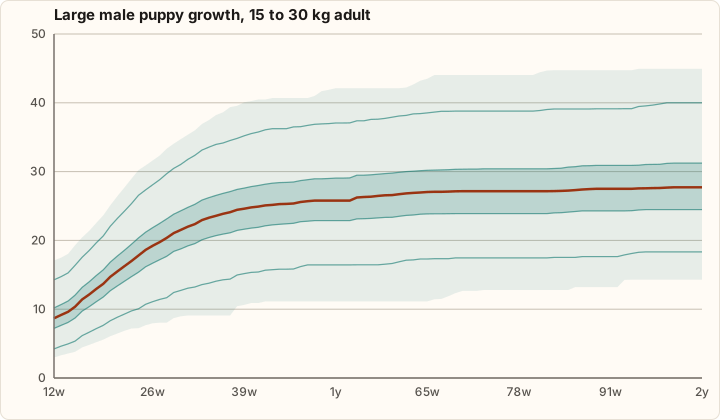
- Weight against age on a growth curve. By far the strongest signal available at home. A puppy’s position on a centile at 12 to 20 weeks already narrows the answer considerably.
- The parents’ adult weights. For a mix, the best anchor you have. See mixed breed size without a DNA test.
- The breed standard, for a purebred. A published range, and an excellent sanity check.
- Sex. Consistent and worth entering. Males run heavier at every age.
- Paw size. A tiebreaker at best.
What about paw size for predicting height?
The same limitation applies, with an extra one on top: we do not publish a height prediction at all, because the dataset behind this site records weight rather than height. Building a height tool on it would mean inventing numbers.
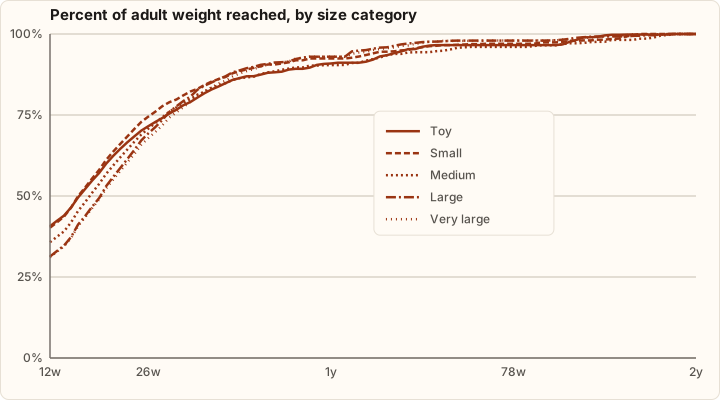
What is worth knowing is that height finishes before weight. A large breed dog usually reaches its adult shoulder height months before it fills out, which is exactly why so many adolescent dogs look leggy and unfinished. That gangly stage is normal and it resolves.
The related myths, briefly
- Loose skin means a big dog. Loose skin means a breed with loose skin.
- Big ears mean a big dog. Ear size is a breed trait, not a growth signal.
- The biggest puppy in the litter stays biggest. Often, but not reliably. Birth weight reflects position in the uterus and competition for milk as much as genetics, and littermates reshuffle over the first few months.
- You can tell from the mother alone. Only half the genetics, and sex shifts the answer as well.
So what should you do?
Weigh your puppy, note its age accurately, and run it through a proper growth curve. Then do it again in a fortnight and watch the estimate tighten as your puppy grows.
That takes about a minute and it beats studying feet. Start with the puppy weight calculator for the adult figure, or the puppy size calculator if what you actually want to know is what size crate to buy and when the growing stops.
And if the paws really are enormous, enjoy them. They are one of the better parts of the puppy stage, and they will not last.
Related guides
- How big will my puppy get? What actually predicts your puppy's adult size, which rules of thumb work, and which quietly fail. Read this before you trust any single number.
- Growth plates and when puppies stop growing When growth plates close by size, why it matters for exercise and joints, and what our own data says about when growing really ends. Check your puppy's stage.
- Working out mixed breed size without a DNA test How to work out how big a mixed breed puppy will get using parent weights and its own growth curve, and when a DNA test is worth it. Estimate yours free.
Calculators for this
References
Every figure on this page comes from one of these. Full details, including what each source is used for, are on our sources page.
- Salt C, Morris PJ, German AJ, Wilson D, Lund EM, Cole TJ, Butterwick RF. Growth standard charts for monitoring bodyweight in dogs of different sizes. PLOS ONE. 2017;12(9):e0182064. doi:10.1371/journal.pone.0182064
- American Kennel Club. Official Breed Standards.
- WALTHAM Petcare Science Institute. Puppy Growth Charts.