Are puppy weight calculators accurate?
Every puppy weight calculator on the internet says it is accurate. Almost none of them say how they know. So we measured ours, and this page shows the working.
The short answer
At 12 to 15 weeks, eight puppies in ten land within roughly 23 percent below to 35 percent above the estimate.
At 46 to 60 weeks, that tightens to about 12 percent below and 17 percent above.
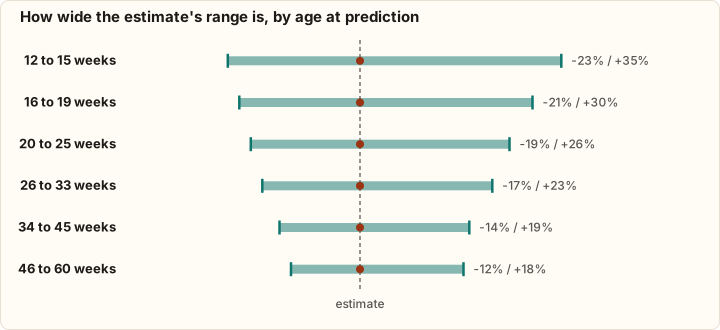
In plain terms: a 20 kg estimate made at 13 weeks honestly means “somewhere between about 15 and 27 kg”. A 20 kg estimate made at a year old means “somewhere between about 18 and 23 kg”.
That is good enough to choose a crate, size a harness, budget for food and decide whether your car boot will cope. It is not good enough to argue with a breeder over.
How we measured it
This is the part most sites skip, so here it is in full.
The growth reference behind this site is derived from an open dataset published alongside a 2017 study in PLOS ONE: roughly 15 million bodyweight records from Banfield Pet Hospitals in the United States, released under a Creative Commons Attribution licence.
Because those records follow individual dogs over time, they support a test that a one-off snapshot cannot:
- Find dogs with both an early weight and a mature weight at 95 to 110 weeks.
- Take only the early measurement and project forward, exactly as the calculator does for a live visitor.
- Compare the projection against what the dog actually weighed as an adult.
- Repeat several hundred thousand times and look at the spread of errors.
That produced 579,135 prediction-versus-outcome pairs. The error distribution from those pairs is not a modelling assumption or a confidence interval pulled out of the statistics. It is a record of how often the method was right about real dogs.
The numbers in full
| Age at prediction | Range covering 8 in 10 puppies | Predictions measured |
|---|---|---|
| 12 to 15 weeks | −23% to +35% | 87,457 |
| 16 to 19 weeks | −21% to +30% | 99,006 |
| 20 to 25 weeks | −19% to +26% | 116,149 |
| 26 to 33 weeks | −17% to +23% | 79,281 |
| 34 to 45 weeks | −14% to +19% | 87,389 |
| 46 to 60 weeks | −12% to +17% | 109,853 |
Two things stand out.
The range narrows with age, exactly as you would expect. The more growing a puppy has already done, the less room there is for surprises.
The range is not symmetric. The upside is consistently larger than the downside. A puppy is more likely to surprise you by finishing bigger than predicted than smaller. That asymmetry is why we quote both bounds rather than a tidy plus-or-minus.
We also found a bias, and corrected it
Across the pairs, the median ratio of predicted to actual weight sat at almost exactly 1.00 from 16 weeks onwards, which is what an unbiased method should do.
At 12 to 15 weeks it was 0.955 — the projection ran about 4.5 percent light.
Rather than shrug at that, the calculator corrects for it. Finding the bias is the entire point of measuring, and leaving a known 4.5 percent error in place while advertising accuracy would be indefensible.
Why most calculators are less accurate than this
Most use the linear rule: current weight divided by age in weeks, times 52. It assumes growth is a straight line.
It is not. Growth is an S-curve whose shape depends on adult size, so a single multiplier is wrong for at least one end of the size range. We look at where that formula came from and when it does work in the AKC puppy weight formula explained. To see what it produces for your own puppy next to a curve-based estimate, run the AKC puppy weight calculator.
Some calculators improve on it with breed lookup tables. That is better, but a table tells you the breed average, not where your individual puppy sits. Two Labradors from the same litter can finish 8 kg apart, and only their own growth curves will tell you which one you have.
What makes a prediction worse
- A guessed age. Common with rescue puppies, and it hurts most when the puppy is young. Two weeks of error at 12 weeks moves the answer a lot; at 40 weeks it barely registers.
- The wrong size category. The single most common reason an estimate looks obviously off. Check this first.
- Weighing under 12 weeks. Below the reference range. We flag it and widen the range rather than pretending.
- Mixed breeds with unknown parents. No breed standard to anchor against, so more of the answer rests on the curve alone.
- Sloppy weighing. Different scales, a wriggling puppy, or weighing straight after a big meal. See how to weigh a puppy correctly.
- Illness. A puppy that is unwell will not follow its curve, which is precisely why a changing centile is worth noticing.
What makes it better
- Weigh at 16 weeks or later if you can wait.
- Get the size category right, or let the calculator infer it.
- Enter the sex. It is not a formality; males run heavier at every age.
- Re-run it every few weeks. The estimate tightens on its own as your puppy grows.
- Track the trajectory, not just the endpoint, with the growth tracker.
The limits we cannot engineer away
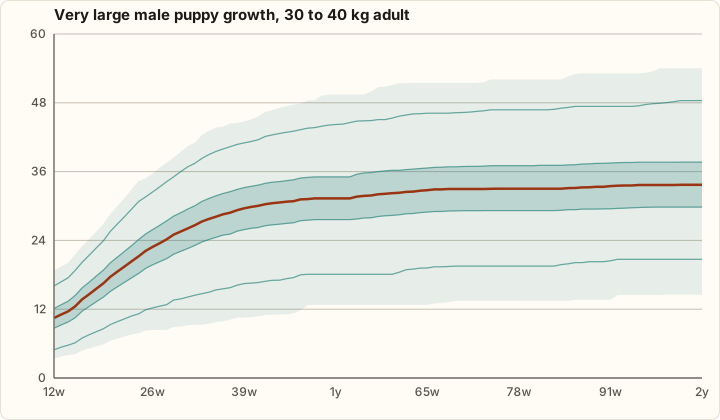
The reference covers 12 weeks to 2 years and adult weights up to 40 kg. Outside that we say so rather than quietly extrapolating.
Giant breeds sit beyond it entirely. A Great Dane is genuinely further behind at 16 weeks than our largest category suggests, and we do not have the data to tell you by how much. Saying that is more useful than inventing a figure.
And no calculator can examine your puppy. Weight is not body condition. A dog can sit on a perfectly ordinary centile and still be carrying too much or too little for its frame, which is a judgement made by hand, by a vet.
So should you trust one?
Trust the range, not the number. Trust it more at 26 weeks than at 12. Use it to make decisions that a 20 percent error would not ruin, which covers almost everything a new owner actually needs to decide.
And treat any calculator that will not tell you its margin of error as one that has never checked.
Try it yourself with the puppy weight calculator, or read how the whole thing is put together on our methodology page.
Related guides
- How big will my puppy get? What actually predicts your puppy's adult size, which rules of thumb work, and which quietly fail. Read this before you trust any single number.
- The AKC puppy weight formula, explained and tested Where the popular puppy weight formula comes from, the maths behind it, and where it breaks down by size. See how it compares against real growth curves.
- How to weigh a puppy correctly at home The bathroom scale method, how often to weigh, and the small mistakes that quietly ruin a growth chart. Get an accurate weight in under a minute.
Calculators for this
References
Every figure on this page comes from one of these. Full details, including what each source is used for, are on our sources page.
- Salt C, Morris PJ, German AJ, Wilson D, Lund EM, Cole TJ, Butterwick RF. Growth standard charts for monitoring bodyweight in dogs of different sizes. PLOS ONE. 2017;12(9):e0182064. doi:10.1371/journal.pone.0182064
- Correction: Growth standard charts for monitoring bodyweight in dogs of different sizes. PLOS ONE. 2024;19(11):e0314711. doi:10.1371/journal.pone.0314711
- WALTHAM Petcare Science Institute. Puppy Growth Charts.