Puppy cost calculator
We do not know what a vaccination costs where you live, and we will not pretend to. What we can work out is how much: the kilograms of food a puppy of your size eats across its first year, and the number of appointments the veterinary schedules call for. You supply the prices, and the quantities come from published sources.
What will the first year cost?
Fill in the prices you know. Anything you leave blank is simply left out, and the quantities still work: how much food a puppy of this size eats in a year, and how many appointments the vaccination and worming schedules call for, are worked out for you either way.
First year, as far as you have priced it
—
- Food for the year
- —
- Vaccination visits
- —
- Worming treatments
- —
- Faecal examinations
- —
| Item | Cost | How we got there |
|---|
| Month | Typical weight | Calories a day | Food | Cost |
|---|
How to use the calculator
- Set the size and the homecoming age. Size drives the food bill, which is the largest recurring cost by a distance. The age you brought your puppy home decides how much of the vaccination and worming schedule is still ahead of you.
- Copy three numbers off your food bag. The price, the bag weight and the energy density in kcal per kilogram. AAFCO requires that last one on the label under a Calorie Content heading, so it is printed there whatever brand you buy.
- Fill in the prices you actually know. Whatever you leave blank is left out of the total rather than filled in with a national average. A partial answer built from real prices beats a complete one built from someone else's.
- Read the quantities even if you skip the prices. How many kilograms of food, how many vaccination visits, how many worming treatments: those are the parts we can derive from published schedules, and they are worth having on their own before you ring round for quotes.
What we work out, and what we ask you for
Every other puppy cost calculator we looked at hands you a total built from national averages. That total is precise, confident and almost certainly not your cost. So the split here is deliberate:
| Figure | Source | Why |
|---|---|---|
| Kilograms of food per year | Derived | From our growth reference and Merck’s energy formulas, integrated month by month as the puppy grows. |
| Number of vaccination visits | Derived | The AAHA core series repeats every 2 to 4 weeks until past 16 weeks, which fixes the count once you say when the puppy came home. |
| Number of worming treatments | Derived | CAPC timings: 2, 4, 6 and 8 weeks, then monthly to six months, then quarterly. Timing only, never a dose. |
| Every price | Yours | A vet visit costs what your vet charges. Nothing we publish changes that, and a plausible-looking average would just be a guess wearing a decimal point. |
Food is the cost that scales
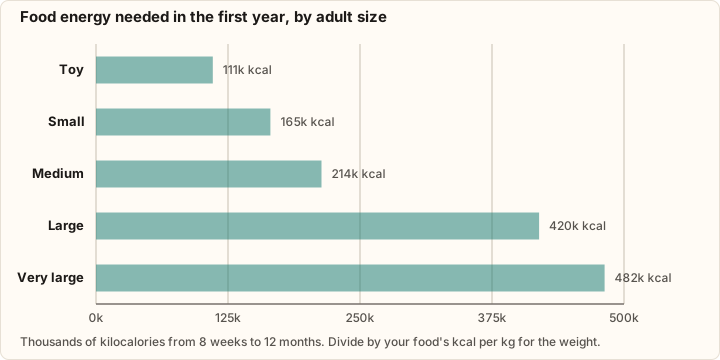
It is the largest recurring expense in year one, and it is the one that depends most on the dog. Here is the energy a puppy needs across its first year for each size category, integrated over the growth curve rather than assumed flat. Calories are the honest unit because they need no assumption about your food; the kilogram column converts them at an example density of 3,800 kcal per kg, which stands in for whatever is printed on your own bag.
| Size category | Adult weight | Energy for the year | Food at 3,800 kcal/kg |
|---|---|---|---|
| Toy | Under 6.5 kg | 110,595 kcal | 29 kg |
| Small | 6.5 to 9 kg | 165,104 kcal | 43 kg |
| Medium | 9 to 15 kg | 213,520 kcal | 56 kg |
| Large | 15 to 30 kg | 419,634 kcal | 110 kg |
| Very large | 30 to 40 kg | 481,609 kcal | 127 kg |
The month by month working, including why the daily figure falls after four months, is in how much food a puppy eats in its first year.
If you know the breed, its page gives an adult weight from the published standard, which pins the food figure down better than a category average. Figures below are for a male puppy at the median of the reference. A female of the same category runs slightly lighter, and a puppy tracking above or below the median moves in proportion. Use the puppy weight calculator if you are not sure which category yours belongs in.
The dip nobody expects at four months
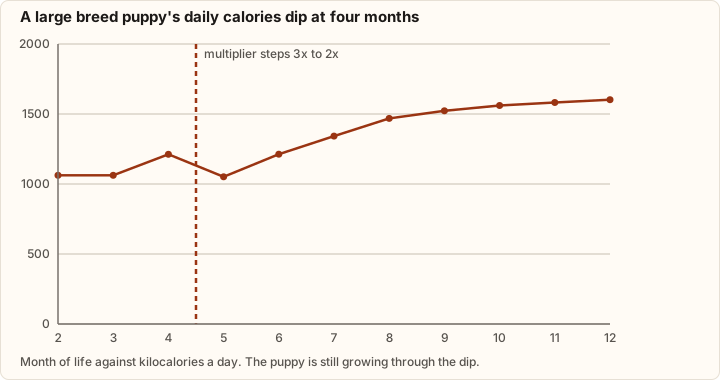
Run the calculator and watch the calories column in its month-by-month table. It rises, then falls after four months, then rises again. That is not a bug, and it is not the puppy slowing down.
Merck feeds a growing puppy at three times its resting energy requirement under four months and twice over, and that is a step rather than a taper. A puppy crossing four months genuinely needs fewer calories for a while, even though it is still growing. Miss the step and you carry on feeding at the three-times rate, which is roughly a third more food than the puppy needs, every day, for months.
Worked through on our example large male: about 1,212 kcal a day in month four, falling to about 1,051 kcal in month five. That is a drop of 13% in a still-growing puppy, and it does not climb back to its month-four level until month 6. The feeding calculator applies the same step to a single day’s portion.
Reference values: how many appointments, and when
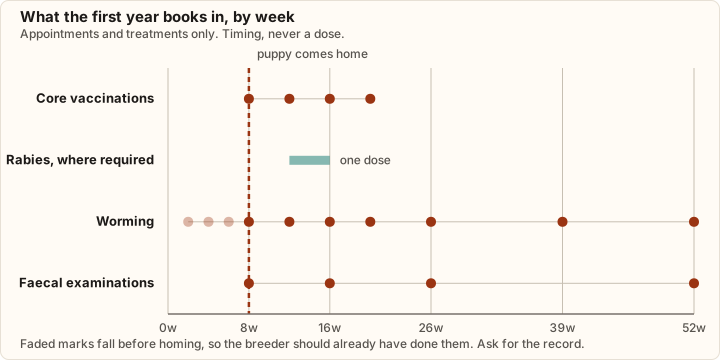
The count is not a matter of opinion once you know how old the puppy was when it came home. For a puppy homed at eight weeks:
| Event | Homed at 8 weeks | Homed at 14 weeks | From |
|---|---|---|---|
| Core vaccination visits | 4 | 2 | AAHA, every 2 to 4 weeks until past 16 weeks |
| Rabies vaccination | 1 | 1 | AAHA, a single dose at 12 to 16 weeks where required |
| Worming treatments | 7 | 6 | CAPC, 2 to 8 weeks then monthly to six months then quarterly |
| Faecal examinations | 4 | 4 | CAPC, at least four in the first year |
A puppy homed at eight weeks should already have had 3 worming treatments from the breeder. Ask for the record and do not pay for them twice. We publish timing only and never a dose: worming products are concentration-dependent, a puppy gains weight weekly, and that makes dosing your vet’s job rather than a web page’s.
What each value means
- Worked out
- A line whose quantity we derived from a published schedule or from the growth reference. You supplied only the unit price.
- Energy density, kcal per kg
- How many calories are in a kilogram of your food. AAFCO requires it on the label under a Calorie Content heading. Two puppy foods can differ by hundreds of kcal per kg, so this single number changes the food bill more than the price on the bag does.
- Food for the year
- What the puppy eats, not what you buy. Bags come in fixed sizes, so the calculator also shows the whole-bag figure. The difference is the part of the last bag still in the cupboard on the first birthday.
- Averaged monthly
- The total divided by twelve. Useful for a standing order, misleading as a picture of any actual month, because the setup costs and most vet visits fall in the first quarter.
Example calculations
Three puppies through the quantity side of the calculator. There is deliberately no money on these cards: the energy and the appointment counts are what we derive, and the prices are the part only you can supply.
Toy
Toy male · home at 8 weeks · first 12 months
111k kcal of food in year one
- Peak daily need 399 kcal, in month 12
- 9 veterinary appointments, plus 7 wormings
- 3 wormings already done by the breeder
The cheapest year on the food line by a wide margin, and the one where the fixed costs dominate. Vaccination and worming counts do not shrink with the dog.
Medium
Medium male · home at 8 weeks · first 12 months
214k kcal of food in year one
- Peak daily need 786 kcal, in month 12
- 9 veterinary appointments, plus 7 wormings
- 3 wormings already done by the breeder
The middle case. Note that the appointment count is identical to the toy's: everything that scales with size is on the food line, and nothing else.
Very large
Very large male · home at 8 weeks · first 12 months
482k kcal of food in year one
- Peak daily need 1854 kcal, in month 12
- 9 veterinary appointments, plus 7 wormings
- 3 wormings already done by the breeder
Several times the toy's food energy for exactly the same schedule of appointments. If you want one number to explain why big dogs cost more, it is this one.
Measuring your total against a published one
One figure we can cite: Synchrony’s 2025 Lifetime of Care study surveyed 4,861 US pet owners between 31 January and 22 February 2025 and put a dog’s lifetime cost at $22,125 to $60,602 over 15 years, up 11.65% from 2022. Owners themselves estimated about $8,200, which is the finding that actually matters.
Dividing by 15 gives $1,475 to $4,040 a year. That division is ours, not the study’s, and it is a crude one: year one is not an average year, because almost every one-off cost lands in it. We show the band as a sanity check on your own total rather than applying an invented first-year multiplier to it.
Accuracy and limits
- This is a budget, not a forecast. It totals the predictable costs you priced. It cannot tell you what a puppy costs where you live, because that depends on prices we do not have.
- Illness and injury are not in it. That is the cost that actually breaks budgets, and it is unpredictable by nature. Synchrony found more than two thirds of dog owners had faced an unexpected bill over $250.
- Food is modelled at the median of the reference. A puppy tracking well above or below the middle of its category will eat proportionally more or less.
- The growth reference starts at 12 weeks. Before that the weight is held flat at the 12 week figure rather than extrapolated, which slightly overstates the food a very young puppy eats. For a budget that is the safe direction to be wrong in, and the calculator flags the affected rows.
- Visit counts are the schedule, not your vet’s protocol. Practices vary, and a puppy may need extra visits for reasons nobody can schedule in advance.
- The benchmark band is US data. If you are not in the US, use it as a shape rather than a target.
Frequently asked questions
How much does a puppy cost in the first year?
Nobody can tell you that without knowing where you live, and any calculator that answers with a single confident figure is quoting a national average from a country that may not be yours.
What we can tell you is the shape of it. Synchrony's 2025 study of 4,861 US pet owners puts a dog's lifetime cost at $22,125 to $60,602 over 15 years, which averages $1,475 to $4,040 a year. Year one usually runs higher than an average year because the one-off costs all land in it.
Why does this calculator ask me for prices instead of telling me?
Because a vaccination visit costs what your vet charges, and nothing we publish changes that. Prices vary several-fold between countries, and by a lot within one city.
What we can derive honestly is the quantities: how much food a puppy of a given size eats across its first year, and how many appointments the AAHA and CAPC schedules call for. Those are the parts that are genuinely hard to look up, and they are the parts we can source.
How is the food cost worked out?
Month by month, from the puppy's actual weight rather than a flat yearly figure.
We take the median weight for your size category at each month from our growth reference, run it through the Merck resting energy formula with the growth multiplier, and convert the calories into kilograms using the energy density on your bag. A large male comes out at about 110 kg of food across the first year at 3,800 kcal per kg.
Why does the daily food cost drop after four months?
Because the growth multiplier steps down. Merck feeds a puppy at three times its resting energy requirement under four months and twice over, and that is a step rather than a gradual taper.
So a puppy that is still growing can genuinely need fewer calories at five months than it did at three and a half. It surprises people, and it is the single most common reason a puppy is overfed through the second half of its first year.
How many vet visits does a puppy need in the first year?
For a puppy homed at eight weeks: 4 core vaccination appointments, since the AAHA schedule repeats every two to four weeks until past 16 weeks, plus a rabies dose at 12 to 16 weeks where it is required.
On top of that the CAPC worming timings work out to 7 treatments across the year, and CAPC recommends at least 4 faecal examinations in the first year. Homed later, some of that is already behind you: at 14 weeks it drops to 2 vaccination visits.
What is the biggest cost people forget?
Illness and injury, and it is not close. Everything on this page is the predictable part of owning a puppy, and none of it is what empties a savings account.
The Synchrony study found more than two thirds of dog owners had faced an unexpected bill over $250. That is what insurance, or a dedicated savings pot, actually exists for, and it is why we show the predictable total rather than calling it "the cost of a puppy".
Does a bigger dog really cost that much more?
On food, yes. Using the same example food for all of them, a toy puppy gets through about 29 kg in its first year against about 127 kg for a very large one, which is roughly 4.4 times as much.
Vet fees often scale too, because many treatments are dosed by bodyweight. The fixed costs, like microchipping and puppy classes, do not.
Should I include spay or neuter in the first year?
It depends on size and on your vet. For small breeds it commonly falls inside the first year; for large and giant breeds it is often deliberately deferred past it, because the timing interacts with growth plate closure.
The field is there and it is yours to fill in or leave blank. We do not assume a date, because the decision is a clinical one rather than a budgeting one.
Related calculators
References
Every figure on this page comes from one of these. Full details, including what each source is used for, are on our sources page.
- Synchrony. 2025 Pet Lifetime of Care Study. Survey of 4,861 US pet owners conducted 31 January to 22 February 2025.
- Association of American Feed Control Officials. Calories, Understanding Pet Food.
- Merck Veterinary Manual. Nutritional Requirements of Small Animals. Management and Nutrition.
- American Animal Hospital Association. 2022 AAHA Canine Vaccination Guidelines (2024 update).
- Companion Animal Parasite Council. Guidelines for the diagnosis, treatment and control of internal parasites in dogs.
- Salt C, Morris PJ, German AJ, Wilson D, Lund EM, Cole TJ, Butterwick RF. Growth standard charts for monitoring bodyweight in dogs of different sizes. PLOS ONE. 2017;12(9):e0182064. doi:10.1371/journal.pone.0182064