AKC puppy weight calculator
This runs the three puppy weight formulas the American Kennel Club made famous, then puts the answer next to what a veterinary growth reference says about the same puppy. The gap is usually large: at 12 weeks the best known of the three predicts 35 to 76 percent too much, depending on how big your dog will be.
We are not affiliated with the American Kennel Club. The AKC publishes breed standards and its articles popularised the rules below. It runs no weight calculator, and nothing here is endorsed by it. This page is named for the formula it calculates, not for the organisation that circulated it.
Run the AKC formula on your puppy
The AKC 52-week rule says
—
Our growth curves say
—
All three formulas on your puppy
The 52-week rule
adult weight = (current weight ÷ age in weeks) × 52
—
Double the four-month weight
adult weight = weight at 4 months × 2
—
Quadruple the six-week weight
adult weight = weight at 6 weeks × 4
—
- Size category used for the comparison
- —
- Multiplier the rule applies
- —
- Multiplier a puppy this size actually needs
- —
- Week the rule stops overshooting
- —
The three formulas
All three do the same thing: take one measurement, multiply it by a constant, and call the result a prediction. They differ only in which measurement they take.
| Rule | Formula | Age it reads |
|---|---|---|
| The 52-week rule | adult weight = (current weight ÷ age in weeks) × 52 | any age |
| Double the four-month weight | adult weight = weight at 4 months × 2 | 16 to 19 weeks |
| Quadruple the six-week weight | adult weight = weight at 6 weeks × 4 | 5 to 7 weeks |
The two age-specific rules are run only at the ages they name. The four-month window is every age that rounds to four calendar months; the six-week window is a week either side of six, which is our tolerance rather than a figure anyone published. Where a rule does not apply, the calculator says so instead of running it anyway.
How to use the calculator
- Weigh your puppy and enter the weight. This is the single number every one of these formulas multiplies, so an old weight produces an old answer. Stand on the scales holding your puppy, weigh yourself alone, and subtract.
- Enter the age in weeks. The 52-week rule divides by this, so it moves the answer more than anything else you type. Switch the toggle for months and we convert on a real calendar month of 4.345 weeks.
- Add the sex and expected adult size. The AKC rules ignore both, which is the point. We use them for the growth-curve answer sitting next to the rule, and for working out how far off the rule usually lands for a dog your puppy’s size.
- Read the two answers side by side. The left card is the formula you came for. The right card is what our growth reference says about the same puppy, with the range it was measured to hold. The sentence underneath gives the distance between them.
- Check which of the three rules actually applied. Two of them read a weight taken at a specific age. If your puppy is not that age, the card says so instead of running the formula anyway on a number it was never meant to take.
What each value means
- What the AKC 52-week rule says
- The formula’s own answer, with nothing done to it. This is the number you came for, and it is shown first for that reason.
- What our growth curves say
- The same puppy read against a veterinary growth reference: find the centile it is tracking today, follow that centile to two years, and calibrate against measured outcomes. It comes with a range because a single figure would imply a precision the data does not support.
- The gap
- How far apart the two answers are for your puppy, in weight and as a percentage, and whether the rule’s answer even falls inside the range the curve method was measured to hold.
- Multiplier the rule applies
- 52 divided by your puppy’s age in weeks. The rule uses this same number for a Chihuahua and a Great Dane, which is the source of nearly all of its error.
- Multiplier a puppy this size actually needs
- The adult weight of a median puppy in that size category divided by its weight at your puppy’s age. The distance between this and the line above is the error, expressed as the two multipliers rather than as an argument.
- Week the rule stops overshooting
- The first age at which the 52-week rule no longer predicts too much for a puppy of that size, read off our reference. For every size category it lands between weeks 46 and 49.
Example calculations
Each of these is a median puppy of its size category read straight from the growth reference, then passed through the same comparison the calculator runs. Nothing here is typed in by hand.
A 12-week Yorkshire Terrier
1.8 kg at 12 weeks · male · toy category
7.8 kg says the 52-week rule
- Growth curves say 4.6 kg, likely 3.6 to 6.2 kg
- The rule reads 3.2 kg high, or 70 percent
- It multiplies by 4.33; this puppy needs 2.46
- Outside the measured range: yes
The rule stops overshooting a puppy this size at week 47, which is 35 weeks after this reading.
A 16-week Beagle
4.4 kg at 16 weeks · female · medium category
14.3 kg says the 52-week rule
- Growth curves say 9.4 kg, likely 7.5 to 12.3 kg
- The rule reads 4.9 kg high, or 52 percent
- It multiplies by 3.25; this puppy needs 2.15
- Outside the measured range: yes
The rule stops overshooting a puppy this size at week 47, which is 31 weeks after this reading.
A 26-week Labrador Retriever
22.9 kg at 26 weeks · male · very large category
45.8 kg says the 52-week rule
- Growth curves say 33.3 kg, likely 27.7 to 41 kg
- The rule reads 12.5 kg high, or 38 percent
- It multiplies by 2.00; this puppy needs 1.47
- Outside the measured range: yes
The rule stops overshooting a puppy this size at week 49, which is 23 weeks after this reading.
Why the rule misses, and by how much
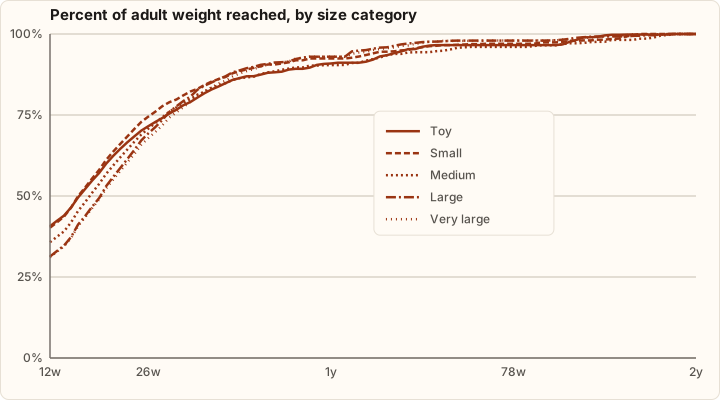
The reasoning behind the 52-week rule is sound as far as it goes. If a puppy took n weeks to reach its current weight and a year has 52 weeks, scaling by 52/n projects that rate of gain across the first year. That works only if the rate is constant, and it is not: puppy growth is an S-curve, slow then fast then flattening, and the shape of that curve depends on how big the dog will be.
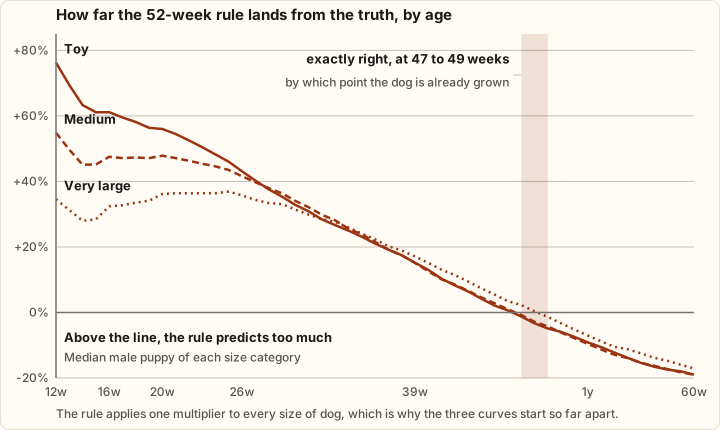
The three curves start 41 percentage points apart at 12 weeks and converge as the dogs mature, which is the shape of the problem: one constant is being asked to serve five very different growth timetables. A toy puppy has done far more of its growing by any given week than a very large one, so the same multiplier overshoots it by much more.
The two multipliers, side by side
The clearest way to see the error is not as a percentage but as the two numbers being confused for each other: the one the rule uses, and the one each size actually needs.
| Age | Rule uses | Toy | Small | Medium | Large | Very large |
|---|---|---|---|---|---|---|
| 12 weeks | ×4.33 | ×2.46 | ×2.49 | ×2.80 | ×3.19 | ×3.22 |
| 16 weeks | ×3.25 | ×2.02 | ×2.00 | ×2.20 | ×2.43 | ×2.45 |
| 20 weeks | ×2.60 | ×1.67 | ×1.63 | ×1.76 | ×1.89 | ×1.91 |
| 26 weeks | ×2.00 | ×1.40 | ×1.34 | ×1.41 | ×1.44 | ×1.47 |
At 16 weeks the rule multiplies by 3.25 for every dog alive. A median toy puppy needs 2.02 and a median very large puppy needs 2.45. Neither is close, and no single constant could be close to both.
Reference values
How far the 52-week rule lands from the truth for a median male puppy of each size category, at the ages people actually use it. Positive means it predicts too much. These are computed from the growth reference at build time, and a test re-derives them from the same function that produced them.
| Size category | 12 weeks | 16 weeks | 20 weeks | 26 weeks | 39 weeks | 52 weeks | Stops overshooting |
|---|---|---|---|---|---|---|---|
| Toy | +76% | +61% | +56% | +43% | +15% | -9% | week 47 |
| Small | +74% | +62% | +59% | +49% | +18% | -8% | week 48 |
| Medium | +55% | +48% | +48% | +42% | +15% | -10% | week 47 |
| Large | +36% | +34% | +38% | +39% | +18% | -7% | week 49 |
| Very large | +35% | +32% | +36% | +36% | +17% | -7% | week 49 |
Read the last column first. For every size of dog the rule only stops overshooting between weeks 46 and 49, and a median puppy at that age is already 88 to 93 percent of its adult weight. The one age the formula can be trusted is the age at which you can simply weigh the dog.
Accuracy and limits
Four things about the comparison on this page are worth being straight about.
- We cannot check the six-week rule at all. Our growth reference begins at 12 weeks. A six-week weight sits before the data starts, so the calculator runs that rule and then tells you it has nothing to compare it against. That is not a soft judgement, it is an absence of evidence.
- The error figures are for the median puppy of each category. The rule takes no account of centile, so the median is the right subject for the published table. The gap the calculator reports is computed for your own puppy instead, which is a different number and deliberately so.
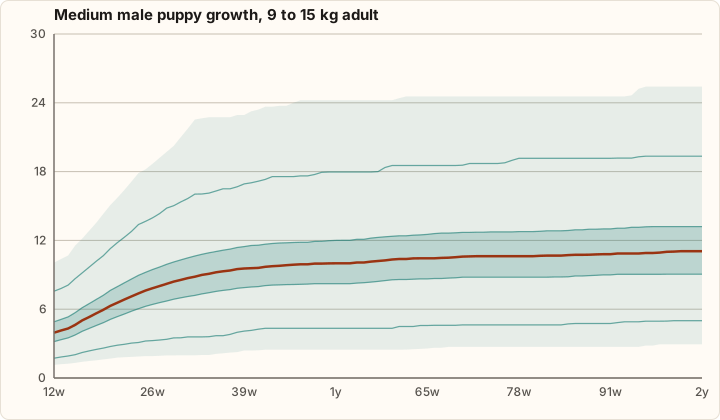
- Our own method has a measured range, not a guarantee. At 12 to 15 weeks it holds eight puppies in ten within about a quarter below to a third above the estimate. At 12 weeks that range is wide enough to contain the 52-week rule’s answer for the largest puppies, which is the one age the two methods are hard to separate.
- The reference stops at 40 kg predicted adult weight. True giant breeds are not in it, and they are exactly the dogs the linear rule treats worst.
If you want the method rather than the shortcut, the puppy weight calculator is the flagship version of it, and we wrote up where this formula came from and what it was originally for. For how accurate the curve-based method is, we measured it against half a million real outcomes.
Frequently asked questions
Is there an official AKC puppy weight calculator?
No. The American Kennel Club publishes breed standards containing adult height and weight ranges, and its expert-advice articles put these rules of thumb into wide circulation. It does not run a weight prediction calculator, and this site is not affiliated with or endorsed by the AKC.
This page runs the formulas the AKC popularised and shows you what they produce. The name describes the formula, not the publisher of the page.
What is the AKC puppy weight formula?
The one you will meet first is the 52-week rule: adult weight = (current weight ÷ age in weeks) × 52. It projects the puppy's average weekly gain across a full year.
Two age-specific variants circulate alongside it: double the weight at four months, and quadruple the weight at six weeks. All three are the same idea, which is to take one measurement and multiply it by a constant.
How accurate is the AKC puppy weight formula?
We measured it against our growth reference rather than guessing. For a median male puppy at 12 weeks the 52-week rule predicts too much by 35 to 76 percent depending on size. The overshoot narrows with age but does not disappear until week 46 to 49.
By that age a median puppy is already 88 to 93 percent of its adult weight, so the only moment the rule is accurate is the moment it has nothing left to tell you.
Why does the formula overshoot so badly for small dogs?
Because it assumes growth is a straight line and small dogs finish first. A toy puppy is already close to half its adult weight at four months, so multiplying by 52/17 projects a rate of gain it has largely stopped doing.
That is why the overshoot at 12 weeks runs to 76 percent for a toy puppy against 35 percent for a very large one. The intuition that the rule must be worse for big dogs is the wrong way round.
Does the "double the four-month weight" rule work?
It is the best of the three, and for medium breeds it is genuinely close: against our reference it lands 4 percent under for a median medium male at 17 weeks.
Its problem is that people apply it to every dog. The same rule lands 13 percent under for a very large male and 4 percent over for a toy male, because those two finish growing at opposite ends of the timetable.
Can you check the "quadruple the six-week weight" rule?
No, and we would rather say so than publish a number we cannot support. Our growth reference begins at 12 weeks, because the open dataset it is derived from does not cover younger puppies reliably. A six-week weight sits before the data starts.
The calculator will still run that rule if your puppy is around six weeks old, and the card says plainly that we cannot check the answer against anything.
Should I use the AKC formula or a growth curve?
Use the formula for a number in your head at the park. Use a growth curve for anything you are going to spend money on: crate size, harness size, an adult food, a year of feeding, or whether the dog will fit in the car.
The curve method reads the centile your puppy is tracking and follows it to maturity, which accounts for both the S-shape of growth and how that shape differs by size. That is what our own weight calculator does, linked below, and its accuracy is measured against 579,135 real outcomes.
Why does the calculator ask for sex and size if the formula ignores them?
Because the comparison needs them. The AKC rules take a weight and an age and nothing else, which is exactly the simplification being examined. To show you what a puppy of your dog’s size and sex actually does, the growth reference needs to know which of its ten curves to read.
Leave the size dropdown on "work it out for me" if you do not know. We infer the most likely category from the weight and age you entered.
My breeder used this formula. Are they wrong?
Not wrong so much as using a shortcut past the range it holds up in. The formula was never meant to be precise and it is repeated far beyond where it works, which is a different thing from being a fraud.
If the number matters, weigh the puppy again in a fortnight and plot both readings. A trajectory over time beats any single-measurement formula, including ours.
Where do the comparison figures come from?
From the growth reference this site is built on, derived from the open dataset published alongside Salt and colleagues in PLOS ONE in 2017: roughly 15 million bodyweight records from Banfield Pet Hospitals, released under a Creative Commons Attribution licence.
Every error figure on this page is computed from that reference at build time rather than typed in, and a test re-derives the published table from the same functions so the two cannot drift apart. The full method is on the methodology page.
Related calculators
References
Every figure on this page comes from one of these. Full details, including what each source is used for, are on our sources page.
- American Kennel Club. Official Breed Standards.
- Salt C, Morris PJ, German AJ, Wilson D, Lund EM, Cole TJ, Butterwick RF. Growth standard charts for monitoring bodyweight in dogs of different sizes. PLOS ONE. 2017;12(9):e0182064. doi:10.1371/journal.pone.0182064
- Correction: Growth standard charts for monitoring bodyweight in dogs of different sizes. PLOS ONE. 2024;19(11):e0314711. doi:10.1371/journal.pone.0314711
- WALTHAM Petcare Science Institute. Puppy Growth Charts.