Puppy to dog weight calculator
Converting a puppy weight into an adult dog weight is not a multiplication. The right conversion depends on how far along the growth curve your puppy already is, which depends on how big it is going to be. This does that properly, and the table below shows the conversion at every age so you can check it by eye.
Estimate your puppy’s adult weight
Estimated adult weight
—
- Growth centile today
- —
- Size category
- —
- Percent of adult weight reached
- —
- The old “weight ÷ age × 52” rule says
- —
How to use the converter
- Find your puppy today. Enter the current weight, the age in weeks, and the sex. These three between them fix which growth curve your puppy is on.
- Set the adult size band. Pick it if you know the breed. Leave it on automatic if you do not, and we work backwards from the weight and age you gave.
- Read the conversion. The result converts today's puppy weight into an adult weight range by following the growth curve your puppy is tracking rather than multiplying by a constant.
- Check it against the table. The reference table further down shows the same conversion for a median puppy at every age, so you can sanity check the answer by eye.
What each value means
- Estimated adult weight
- What today’s puppy weight converts to once your dog has finished growing.
- Likely range
- The band covering eight puppies in ten. Wider for young puppies, narrower as they grow, because that is what the measured outcomes show.
- Percent of adult weight reached
- How much of the conversion has already happened. This is the number that makes the whole thing intuitive.
- Growth centile
- The line your puppy is tracking. The conversion follows this line forward rather than applying a fixed multiplier.
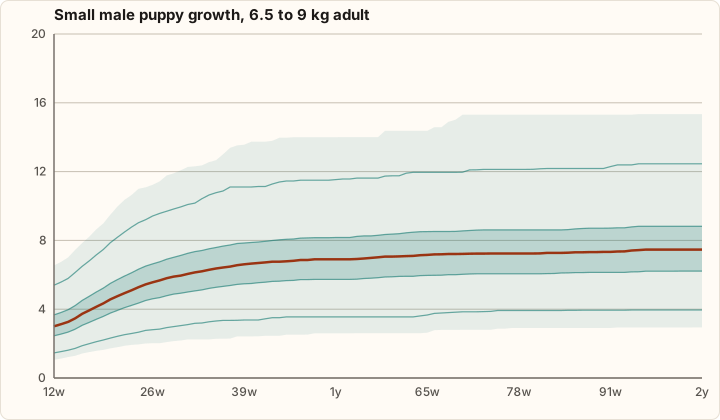
Reference values: puppy weight to adult weight
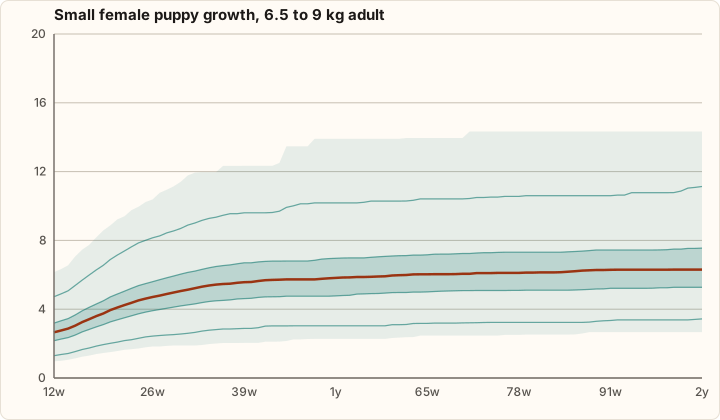
Each table shows what a median puppy of that size band weighs at each age, and what it converts to as an adult. If your puppy is heavier or lighter than the median at its age, it will usually stay proportionally heavier or lighter as an adult.
Weights in kilograms. Rows before 12 weeks are outside the reference and left blank rather than estimated.
Toy (under 6.5 kg adult)
| Puppy age | Male puppy | Female puppy | Percent of adult | Converts to (M / F) |
|---|---|---|---|---|
| 8 weeks | — | — | — | 4.5 / 3.8 |
| 12 weeks | 1.82 | 1.62 | 41% | 4.5 / 3.8 |
| 16 weeks | 2.22 | 1.97 | 50% | 4.5 / 3.8 |
| 20 weeks | 2.68 | 2.35 | 60% | 4.5 / 3.8 |
| 26 weeks | 3.20 | 2.75 | 72% | 4.5 / 3.8 |
| 34 weeks | 3.65 | 3.08 | 82% | 4.5 / 3.8 |
| 43 weeks | 3.94 | 3.33 | 88% | 4.5 / 3.8 |
| 52 weeks | 4.07 | 3.41 | 91% | 4.5 / 3.8 |
Small (6.5 to 9 kg adult)
| Puppy age | Male puppy | Female puppy | Percent of adult | Converts to (M / F) |
|---|---|---|---|---|
| 8 weeks | — | — | — | 7.5 / 6.3 |
| 12 weeks | 3.00 | 2.66 | 40% | 7.5 / 6.3 |
| 16 weeks | 3.73 | 3.25 | 50% | 7.5 / 6.3 |
| 20 weeks | 4.57 | 3.95 | 61% | 7.5 / 6.3 |
| 26 weeks | 5.56 | 4.71 | 75% | 7.5 / 6.3 |
| 34 weeks | 6.29 | 5.38 | 84% | 7.5 / 6.3 |
| 43 weeks | 6.76 | 5.71 | 91% | 7.5 / 6.3 |
| 52 weeks | 6.90 | 5.82 | 92% | 7.5 / 6.3 |
Medium (9 to 15 kg adult)
| Puppy age | Male puppy | Female puppy | Percent of adult | Converts to (M / F) |
|---|---|---|---|---|
| 8 weeks | — | — | — | 11.1 / 9.4 |
| 12 weeks | 3.95 | 3.47 | 36% | 11.1 / 9.4 |
| 16 weeks | 5.02 | 4.35 | 45% | 11.1 / 9.4 |
| 20 weeks | 6.29 | 5.40 | 57% | 11.1 / 9.4 |
| 26 weeks | 7.83 | 6.61 | 71% | 11.1 / 9.4 |
| 34 weeks | 9.08 | 7.59 | 82% | 11.1 / 9.4 |
| 43 weeks | 9.75 | 8.19 | 88% | 11.1 / 9.4 |
| 52 weeks | 10.0 | 8.43 | 90% | 11.1 / 9.4 |
Large (15 to 30 kg adult)
| Puppy age | Male puppy | Female puppy | Percent of adult | Converts to (M / F) |
|---|---|---|---|---|
| 8 weeks | — | — | — | 27.7 / 23.4 |
| 12 weeks | 8.68 | 7.80 | 31% | 27.7 / 23.4 |
| 16 weeks | 11.4 | 10.2 | 41% | 27.7 / 23.4 |
| 20 weeks | 14.7 | 13.0 | 53% | 27.7 / 23.4 |
| 26 weeks | 19.2 | 16.5 | 69% | 27.7 / 23.4 |
| 34 weeks | 23.3 | 19.6 | 84% | 27.7 / 23.4 |
| 43 weeks | 25.2 | 21.4 | 91% | 27.7 / 23.4 |
| 52 weeks | 25.8 | 21.9 | 93% | 27.7 / 23.4 |
Very large (30 to 40 kg adult)
| Puppy age | Male puppy | Female puppy | Percent of adult | Converts to (M / F) |
|---|---|---|---|---|
| 8 weeks | — | — | — | 33.7 / 28.9 |
| 12 weeks | 10.5 | 9.34 | 31% | 33.7 / 28.9 |
| 16 weeks | 13.7 | 12.1 | 41% | 33.7 / 28.9 |
| 20 weeks | 17.6 | 15.4 | 52% | 33.7 / 28.9 |
| 26 weeks | 22.9 | 19.7 | 68% | 33.7 / 28.9 |
| 34 weeks | 27.7 | 23.6 | 82% | 33.7 / 28.9 |
| 43 weeks | 30.5 | 25.9 | 91% | 33.7 / 28.9 |
| 52 weeks | 31.3 | 26.9 | 93% | 33.7 / 28.9 |
Example calculations
Three conversions run through the converter above, with the linear rule's answer beside each one so you can see where it holds up and where it falls apart.
A toy female at 16 weeks
2 kg at 16 weeks · female · toy category
3.9 kg as an adult
- Likely range 3.1 to 5.1 kg
- Still to gain: about 1.9 kg
- Linear rule would say 6.5 kg
The narrowest answer on the page: a 2 kg band, because a toy at 16 weeks is most of the way through its growing. It is also where the linear rule does worst of these three, overshooting by 67 percent: the rule keeps projecting as though the steep part were still ahead of her.
A medium male at 20 weeks
7.5 kg at 20 weeks · male · medium category
12.9 kg as an adult
- Likely range 10.5 to 16.3 kg
- Still to gain: about 5.4 kg
- Linear rule would say 19.5 kg
Halfway through the conversion and halfway through the growing. The linear rule is 6.6 kg adrift here, or 51 percent, which is a real difference in food, crate and collar.
A very large male at 12 weeks
11 kg at 12 weeks · male · very large category
36.6 kg as an adult
- Likely range 28.1 to 49.4 kg
- Still to gain: about 25.6 kg
- Linear rule would say 47.7 kg
The widest answer, at 21.3 kg, because 12 weeks is the earliest the reference covers and this puppy has 25.6 kg still to gain. Even here the linear rule overshoots, by 30 percent.
Why you cannot just multiply
The rule everyone repeats is weight divided by age in weeks, times 52. It is easy to do in your head, and that is its only virtue. It assumes a puppy gains weight at a constant rate for its whole first year.
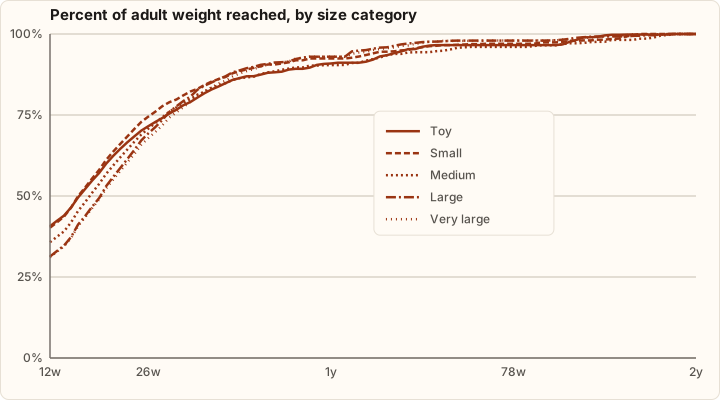
Real growth is an S-curve: slow, then fast, then flattening off, and the rule projects the steepest part of it across the whole year. It overshoots every size of dog, and it overshoots small ones hardest, which is the opposite of the usual assumption: a toy puppy is already most of the way through its growing at four months, so multiplying it up as though the steep part were still ahead is where the rule goes furthest wrong. The examples above show that for three real puppies, and the AKC puppy weight calculator runs the rule on yours with the error measured beside it. The puppy growth chart gives the same curves as tables you can read off directly.
Accuracy and limits
- The reference starts at 12 weeks. Younger conversions are flagged and widened rather than quietly extrapolated.
- It covers adult weights up to 40 kg. Beyond that we say the estimate is rough.
- The table shows medians. Half of healthy puppies weigh more than these figures and half weigh less, so use the puppy weight calculator for your actual puppy.
- Conversions assume steady health. A puppy that is unwell will not track its curve, which is itself the signal worth acting on.
Frequently asked questions
How do you convert a puppy weight to an adult dog weight?
Not by multiplying. The internet rule of dividing weight by age in weeks and multiplying by 52 assumes growth is a straight line, and it is not.
The proper conversion works out which growth centile your puppy sits on today, then follows that same centile forward to two years. A puppy on the 60th centile at 16 weeks will usually still be near the 60th centile as an adult, and that is what makes the conversion work across every size of dog.
What is the puppy to adult weight ratio?
There is no single ratio, and that is the whole problem with the question. Read off our reference: at 16 weeks a toy puppy is around 50 percent of its adult weight, while a very large puppy is around 41 percent.
Use one multiplier for both and you will be badly wrong for at least one of them. The table on this page gives the ratio at each age for each size band.
Can I convert backwards, from a target adult weight to a puppy weight?
Yes, and the table on this page is the tool for it. Find the size band whose adult weight matches your target, then read up the column to see what a median puppy of that band weighs at each age.
Breeders and buyers use this to sanity check whether a puppy is developing in line with what was promised. Treat it as a rough guide: a single puppy can sit well above or below the median and still be perfectly healthy.
Does the conversion work for a puppy under 12 weeks?
Less well, and we say so rather than hiding it. The reference begins at 12 weeks, so for a younger puppy we treat it as 12 weeks old and widen the range to reflect the extra assumption.
An 8 week old puppy is genuinely hard to project from. Re-run it at 12 and again at 16 weeks and watch the answer tighten.
Why does my puppy convert to a different adult weight than the breeder said?
Breeders usually quote the breed average or the size of the parents, which is a reasonable prediction but not a measurement of your individual puppy. Our conversion uses your puppy's actual weight today.
If the two disagree by a lot, check the size band first, since that is the most common cause. If they still disagree, remember a litter spreads out: some puppies genuinely finish above or below what the parents suggest.
How much more will my puppy grow?
The result tells you both the projected adult weight and how far along your puppy already is. As a rough orientation, most dogs are half grown by four to four and a half months and essentially full size somewhere between nine and thirteen months depending on size band.
Bigger dogs take longer, which is why the same puppy weight converts differently depending on the band it belongs to.
Is a heavier puppy always a bigger dog?
Within a size band, largely yes. Across bands, no. A 10 kg puppy could be a nearly grown medium dog or a four month old very large one, and those two finish at completely different weights.
That is why age matters as much as weight, and why the calculator asks for both rather than working off weight alone.
Related calculators
References
Every figure on this page comes from one of these. Full details, including what each source is used for, are on our sources page.