How much food will a puppy eat in its first year?
Food is the biggest recurring cost of a puppy’s first year, and it is the one nobody can quote you a figure for, because it depends on two things: how big your puppy will get, and what is in your bag.
The first of those we can work out. The second is printed on the bag.
Energy first, kilograms second
The honest unit here is calories, because calories need no assumption about your food. Here is what a puppy needs across its first year, integrated month by month over the growth curve rather than assumed flat:
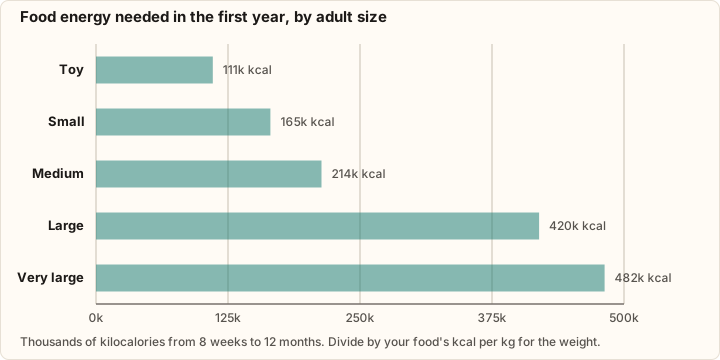
A very large puppy needs roughly four times the energy of a toy one over the same twelve months. That single fact drives the food budget more than brand, more than price per kilogram, more than anything else you might agonise over.
To turn calories into kilograms you need one number: the energy density of your food, in kilocalories per kilogram. AAFCO requires it on the label under a “Calorie Content” heading, so it is there on every bag whatever you buy. Divide the energy figure above by it.
At a food of 3,800 kcal/kg, those totals come out at roughly 29 kg of food for a toy puppy and 127 kg for a very large one across the first year.
Two puppy foods can differ by hundreds of kcal per kilogram. That is why we ask for the number rather than assuming one, and it is also why a food that looks expensive per bag can be cheaper per calorie than one that does not.
The dip at four months
Watch what happens to daily calories partway through:
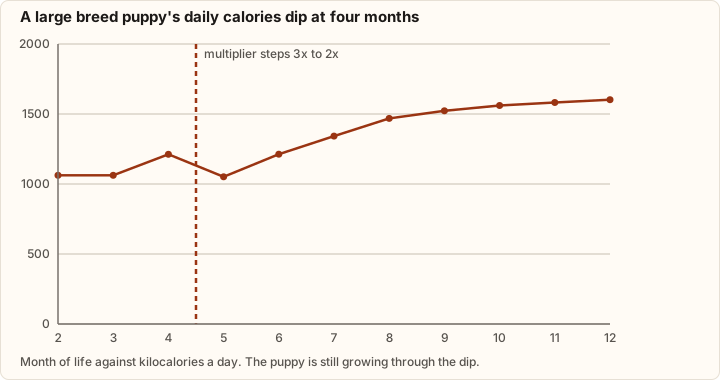
That fall is real and it surprises almost everyone. The Merck Veterinary Manual feeds a growing puppy at three times its resting energy requirement under four months and twice over, and that is a step rather than a gradual taper.
So a puppy crossing four months genuinely needs fewer calories for a while, even though it is still growing. Our worked example, a large breed male at the middle of its category, drops about 13% in daily calories between month four and month five and does not climb back to its month-four figure until month six.
Miss the step and you keep feeding at the three-times rate. That is roughly a third more food than the puppy needs, every day, through the second half of its first year — which is both the commonest way puppies end up overweight and a quiet, continuous waste of money.
The puppy feeding calculator applies the step automatically. The calorie calculator shows the daily figure alone if you want to see the arithmetic.
Why a flat monthly figure is wrong at both ends
Plenty of cost guides quote “about £X a month on food”. For an adult dog that is reasonable. For a puppy it is wrong twice over.
In month three a large breed puppy is eating a fraction of what it will eat in month twelve. Average those and you overstate the early months and understate the late ones, which is exactly backwards from what a budget needs, because the early months are when you are also paying for everything else: the crate, the vaccinations, the classes.
Working it out month by month costs nothing and gets both ends right. That is what the puppy cost calculator does.
Buying whole bags
One small thing worth knowing. The figures above are what your puppy eats. Bags come in fixed sizes, so what you buy rounds up, and the difference is whatever is left in the cupboard on the first birthday.
For a large breed puppy on 12 kg bags that is around ten bags across the year. Not a huge difference, but it is the sort of thing that makes a carefully built budget miss by one bag and feel wrong.
What this does not cover
Treats and training rewards are not in these figures, and during the socialisation and training months they are not trivial. The usual rule is to keep treats under about a tenth of daily calories and to subtract them from meals rather than adding them on top, which keeps the arithmetic above roughly intact.
Neither is anything to do with illness. Synchrony’s 2025 study of 4,861 US pet owners found more than two thirds of dog owners had faced an unexpected bill over $250, and that is the cost that actually breaks a budget. Food is the predictable part, which is precisely why it is worth predicting properly.
Related guides
- How much to feed a puppy, by age and weight The veterinary formula behind puppy portions, why the amount drops at four months, and how to convert calories to cups. Work out your portions now.
- Puppy feeding chart by weight and age Daily calorie tables for puppies from 2 to 40 kg at every age, with meal counts and how to convert to cups from your own bag. Find your puppy's row.
- Switching from puppy food to adult food When to make the switch by size, how to transition over a week, and why timing it to growth beats timing it to a birthday. Plan the switch now.
Calculators for this
References
Every figure on this page comes from one of these. Full details, including what each source is used for, are on our sources page.
- Merck Veterinary Manual. Nutritional Requirements of Small Animals. Management and Nutrition.
- Association of American Feed Control Officials. Calories, Understanding Pet Food.
- Salt C, Morris PJ, German AJ, Wilson D, Lund EM, Cole TJ, Butterwick RF. Growth standard charts for monitoring bodyweight in dogs of different sizes. PLOS ONE. 2017;12(9):e0182064. doi:10.1371/journal.pone.0182064
- Synchrony. 2025 Pet Lifetime of Care Study. Survey of 4,861 US pet owners conducted 31 January to 22 February 2025.