Puppy calorie calculator
The energy maths on its own, with the working shown. Resting energy requirement from bodyweight, a growth multiplier on top, and a treat allowance taken out rather than added on. If you want portions in cups instead, use the feeding calculator.
Daily calories for your puppy
Total daily calories
—
- From meals
- —
- Treat allowance
- —
- Resting energy (RER)
- —
- Growth multiplier
- —
| Formula | Valid for | RER |
|---|
How to use the calculator
- Enter weight and age. Weight drives the resting energy requirement; age decides the growth multiplier applied on top of it.
- Choose a treat allowance. Treats come out of the daily total, not on top of it. Ten percent is the usual ceiling.
- Read the meal figure, not the total. The meal figure is what your puppy's food needs to deliver once treats are accounted for.
- Convert to a portion. Divide by the calories per cup or per kilogram printed on your bag. The feeding calculator does this for you.
The formula, shown
RER = 70 × (bodyweight in kg)0.75
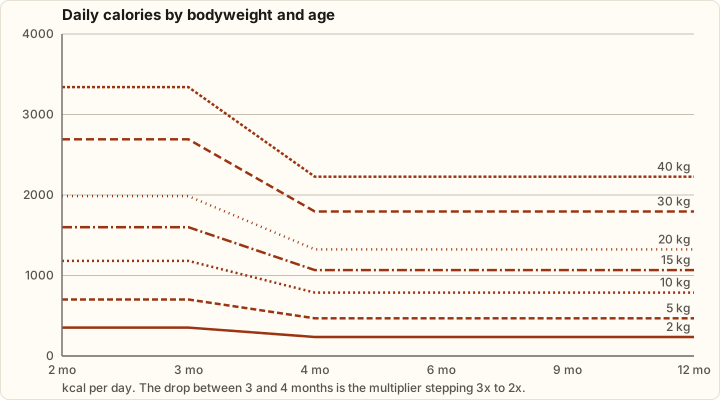
daily kcal = RER × 3 (under 4 months)
daily kcal = RER × 2 (4 months and over)
There is a second published form, RER = 30 × kg + 70, which is easier to do in your head. It is explicitly valid only between 2 and 45 kg. We apply it only inside that range and show it beside the exponential result so you can see how closely the two agree for your puppy.
What each value means
- Resting energy requirement (RER)
- What your puppy would burn at complete rest. The base everything else is built on.
- Growth multiplier
- Three times RER under four months, twice after. It already includes normal puppy activity, which is why we do not add a separate activity factor on top.
- Total daily calories
- RER multiplied by the growth factor. This is the whole calculation.
- From meals
- The total minus the treat allowance. This is what your puppy’s food needs to deliver.
Example calculations
Four puppies through the same dailyEnergy call the calculator makes. The middle two are the same weight two months apart, which is the comparison worth sitting with.
A 2.5 kg puppy at 3 months
2.5 kg · 3 months old
418 kcal a day
- Resting requirement 139 kcal
- Growth multiplier 3x, because it is under four months
- Linear cross-check 145 kcal
Small puppies eat far more than their size suggests, because the resting requirement scales with weight to the power of three quarters rather than with weight itself.
A 12 kg puppy at 3 months
12 kg · 3 months old
1354 kcal a day
- Resting requirement 451 kcal
- Growth multiplier 3x
- Under four months, so the higher multiplier applies
Read this card against the next one. They are the same puppy weight, two months apart.
The same 12 kg at 5 months
12 kg · 5 months old
903 kcal a day
- Resting requirement 451 kcal, unchanged
- Growth multiplier 2x, stepped down
- 451 kcal a day less than at three months
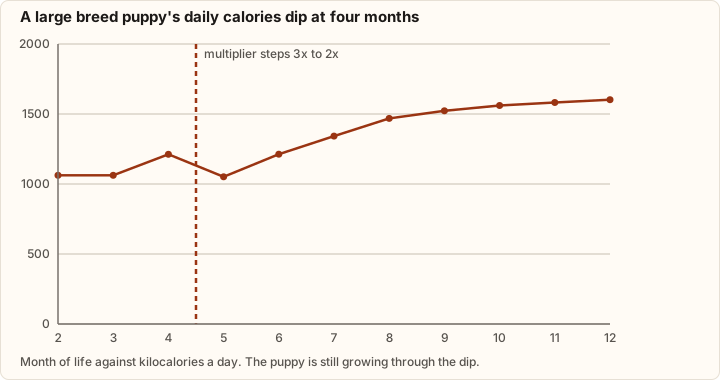
Nothing about the puppy changed except its age. At four months the multiplier steps from 3x to 2x in one move rather than tapering, so the same dog on the same scales needs 451 fewer kilocalories a day, a drop of 33 percent.
A 28 kg puppy at 9 months
28 kg · 9 months old
1704 kcal a day
- Resting requirement 852 kcal
- Growth multiplier 2x
- Linear cross-check 910 kcal
A large adolescent still on the growth multiplier. This is where overfeeding does the most harm, because excess growth rate is itself a risk factor for large breed joint disease.
Reference values
| Weight | RER (exponential) | RER (linear) | Under 4 months | 4 months and over |
|---|---|---|---|---|
| 1 kg | 70 kcal | outside range | 210 kcal | 140 kcal |
| 2 kg | 118 kcal | 130 kcal | 353 kcal | 235 kcal |
| 5 kg | 234 kcal | 220 kcal | 702 kcal | 468 kcal |
| 10 kg | 394 kcal | 370 kcal | 1181 kcal | 787 kcal |
| 15 kg | 534 kcal | 520 kcal | 1601 kcal | 1067 kcal |
| 20 kg | 662 kcal | 670 kcal | 1986 kcal | 1324 kcal |
| 30 kg | 897 kcal | 970 kcal | 2692 kcal | 1795 kcal |
| 40 kg | 1113 kcal | 1270 kcal | 3340 kcal | 2227 kcal |
Notice where the linear column says “outside range”. Below 2 kg and above 45 kg the linear formula is not published as valid, and stretching it is how calculators produce confident nonsense for very small and very large dogs.
Where treats fit
Treats belong inside the daily total, not on top of it. The usual guidance is to keep them under about ten percent of daily calories so the rest comes from a complete and balanced food that is actually formulated for growth.
This matters most during training, when a puppy can easily take fifty small treats in a day. Take that allowance out of the meal portions rather than pretending it does not exist.
Accuracy and limits
- A starting point, not a prescription. Published energy requirements carry real individual variation, which is why the guidance is to calculate then adjust.
- Body condition is the tiebreaker. Ribs easily felt under a thin layer of fat, waist visible from above.
- Recalculate as your puppy grows, and expect a sharp drop at four months. Plotting weight on the growth tracker shows when the figure is out of date.
- Illness changes everything. A puppy recovering from surgery or fighting an infection has different needs and should be on a vet’s plan.
Frequently asked questions
How many calories does a puppy need per day?
Start from the resting energy requirement, RER = 70 x (bodyweight in kg)^0.75, then apply a growth multiplier: three times RER under four months, twice RER from four months.
A 10 kg puppy has an RER of about 394 kcal, so roughly 1,180 kcal a day at three months and about 790 at six months. Growing is expensive, and it gets less expensive quite suddenly.
Why are there two different RER formulas?
The Merck Veterinary Manual publishes both. The exponential form, 70 x kg^0.75, is the general one and applies at any bodyweight. The linear form, 30 x kg + 70, is an easier approximation but is explicitly restricted to dogs between 2 and 45 kg.
We use the exponential form throughout and show the linear one alongside it when your puppy is inside its valid range. Applying the linear formula outside 2 to 45 kg is a common way to produce a confidently wrong number.
Why does the calorie need drop at four months?
Because the multiplier steps from 3 x RER to 2 x RER. It is a published step change rather than a gradual taper.
In practice this means a puppy that keeps eating its three-month portion at seven months is getting about a third more than it needs. Combined with growth slowing at the same time, this is one of the most common routes to an overweight adolescent dog.
Do treats count towards the total?
Yes, and they should come out of it rather than be added on top. The usual guidance is to keep treats under about ten percent of daily calories so that the rest comes from a complete and balanced food.
If you are doing a lot of training, take the treat calories out of the meal portions. Training treats add up much faster than people expect.
Should I adjust for how active my puppy is?
The published growth multipliers already fold in normal puppy activity, which is considerable. We do not layer an extra activity factor on top, because doing so would double-count it.
Individual variation is real, but the honest way to handle it is to start from the calculated figure and adjust based on body condition over a few weeks, not to guess a multiplier at the outset.
How do I turn calories into cups?
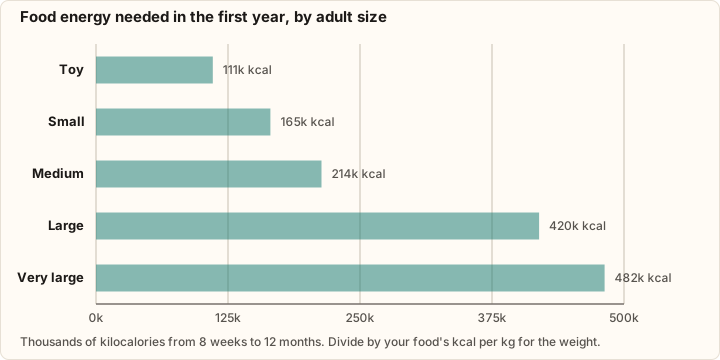
Divide the daily calories by the calories per cup printed on your bag, usually near the guaranteed analysis as “kcal/cup”.
Our feeding calculator does this and splits the result into meals. We never substitute an average density, because two puppy foods can differ by 150 kcal a cup, which changes the portion by nearly half.
Is a calorie target better than the chart on the bag?
They answer slightly different questions and will usually disagree a little. Bag charts are built around a breed-average puppy and tend to be generous.
A calculated figure is specific to your puppy's weight and age, which makes it a better starting point. Neither can see your dog, so body condition remains the tiebreaker.
Does neutering change the calorie requirement?
For adult dogs, yes: neutered dogs generally need fewer calories, and standard maintenance factors reflect that.
For a growing puppy the growth multiplier dominates, so the effect is smaller during this stage. It becomes a much bigger deal at the point you switch to adult feeding, which is worth raising with your vet at the time.
Related calculators
References
Every figure on this page comes from one of these. Full details, including what each source is used for, are on our sources page.