Puppy raw food calculator
Works out the daily portion as a share of your puppy’s current weight, then splits it into muscle, bone and organ. It also tells you where this method’s evidence is weaker than the calorie-based alternative, which most raw feeding calculators do not.
Daily raw portion and the 80/10/10 split
Daily raw portion
—
| Component | Share | Amount |
|---|
How to use the calculator
- Weigh your puppy today. Raw portions are a percentage of current bodyweight, not adult weight, so a stale figure gives the wrong portion.
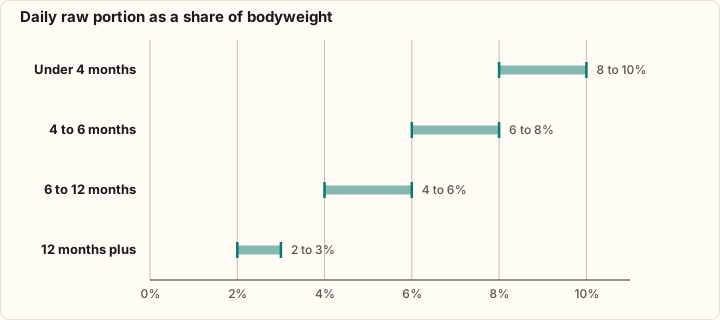
- Enter the age in months. The percentage falls as your puppy grows, from 8 to 10 percent under four months down to 2 to 3 percent as an adult.
- Start in the middle of the range. The band is wide because activity and metabolism vary. The midpoint is a sensible starting point.
- Split it 80/10/10. Eighty percent muscle meat, ten percent raw edible bone, ten percent secreting organ of which at least half is liver.
- Adjust on body condition, and recalculate often. Ribs easily felt under a thin layer of fat. And because the portion tracks current weight, it changes every time your puppy grows.
What each value means
- Daily raw portion
- The total weight of food per day, as a percentage of your puppy’s current bodyweight. It changes every time your puppy grows.
- Muscle meat, 80 percent
- The bulk of the diet. Heart and gizzard count here, despite being organs.
- Raw edible bone, 10 percent
- The calcium source, which is why this share is load-bearing rather than decorative. Soft enough to eat and digest, never cooked.
- Secreting organ, 10 percent
- Liver and other secreting organs such as kidney and spleen. At least half should be liver.
Percentage by age
| Age | Percentage of bodyweight |
|---|---|
| Under 4 months | 8 to 10% |
| 4 to 6 months | 6 to 8% |
| 6 to 12 months | 4 to 6% |
| 12 months and over | 2 to 3% |
Reference values
Daily portions in grams, at the midpoint of each age band.
| Puppy weight | Under 4 months | 4 to 6 months | 6 to 12 months | 12 months and over |
|---|---|---|---|---|
| 2 kg | 160 to 200 g | 120 to 160 g | 80 to 120 g | 40 to 60 g |
| 5 kg | 400 to 500 g | 300 to 400 g | 200 to 300 g | 100 to 150 g |
| 10 kg | 800 to 1000 g | 600 to 800 g | 400 to 600 g | 200 to 300 g |
| 15 kg | 1200 to 1500 g | 900 to 1200 g | 600 to 900 g | 300 to 450 g |
| 20 kg | 1600 to 2000 g | 1200 to 1600 g | 800 to 1200 g | 400 to 600 g |
| 30 kg | 2400 to 3000 g | 1800 to 2400 g | 1200 to 1800 g | 600 to 900 g |
Example calculations
Three puppies through the same rawDaily call the calculator makes, with the 80/10/10 split shown in grams because that is what a kitchen scale reads.
4 kg at 3 months
4 kg · 3 months · 8 to 10% band
360 g a day
- Range 320 to 400 g
- Muscle meat 288 g · bone 36 g
- Organ 36 g, of which liver 18 g
The heaviest phase, proportionally. Under four months a puppy eats close to a tenth of its own bodyweight a day, and because it is gaining weight weekly the portion needs recalculating far more often than owners expect.
12 kg at 5 months
12 kg · 5 months · 6 to 8% band
840 g a day
- Range 720 to 960 g
- Muscle meat 672 g · bone 84 g
- Organ 84 g, of which liver 42 g
The middle band. Note the portion in grams has gone up while the percentage has come down: the puppy is heavier, so a smaller share of a bigger number is still more food.
24 kg at 11 months
24 kg · 11 months · 4 to 6% band
1200 g a day
- Range 960 to 1440 g
- Muscle meat 960 g · bone 120 g
- Organ 120 g, of which liver 60 g
Approaching the adult band. Feeding an adolescent at the puppy percentage is the most common way raw feeders overfeed, because the number that changed is the one nobody re-reads.
Where this method's evidence is weaker
Worth being straight about. The percentage bands on this page are raw-feeding consensus, repeated consistently across published feeding guides, rather than a finding from peer-reviewed research.
The energy formulas on our feeding calculator come from the Merck Veterinary Manual and rest on a much stronger base. Feeding by percentage persists because raw ingredients rarely carry a calorie label, not because it is the better-founded method.
Why growing puppies are the hard case
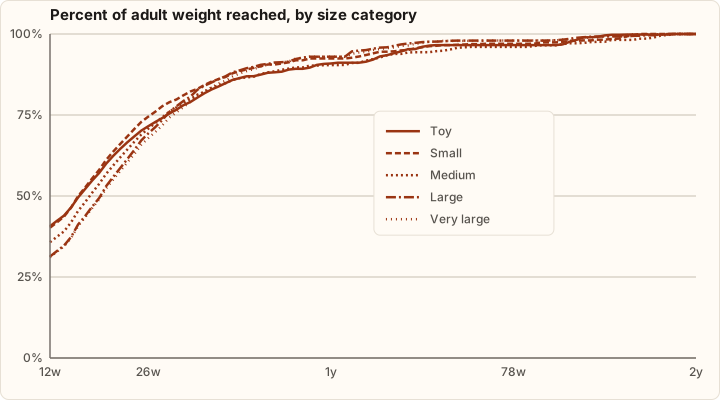
An adult dog on a slightly imbalanced raw diet has considerable slack. A growing puppy does not. Skeletal development needs calcium and phosphorus in the right ratio, and too much calcium is as damaging as too little.
Puppies from weaning to around six months absorb calcium passively and cannot down-regulate when intake is high, which is exactly why large-breed puppy foods cap it deliberately. In a raw diet, bone is the calcium source, so getting the bone percentage wrong is not a rounding error.
If you are feeding a large or very large breed puppy raw, plan the diet with a vet or a qualified veterinary nutritionist. That is a genuine recommendation rather than a liability sentence.
Accuracy and limits
- Percentages are consensus, not research. Stated plainly above.
- Portions track current weight, so they change constantly during the growth phase.
- Balance matters more than portion size for a growing puppy, and this calculator sizes the portion rather than validating the recipe.
- Cooked bone is never safe. Cooking makes it brittle and prone to splintering.
- Raw diets carry handling risks for the household as well as the dog. Standard food hygiene applies.
Frequently asked questions
How much raw food should I feed my puppy?
As a share of current bodyweight, falling with age: roughly 8 to 10 percent a day under four months, 6 to 8 percent from four to six months, 4 to 6 percent from six to twelve months, and 2 to 3 percent as an adult.
The critical detail is that this tracks current weight, not adult weight. A growing puppy needs the sum recalculating every couple of weeks.
What is the 80/10/10 ratio?
Eighty percent muscle meat, ten percent raw edible bone, and ten percent secreting organ, of which at least half should be liver.
A common mistake: heart and gizzard are organs anatomically but count as muscle meat for this purpose. Only secreting organs such as liver, kidney and spleen count towards the ten percent.
Is raw feeding safe for a growing puppy?
It can be done, and it is the hardest case to get right. Growing puppies need calcium and phosphorus balanced for skeletal development, and too much calcium is as damaging as too little, particularly in large breeds who cannot down-regulate absorption before about six months.
Bone provides the calcium in a raw diet, which makes the bone percentage load-bearing rather than decorative. This is genuinely worth planning with a vet or a qualified veterinary nutritionist rather than improvising from a forum post.
How accurate are these percentages?
Less well evidenced than the rest of this site, and we would rather say so. The percentage bands are raw-feeding consensus, repeated consistently across published feeding guides, rather than a finding from peer-reviewed research.
By contrast the energy formulas on our feeding calculator come from the Merck Veterinary Manual and have a much stronger basis. If you want the better-evidenced route, feed to calories.
Should I feed by percentage or by calories?
Calories are the more defensible method, because energy requirements are properly researched and a percentage of bodyweight is a proxy for them.
Percentages persist because they are practical: raw ingredients rarely carry a calorie label. If you can work out the energy density of what you are feeding, the calorie calculator will give you a better-founded target.
What about bone for a small puppy?
Size the bone to the puppy. Raw edible bone means bone soft enough to be eaten and digested, such as chicken wings or necks for a small dog, not weight-bearing bones from large animals, which can fracture teeth.
Cooked bone is never safe for any dog: cooking makes it brittle and prone to splintering.
How many meals should the raw portion be split into?
The same schedule as any other food: four meals a day under twelve weeks, three from twelve weeks to about six months, then two. Toy and small breeds stay on three for longer.
Splitting the daily amount is about digestion and blood sugar, not about what the food is made of.
Do I need supplements on top?
A properly balanced raw diet including bone and organ should not need a calcium supplement, and adding one is actively risky for a large breed puppy rather than merely wasteful.
Whether anything else is needed depends on what you are actually feeding, which is a question for a nutritionist who can see your recipe rather than a calculator.
Related calculators
References
Every figure on this page comes from one of these. Full details, including what each source is used for, are on our sources page.