How to weigh a puppy correctly at home
Every growth prediction, every centile, every chart on this site rests on one number: what your puppy actually weighs. It is worth thirty seconds to get it right.
The bathroom scale method
The standard approach, and the one that works for almost everyone:
- Weigh yourself on ordinary bathroom scales. Note the number.
- Pick up your puppy and weigh yourself again, holding it still.
- Subtract. The difference is your puppy’s weight.
That is it. No special equipment, and accurate enough for the job.
Does the subtraction introduce too much error?
Less than people fear. Digital bathroom scales typically resolve to 100 grams. On a 5 kg puppy, a 100 gram error is 2 percent, which is far smaller than the natural prediction range of any growth calculator, and far smaller than the week-to-week variation in a growing puppy.
For a very small puppy under about 2 kg, that same 100 grams is 5 percent and starts to matter. Kitchen scales with a bowl or a towel-lined box are better at that size, and most resolve to 1 gram.
Getting a consistent number
Consistency matters more than precision. You are tracking a line over time, so what you want is for each reading to be comparable with the last.
- Same scales every time. Two sets of scales can disagree by a few hundred grams and neither is wrong. Switching between them puts a fake step in your chart.
- Same time of day. Morning, before breakfast, is easy to remember and avoids the weight of a full stomach.
- Before a meal, not after. A puppy can drink and eat several percent of its body weight in one sitting.
- After a toilet trip if you can manage the timing.
- On a hard floor. Bathroom scales read high on carpet, sometimes by a lot. Move them onto tile or boards.
Handling a puppy that will not sit still
Wriggling is the main practical problem, and most digital scales cope badly with a moving load.
- Hold the puppy against your chest with both arms, so it is supported and less inclined to squirm.
- Wait for the reading to settle rather than taking the first number that flashes up.
- Use a treat to get a couple of seconds of stillness.
- Try after a nap or a walk, when your puppy is naturally calmer.
- If your scales have a hold or lock function, use it. Many do.
For a genuinely uncooperative puppy, put it in a carrier, weigh the loaded carrier, then weigh the carrier alone and subtract.
How often to weigh
| Age | How often |
|---|---|
| Under 12 weeks | Weekly, or twice weekly for very small breeds |
| 12 to 16 weeks | Weekly |
| 4 to 6 months | Every two weeks |
| 6 to 12 months | Monthly |
| Over 12 months | Every few months, or at vet visits |
More often than this is not more informative. Day-to-day noise from meals, water and toilet timing will swamp real growth over a 24 hour window, and watching that noise tends to cause worry rather than insight.
Write it down
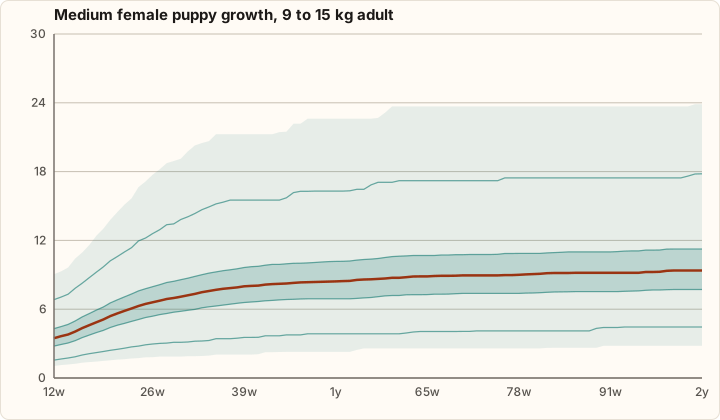
A weight you did not record is a weight you will misremember. Keep a note on your phone, or better, put the figures straight into the growth tracker, which plots them against the reference curves and tells you whether the line is steady.
Two columns is all you need: age in weeks, and weight.
Mistakes that quietly ruin a growth chart
- Mixing units. Entering pounds into a field expecting kilograms produces an absurd answer. Every tool here has an explicit unit toggle for this reason.
- Guessing the age. Common with rescue puppies. Age drives the whole calculation, and an error of two weeks matters a great deal at 12 weeks old.
- Using the breeder’s last weight. Fine as a historical data point, useless as “today”. Puppies change fast.
- Rounding hard. Recording 5 kg when the scales said 5.4 throws away real signal.
- Only weighing when worried. You cannot see a trend from readings taken at moments of concern. Routine readings are what make the worrying ones interpretable.
What the number is actually for
Two jobs, and they are different.
Predicting adult size. One good weight and an accurate age is enough to run the puppy weight calculator.
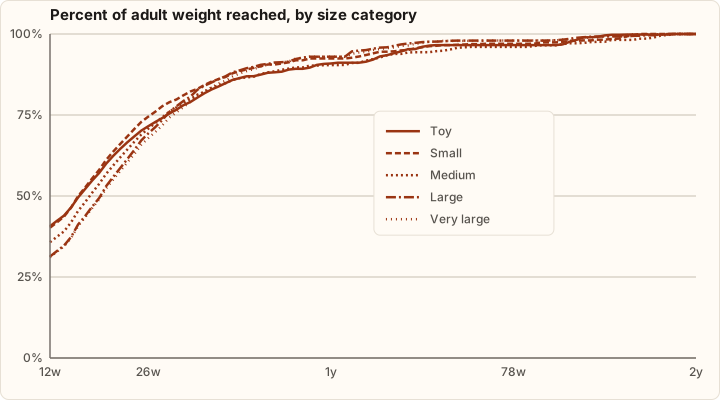
Checking growth is on track. This needs a series, not a snapshot. A puppy tracking steadily along any centile is growing normally. A puppy crossing downward through several centile lines is worth a vet visit even if every individual reading looks fine, which is covered in are puppy weight calculators accurate.
When to bring the numbers to a vet
Take your figures with you if your puppy has lost weight, has not gained anything in two weeks, or has dropped across two or more centile lines. A dated list of weights is genuinely useful clinical information and takes seconds to produce if you have been keeping it.
Weight is not the same as body condition. Your vet checks ribs, waist and fat cover by hand, which tells them things a number never will.
Related guides
- Are puppy weight calculators accurate? How close puppy weight predictors really get, measured against 579,135 real outcomes, and what the honest margin of error is at each age. See the numbers.
- How big will my puppy get? What actually predicts your puppy's adult size, which rules of thumb work, and which quietly fail. Read this before you trust any single number.
- Puppy growth stages from birth to adulthood What happens at each stage of a puppy's development, when the fast growth really is, and what to expect month by month. See where your puppy is now.
Calculators for this
References
Every figure on this page comes from one of these. Full details, including what each source is used for, are on our sources page.