The puppy socialisation window
Almost everything else on this site describes something you can catch up on later. This is the exception. The socialisation window has a deadline, and it does not extend.
What it is
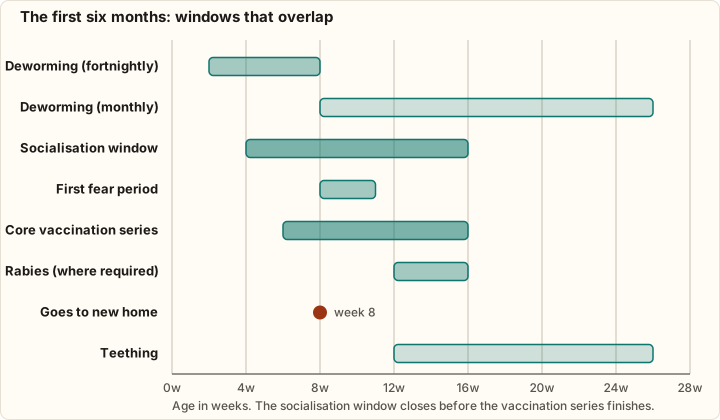
Roughly 4 to 16 weeks, with the most sensitive part earlier in that range.
During it, a puppy is unusually receptive to deciding what counts as normal. Sights, sounds, surfaces, people, animals and handling that a puppy meets calmly during this period are far more likely to be unremarkable to it as an adult. Things it never encounters can become frightening later, and unpicking that takes far more work than preventing it would have.
The awkward arithmetic
Here is the problem in one line: puppies go home at 8 weeks, and the core vaccination series does not finish until after 16 weeks.
The window is open for that entire gap. Keeping a puppy completely indoors until fully vaccinated protects it from infectious disease and costs it the single most important behavioural period of its life. Behavioural problems, not infectious disease, are a leading reason dogs are given up.
Neither risk is imaginary, which is why the sensible answer is not to pick one and ignore the other. Ask your vet how to socialise safely in your area, because local disease risk genuinely varies and they know it.
Socialising before vaccinations finish
Ways to get exposure without putting a puppy on unknown ground:
- Carry your puppy to busy places. Traffic, crowds, buggies, wheelchairs, umbrellas. It costs nothing and the puppy is off the floor.
- Known, vaccinated, healthy dogs in private gardens, rather than public parks.
- Well-run puppy classes that require proof of vaccination and clean their floors.
- Visitors to your home, of varied ages and appearances.
- Household exposure: hoover, washing machine, doorbell, hairdryer, hats, umbrellas, walking sticks.
- Handling practice: paws, ears, mouth, tail, brief restraint. This pays off at every vet visit for the rest of the dog’s life.
- Surfaces: tile, gravel, grating, carpet, wet grass, stairs.
- Car journeys, short and frequent, so the car does not only mean the vet.
Quality beats quantity, by a distance
The single most common mistake is treating this as a checklist to be completed at volume.
A puppy that is overwhelmed is not learning that the world is fine; it is learning the opposite. A calm encounter with three things beats a frightening encounter with thirty.
Watch for the signs a puppy has had enough: tucked tail, lip licking, yawning, turning away, freezing, trying to get behind you. When you see them, increase the distance or leave. Ending early is not a failed session.
The first fear period
Somewhere around 8 to 11 weeks, many puppies go through a stage of startling more easily, where a frightening experience can leave a longer-lasting impression than it otherwise would.
Unhelpfully, this coincides almost exactly with going to a new home.
The handling is simple in principle: keep experiences positive and low pressure, and never force a frightened puppy through something. Pushing on tends to confirm the fear rather than resolve it. Let the puppy approach on its own terms, and reward it for choosing to.
The development timeline shows whether a puppy is currently in this stage.
What to prioritise if time is short
If you can only do a handful of things well:
- People who look different from your household. Beards, hats, high-vis, uniforms, walking aids, children.
- Handling, including feet and mouth. Pays off forever.
- Being alone, in short, calm increments. Separation problems are common and largely preventable.
- Traffic and street noise, from a comfortable distance.
- Other dogs, but calm, known, healthy ones rather than chaotic free-for-alls.
What if I started late?
You have not ruined anything, and it is worth saying that clearly because the literature on this window can read alarmingly.
Dogs continue learning throughout life. What changes is that after about sixteen weeks the process becomes slower and more deliberate: more repetition, smaller steps, more careful management of distance and intensity. It works, it just costs more.
If your puppy is already showing fear responses, a qualified behaviourist working on a reward-based approach is worth the money early rather than late. This is one of the few areas where waiting to see if it improves usually makes it worse.
Common mistakes
- Waiting for full vaccination, and losing the window entirely.
- Flooding: too much, too close, too fast, on the theory that the puppy will get used to it.
- Only meeting friendly adult dogs, and never learning to be calm around dogs at a distance.
- Never practising being alone, because the puppy is adorable and you are working from home.
- Assuming a confident puppy needs less, when confident puppies benefit just as much.
The short version
Four to sixteen weeks, and the clock does not stop for vaccinations. Talk to your vet about doing it safely rather than choosing between two risks, and prioritise calm exposure over volume.
Related guides
- Puppy vaccination schedule The AAHA core vaccination timeline from 6 weeks, why the series runs past 16 weeks, and how it collides with socialisation. See the schedule.
- Puppy age in weeks vs months, and dog years Why weeks matter more than months for a puppy, how to convert without drifting, and what dog years really mean. Convert your puppy's age now.
- Puppy teething timeline When baby teeth arrive and fall out, when adult teeth erupt, and what to check at seven months. See where your puppy is on the timeline.
Calculators for this
References
Every figure on this page comes from one of these. Full details, including what each source is used for, are on our sources page.