Puppy development timeline
Most timelines list stages in order and leave you to work out where you are. This one puts your puppy on it: what is happening right now, what is coming next, and what to actually do about each stage while the window is still open.
Where is your puppy on the timeline?
Happening now
—
Coming up next
Already passed
How to use the timeline
- Enter the age or birth date. Either works. A birth date gives a more precise position on the timeline.
- Read what is happening now. Stages that are currently open matter more than ones months away, because they are the ones you can still act on.
- Look at what is coming next. The next three stages, so you can prepare rather than react.
- Act on the window, not the date. Most of these are ranges rather than switches. The socialisation window in particular is the one worth not missing.
What each value means
- Open now
- Windows your puppy is inside today. Several routinely overlap, and that is the normal state of the first four months rather than a scheduling error.
- Coming up next
- The next window to open, with the week it starts. Most of these need something booked or bought in advance, which is the only reason to look ahead at all.
- Already behind you
- Windows that have closed. Worth reading rather than skipping: several, like socialisation, cannot be reopened later, and knowing one has shut changes what you do next rather than being a reason to feel bad about it.
- The week ranges
- Typical windows from the veterinary and behavioural literature, not deadlines your puppy is failing to meet. Individual puppies run early or late, and a week or two either side of any of these is ordinary.
- What this is not
- It is not a developmental assessment, and it carries no doses. Where a milestone involves a treatment we give the timing and leave the rest to your vet.
Example calculations
Three ages through the same milestonesAt call the timeline above makes. Read them as a sequence: what is striking is how much of the work is front-loaded.
At 9 weeks
9 weeks old · about 2.1 months
2 windows open now
- Open: Socialisation window, First fear period
- Next: Teething, from week 12
- 4 already behind you
A newly homed puppy, with the socialisation window and the first fear period open at the same time. That overlap is why a bad experience in these weeks lands harder than the same experience a month later.
At 16 weeks
16 weeks old · about 3.7 months
5 windows open now
- Open: Socialisation window, Teething, Rabies vaccination, Core vaccination series complete, Half adult weight
- Next: Adolescence begins, from week 26
- 6 already behind you
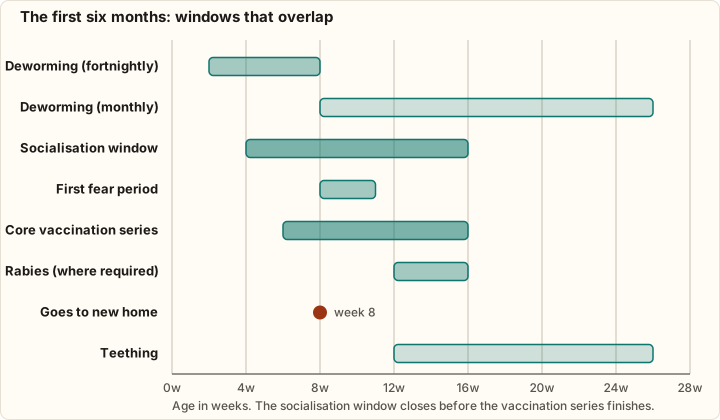
The busiest point on the timeline, with five windows open at once. The end of the socialisation window and the vaccination course overlap here, which is the tension every new owner meets: the safest thing medically and the safest thing behaviourally pull in opposite directions.
At 32 weeks
32 weeks old · about 7.4 months
1 window open now
- Open: Down to two meals a day
- Next: Essentially full size, from week 40
- 12 already behind you
Adolescence. Almost nothing new opens, which is exactly why this stage catches people out: the puppy gets harder while the timeline goes quiet.
Reference values: the full timeline
| Weeks | Milestone | Area | What to do |
|---|---|---|---|
| 1.5–2.5 | Eyes and ears open | development | Nothing to do. Keep light levels gentle while the eyes adjust. |
| 4–7 | Weaning | feeding | Handled by the breeder in almost all cases. A puppy should be fully weaned before going home. |
| 4–16 | Socialisation window | behaviour | Introduce sights, sounds, surfaces, people and handling deliberately and at your puppy's pace. Calm exposure beats quantity. |
| 6–8 | Core vaccinations begin | health | Book the first appointment. Ask your vet how to socialise safely before the series finishes. |
| 8 | Going to a new home | development | The new owner inherits a share of the socialisation work. Start immediately rather than waiting for vaccinations. |
| 8–11 | First fear period | behaviour | Keep experiences positive and low pressure. Do not force a frightened puppy through something. |
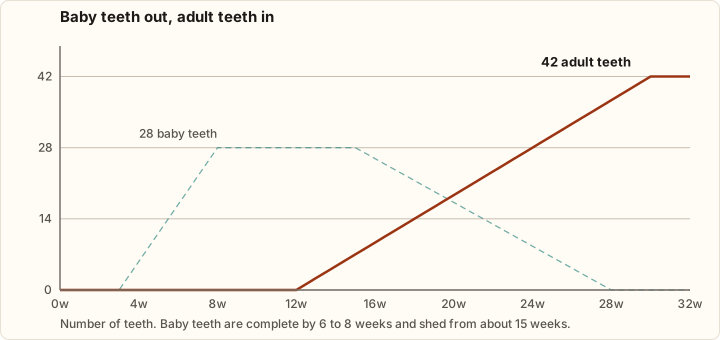
| 12–24 | Teething | development | Provide appropriate chew items. Check at around 7 months that no baby teeth have been retained. |
| 12–16 | Rabies vaccination | health | Check what your area requires; timing is set by law as much as by medicine. |
| 12 | Growth tracking becomes reliable | development | Start plotting weight against age. Weekly to 16 weeks, then fortnightly. |
| 16–20 | Core vaccination series complete | health | Confirm the final dose with your vet, then a booster one year later. |
| 16–20 | Half adult weight | development | A good moment to re-run a weight prediction, since accuracy improves considerably by now. |
| 26 | Adolescence begins | behaviour | Keep training going rather than assuming the work is done. It passes. |
| 26–34 | Down to two meals a day | feeding | Recalculate the daily amount at the same time; the calorie multiplier has already stepped down at four months. |
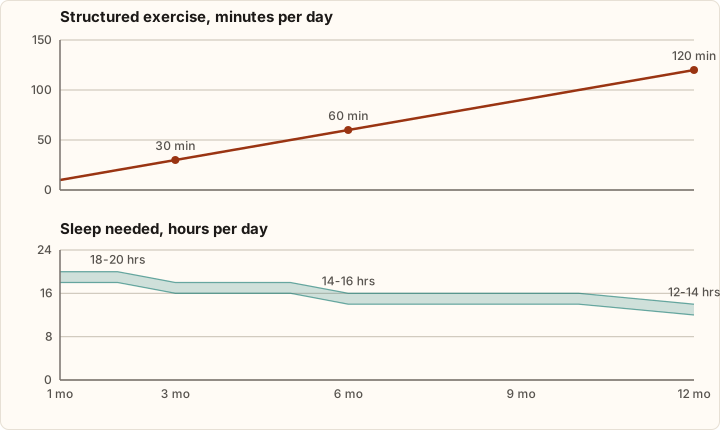
| 35–104 | Growth plates close | development | Structured exercise can build up once plates are closed. Ask your vet before starting real running. |
| 40–60 | Essentially full size | development | Time the switch to adult food around here, guided by your vet rather than a birthday. |
By area
Development
- Eyes and ears open (weeks 1.5 to 2.5)
- Puppies are born with eyes and ear canals closed. Both open around 10 to 14 days.
- Going to a new home (week 8)
- Most puppies leave the litter at eight weeks, in the middle of the socialisation window.
- Teething (weeks 12 to 24)
- Adult teeth replace baby teeth. Chewing peaks and gums can be sore.
- Growth tracking becomes reliable (week 12)
- Veterinary growth references begin at 12 weeks, so weight predictions get considerably more useful from here.
- Half adult weight (weeks 16 to 20)
- Most puppies pass half their adult weight around four to four and a half months, later for bigger breeds.
- Growth plates close (weeks 35 to 104)
- Between roughly 8 months and 2 years depending on size. Bigger dogs finish last.
- Essentially full size (weeks 40 to 60)
- Dogs reach about 90 percent of adult weight between roughly 9.5 and 13 months depending on size.
Health
- Core vaccinations begin (weeks 6 to 8)
- The core series starts, covering distemper, parvovirus and adenovirus.
- Rabies vaccination (weeks 12 to 16)
- A single dose, where local regulations require it.
- Core vaccination series complete (weeks 16 to 20)
- The series runs every 2 to 4 weeks until after 16 weeks; some areas prefer 18 to 20.
Behaviour
- Socialisation window (weeks 4 to 16)
- The most consequential period in a dog's life. What a puppy meets calmly now is far more likely to be unremarkable to it as an adult.
- First fear period (weeks 8 to 11)
- A stage where puppies startle more easily and a bad experience can leave a lasting impression.
- Adolescence begins (week 26)
- Dogs commonly become less responsive, more independent and more reactive. It is the age at which many dogs are given up.
Feeding
- Weaning (weeks 4 to 7)
- Puppies move from milk onto solid food across roughly three weeks.
- Down to two meals a day (weeks 26 to 34)
- Most puppies move from three meals to two around six months. Toy breeds stay on three for longer.
The window that actually has a deadline
Almost everything on this timeline is recoverable if you are late. The socialisation window is the exception, and it closes around sixteen weeks.
The tension is real: puppies usually go home at eight weeks, and the core vaccination series does not finish until after sixteen. Keeping a puppy entirely indoors until then protects it from disease and costs it the window. Ask your vet how to socialise safely in your area rather than picking one risk and ignoring the other.
Accuracy and limits
- These are ranges, not switches. Individual puppies vary considerably.
- Vaccination timings are the firmest here, following AAHA guidance, and are still subject to local regulations and your vet’s judgement.
- Behavioural stages are the loosest. Fear periods in particular are widely described but not sharply defined.
- A puppy that seems behind is usually not. Use this to know what to expect, not to diagnose.
Frequently asked questions
What are the stages of puppy development?
Broadly: neonatal to about two weeks, transitional to four weeks, socialisation from four to sixteen weeks, a fast growth phase to about six months, adolescence from six to twelve months or beyond, and finishing out to two years for the largest breeds.
The socialisation window is the one with the most lasting consequences and the shortest deadline.
What is the socialisation window and why does it matter so much?
Roughly four to sixteen weeks, with the most sensitive period earlier in that range. What a puppy meets calmly during it is far more likely to be unremarkable to it as an adult.
The awkward part is that most puppies go home at eight weeks and the core vaccination series does not finish until after sixteen weeks. That creates real tension between disease risk and behavioural risk, and it is genuinely worth asking your vet how to socialise safely rather than defaulting to keeping a puppy indoors.
What is a fear period?
A stage where a puppy startles more easily and a frightening experience can leave a longer-lasting impression than it would otherwise. The first commonly falls around eight to eleven weeks, which unhelpfully coincides with going to a new home.
The handling is straightforward: keep experiences positive and low pressure, and never force a frightened puppy through something. Pushing on tends to confirm the fear rather than resolve it.
When do puppies lose their baby teeth?
Adult teeth replace baby teeth from roughly twelve to twenty-four weeks, and chewing peaks accordingly. Most owners never find the baby teeth, because puppies usually swallow them.
Worth checking at around seven months that no baby teeth have been retained alongside the adult ones, particularly the canines. Retained teeth are a common reason for a small extraction and your vet will spot them at a routine check.
Why does my puppy suddenly seem badly behaved at six months?
Adolescence. Dogs commonly become less responsive, more independent and more reactive somewhere between six and eighteen months, and it catches owners off guard precisely because the puppy phase went well.
It is a stage rather than a regression, and it is the age at which many dogs are given up. Keep the training going instead of assuming the work was already done.
When can my puppy meet other dogs?
This is a conversation with your vet rather than a fixed date, because it depends on your puppy's vaccination progress and local disease risk.
The general shape of modern advice is to socialise deliberately and early with known, vaccinated, healthy dogs in controlled settings, rather than waiting for the full series to finish and losing the window entirely.
Are these timings exact?
No, and treating them as switches is the main way they get misused. They are typical ranges, and individual puppies vary considerably around them.
Vaccination timings follow AAHA guidance and are the most firmly established here. Behavioural stages are the loosest. Use them to know roughly what to expect and when to prepare, not to diagnose your puppy as behind.
Related calculators
This timeline starts at birth. If you are waiting on a litter rather than raising one, work out the whelping window first, and read what happens during whelping before it starts.
References
Every figure on this page comes from one of these. Full details, including what each source is used for, are on our sources page.
- American Animal Hospital Association. 2022 AAHA Canine Vaccination Guidelines (2024 update).
- American Animal Hospital Association. AAHA Canine Life Stage Guidelines.
- Salt C, Morris PJ, German AJ, Wilson D, Lund EM, Cole TJ, Butterwick RF. Growth standard charts for monitoring bodyweight in dogs of different sizes. PLOS ONE. 2017;12(9):e0182064. doi:10.1371/journal.pone.0182064
- Merck Veterinary Manual. Nutritional Requirements of Small Animals. Management and Nutrition.