Switching from puppy food to adult food
There is no birthday for this. The right moment depends on how big your dog is going to be, and getting it wrong in either direction has real consequences.
When to switch, by size
| Size category | Adult weight | Typical switch |
|---|---|---|
| Toy | Under 6.5 kg | 9 to 12 months |
| Small | 6.5 to 9 kg | 9 to 12 months |
| Medium | 9 to 15 kg | 12 months |
| Large | 15 to 30 kg | 12 to 16 months |
| Very large and giant | 30 kg and over | 14 to 24 months |
The logic is straightforward: switch when growth has essentially finished. Reading off our growth reference, dogs reach about 90 percent of adult weight somewhere between roughly 9.5 and 13 months depending on size band.
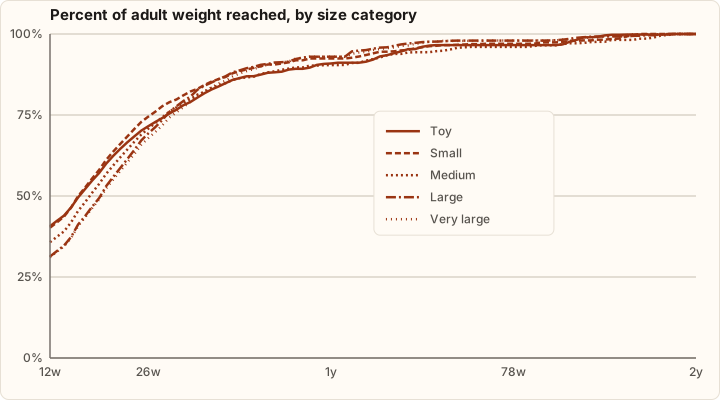
Not sure which band your dog is in? The size calculator works it out from a weight and an age.
Why switching too early matters
Puppy food is formulated for growth: more energy, more protein, and a controlled calcium and phosphorus profile aimed at building a skeleton.
Moving a still-growing dog onto adult maintenance food takes that away during the period it is most needed. For a large-breed dog still filling out at 12 months, that is a real gap rather than a theoretical one.
Why switching too late matters
The other direction is more common and easier to miss.
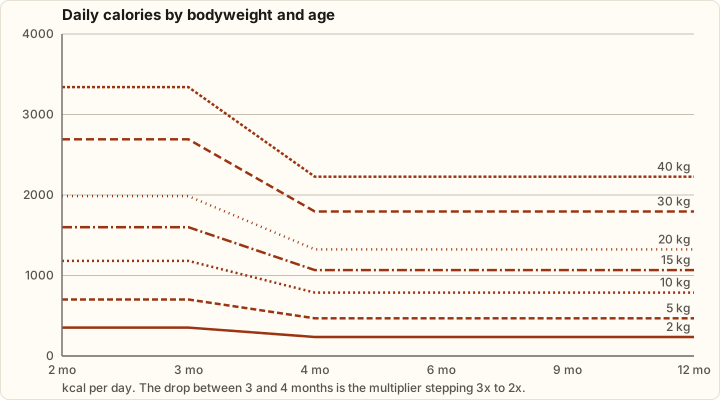
Once growth stops, puppy food’s energy density becomes surplus. Combine that with the calorie multiplier having already stepped down at four months, and with an adolescent dog often getting less exercise than a puppy, and weight gain follows quietly.
The switch is a natural checkpoint for recalculating the portion, which is arguably more valuable than the food change itself. Use the feeding calculator at the same time.
How to transition
Over about seven days, mixing increasing proportions:
| Days | New food | Old food |
|---|---|---|
| 1 to 2 | 25% | 75% |
| 3 to 4 | 50% | 50% |
| 5 to 6 | 75% | 25% |
| 7 onwards | 100% | none |
Slower is fine, and for a dog with a sensitive stomach ten to fourteen days is often better. Faster is where trouble starts: an abrupt change is one of the most common causes of avoidable diarrhoea.
What to watch during the change
- Loose stools for a day or two are common. Persistent diarrhoea, blood, or vomiting are not, and warrant a call to your vet.
- Refusing the new food usually resolves if you slow the transition down rather than giving up and switching back.
- Weight, for a few weeks afterwards. Energy densities differ between foods, so the same scoop is rarely the same calories.
Recalculate the portion, not just the food
This is the step people skip. Adult maintenance and puppy growth use different multipliers, and the new food will have a different energy density.
new cups per day = adult daily calories ÷ kcal per cup of the new food
Both halves of that change at the same time. Carrying the old scoop across to the new bag is how a lean adolescent becomes a heavy two year old.
Large breed dogs specifically
Two points worth holding on to.
Stay on a large breed puppy formula until growth is genuinely done, which for a giant breed can mean approaching two years. The controlled calcium matters for as long as the growth plates are open, as covered in calcium and large breed puppies.
Do not rush to adult food to slow a big puppy down. If growth looks too fast, the answer is portion control on the right food, not the wrong food.
How to know growth has finished
Plot it rather than guess. When the line on a growth chart flattens and stays flat across several weigh-ins, the growing is done. The growth tracker makes that visible.
Height finishes before weight, so a dog that has stopped getting taller may still be filling out for months.
Ask your vet to confirm the timing
This is a genuinely good question for a routine appointment, because your vet can assess body condition, breed, and how the individual dog has grown. A vet who has seen your dog three times over a year has information no calculator does.
The short version
Switch when growth flattens, not on a birthday. Transition over a week. Recalculate the portion at the same time, because the multiplier and the energy density both change.
Related guides
- How much to feed a puppy, by age and weight The veterinary formula behind puppy portions, why the amount drops at four months, and how to convert calories to cups. Work out your portions now.
- Calcium and large breed puppies Why large breed puppy food caps calcium, the AAFCO limits, and why supplementing a complete food is harmful rather than wasteful. Read before you buy.
- Puppy feeding chart by weight and age Daily calorie tables for puppies from 2 to 40 kg at every age, with meal counts and how to convert to cups from your own bag. Find your puppy's row.
Calculators for this
References
Every figure on this page comes from one of these. Full details, including what each source is used for, are on our sources page.
- Merck Veterinary Manual. Nutritional Requirements of Small Animals. Management and Nutrition.
- Association of American Feed Control Officials. Dog and Cat Food Nutrient Profiles, growth and reproduction.
- American Animal Hospital Association. AAHA Canine Life Stage Guidelines.
- Salt C, Morris PJ, German AJ, Wilson D, Lund EM, Cole TJ, Butterwick RF. Growth standard charts for monitoring bodyweight in dogs of different sizes. PLOS ONE. 2017;12(9):e0182064. doi:10.1371/journal.pone.0182064