Puppy feeding chart by weight and age
Most puppy feeding charts give you cups without asking what food you have, which makes them guesses dressed as tables. This one gives you calories, which is the part that does not depend on the brand, and then shows you the one step needed to convert.
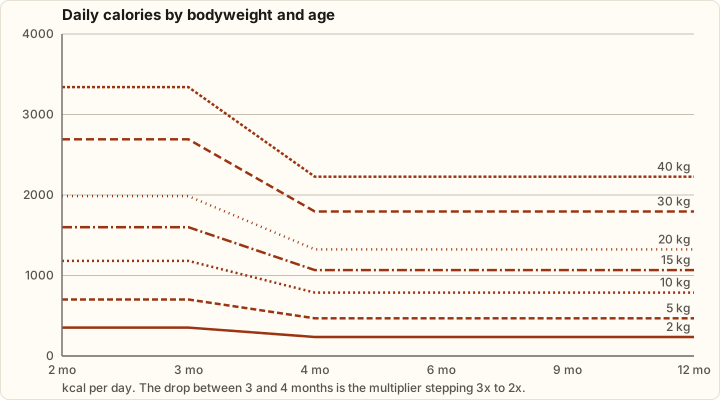
Daily calories by weight and age
Find your puppy’s current weight down the left and its age across the top.
| Weight | 2 mo | 3 mo | 4 mo | 6 mo | 9 mo | 12 mo |
|---|---|---|---|---|---|---|
| 2 kg | 353 | 353 | 235 | 235 | 235 | 235 |
| 5 kg | 702 | 702 | 468 | 468 | 468 | 468 |
| 10 kg | 1181 | 1181 | 787 | 787 | 787 | 787 |
| 15 kg | 1601 | 1601 | 1067 | 1067 | 1067 | 1067 |
| 20 kg | 1986 | 1986 | 1324 | 1324 | 1324 | 1324 |
| 30 kg | 2692 | 2692 | 1795 | 1795 | 1795 | 1795 |
| 40 kg | 3340 | 3340 | 2227 | 2227 | 2227 | 2227 |
Two things stand out, and both are real rather than table errors.
The columns from four months on are identical. That is because the multiplier is the same at every age from four months: twice RER. What changes is your puppy’s weight, so you move down the table rather than across it.
The drop between three and four months is enormous. A 20 kg puppy goes from about 1,986 to about 1,324 kcal overnight. That is the growth multiplier stepping down from three times RER to twice, a fall of a third, and it is the single most important thing on this page.
How to use this table properly
Your puppy does not stay in one row. It grows, so it moves down the table while also moving across it. That is why the useful instruction is not “find your row” but “find your row again in a fortnight”.
Work through it in this order:
- Weigh your puppy today.
- Find the calories for that weight and age.
- Divide by the kcal per cup on your bag.
- Split across the right number of meals.
- Repeat in two weeks.
The feeding calculator does all five and handles weights between rows.
Converting to cups
cups per day = daily calories ÷ kcal per cup
The kcal per cup is on your bag, usually near the guaranteed analysis. It matters more than people expect: at 380 kcal per cup a 1,180 kcal target is about 3.1 cups, but at 500 kcal per cup the same target is 2.4 cups. Same puppy, same calories, very different scoop.
If your food gives kcal per kilogram instead:
grams per day = (daily calories ÷ kcal per kg) × 1000
Meals per day
| Age | Most breeds | Toy and small breeds |
|---|---|---|
| Under 12 weeks | 4 | 4 |
| 12 weeks to 6 months | 3 | 3 |
| 6 to 8 months | 2 | 3 |
| 8 months onwards | 2 | 2 |
Where the numbers come from
The resting energy requirement formula, RER = 70 × kg^0.75, and the growth multipliers of
three times RER under four months and twice over, both come from the Merck Veterinary Manual.
The arithmetic here is exact; the individual variation is what makes it a starting point
rather than a prescription.
A second published form, RER = 30 × kg + 70, exists and is easier to do mentally, but it
is only valid between 2 and 45 kg. We use the exponential form throughout so the table stays
correct at both ends.
Adjusting from the table
The table cannot see your puppy. Adjust on body condition:
- Ribs easily felt under a thin layer of fat, without pressing hard.
- Visible waist from above.
- Visible tuck from the side.
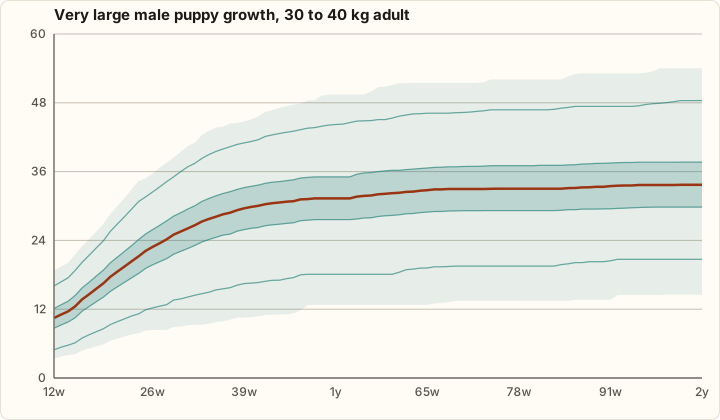
Cannot feel ribs, reduce. Ribs sharp and obvious, increase. And take the numbers to your vet appointments alongside a growth chart, because the two together tell a much fuller story than either alone.
Common mistakes
- Using adult weight instead of current weight. The table is keyed to what your puppy weighs today.
- Never updating. A chart consulted once at twelve weeks is wrong by fourteen.
- Missing the four month step. Set a reminder.
- Ignoring treats. They come out of the total, not on top.
- Assuming cups are universal. They are not, by up to 150 kcal each.
Related guides
- How much to feed a puppy, by age and weight The veterinary formula behind puppy portions, why the amount drops at four months, and how to convert calories to cups. Work out your portions now.
- Puppy food brand feeding charts, compared Why brand feeding guides disagree with each other and with calorie maths, and how to reconcile them for your own bag. Compare the numbers properly.
- Switching from puppy food to adult food When to make the switch by size, how to transition over a week, and why timing it to growth beats timing it to a birthday. Plan the switch now.
Calculators for this
References
Every figure on this page comes from one of these. Full details, including what each source is used for, are on our sources page.