Calcium and large breed puppies
This is the one nutrition topic where getting it wrong causes lasting physical harm rather than an inconvenient waistline, and where the intuitive move is the damaging one.
The counterintuitive part
Most people assume a growing large-breed puppy needs more calcium to build a big skeleton. The opposite is closer to the truth: excess calcium during growth is associated with developmental orthopaedic disease in large breeds.
The reason is a gap in physiology. Puppies from weaning to around six months absorb calcium passively and cannot down-regulate absorption when intake is high. An adult dog takes what it needs and excretes the rest. A young puppy largely takes what it is given.
So adding a calcium supplement on top of a complete food is not merely wasteful, which is how over-supplementation usually plays out. It is actively risky.
The numbers
AAFCO sets limits for foods labelled for large-size growth:
| Measure | Limit |
|---|---|
| Calcium, large-size growth formulas | about 4.5 g per 1,000 kcal maximum |
| Calcium, dry matter basis | not above 1.8% for foods under 3,900 kcal/kg |
| Level where concerns have been reported | above roughly 3.6 g per 1,000 kcal |
That last row is worth noticing. Problems have been reported at levels below the formal maximum, which is why “within the legal limit” is a weaker reassurance than it sounds.
Which puppies this applies to
Any puppy expected to finish above roughly 15 kg, which covers the large and very large size categories used throughout this site. If you are not sure where your puppy will land, the size calculator will tell you.
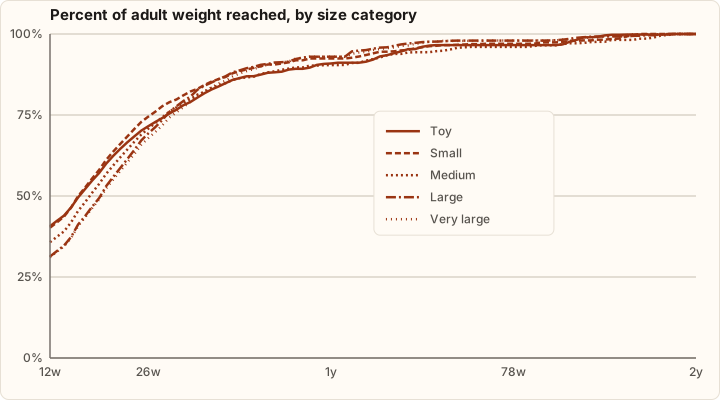
The reason it is a large-breed issue rather than a universal one comes down to how much growing there is to do. A big puppy lays down far more bone over a far longer period, and its growth plates stay open months longer, so there is simply more window for something to go wrong.
Why growing fast is a risk, not an achievement
This is the other half of the same idea, and it surprises people just as much.
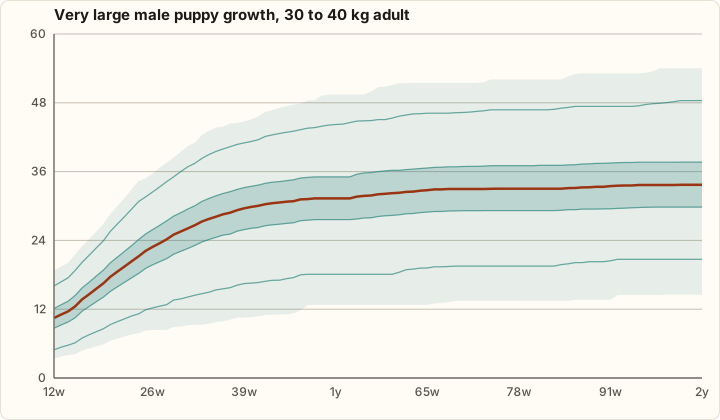
Rapid growth in large-breed puppies is associated with developmental orthopaedic problems. A chunky, fast-growing large-breed puppy is not thriving harder than a lean one; it is carrying more load on immature joints and getting there sooner.
Large breed puppy foods are formulated to control energy density as well as calcium, precisely so growth proceeds steadily rather than at maximum speed. Overfeeding a large-breed puppy on the right food undoes a chunk of the point of buying it.
What to actually do
- Buy a food formulated for large breed growth. Check the AAFCO statement says complete and balanced for growth, and that the bag specifies large size.
- Do not supplement calcium. Not bone meal, not powders, not “just a bit for the joints”.
- Feed to a calculated portion, not free choice, using the feeding calculator.
- Track growth rather than aiming for a big puppy. Steady beats fast. The growth tracker plots it.
- Ask your vet about your specific breed and food, particularly for giant breeds, which sit beyond the range most growth data covers.
Raw and home-prepared diets
This is where the risk is highest, in both directions.
In a raw diet, bone is the calcium source, which makes the bone percentage load-bearing rather than decorative. Too little bone gives a calcium-deficient diet; too much gives an excess, and the puppy cannot regulate either.
Getting that balance right for a growing large-breed puppy is genuinely a job for a vet or a qualified veterinary nutritionist rather than a ratio from a forum. More on the practicalities in raw feeding a puppy safely.
Signs worth a vet visit
Contact your vet if a growing large-breed puppy shows:
- limping or stiffness, particularly after rest;
- reluctance to exercise, or sitting down mid-walk;
- visibly bowed limbs or swollen joints;
- pain when a limb is handled;
- a sudden change in gait.
None of these are things to watch and wait on in a large-breed puppy. Early assessment matters, because some developmental conditions are far more manageable when caught during growth.
The short version
Buy a large breed puppy formula, feed a measured portion, add nothing, and aim for steady growth rather than impressive growth. The instinct to help a big puppy grow bigger, faster is the instinct to resist.
Related guides
- How much to feed a puppy, by age and weight The veterinary formula behind puppy portions, why the amount drops at four months, and how to convert calories to cups. Work out your portions now.
- Raw feeding a puppy safely Portion percentages, the 80/10/10 split, why calcium balance is the hard part for growing puppies, and where the evidence is thin. Read before you start.
- Switching from puppy food to adult food When to make the switch by size, how to transition over a week, and why timing it to growth beats timing it to a birthday. Plan the switch now.
Calculators for this
References
Every figure on this page comes from one of these. Full details, including what each source is used for, are on our sources page.
- Association of American Feed Control Officials. Dog and Cat Food Nutrient Profiles, growth and reproduction.
- Merck Veterinary Manual. Nutritional Requirements of Small Animals. Management and Nutrition.
- World Small Animal Veterinary Association. Global Nutrition Guidelines.
- Salt C, Morris PJ, German AJ, Wilson D, Lund EM, Cole TJ, Butterwick RF. Growth standard charts for monitoring bodyweight in dogs of different sizes. PLOS ONE. 2017;12(9):e0182064. doi:10.1371/journal.pone.0182064