How much to feed a puppy, by age and weight
Almost every answer to this question online is a chart with no arithmetic behind it. Here is the actual calculation vets use, why it changes so sharply at four months, and how to turn it into an amount you can put in a bowl.
The formula
Two steps. First, the resting energy requirement: what your puppy would burn doing nothing at all.
RER = 70 × (bodyweight in kg)0.75
Then a growth multiplier on top:
under 4 months: daily calories = RER × 3 4 months and over: daily calories = RER × 2
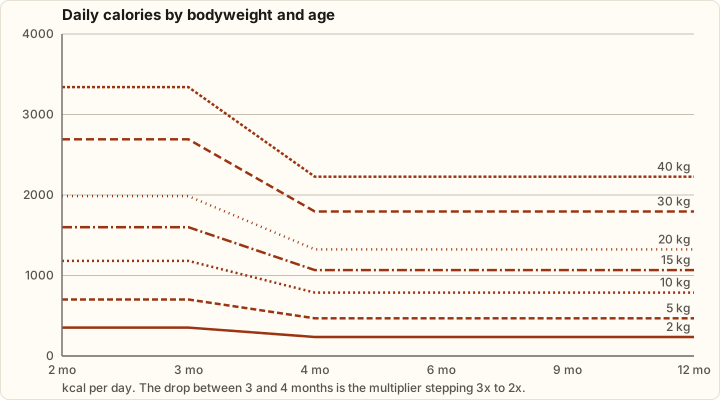
That is the whole thing. A 10 kg puppy has an RER of about 394 kcal, so roughly 1,180 kcal a day at three months and about 790 at six months.
The feeding calculator does this and splits the result into meals, or the calorie calculator shows the energy maths on its own.
The four month cliff
This is the part worth setting a reminder for. The multiplier does not taper. It steps from three times RER to twice RER, and it does so at four months.
In practice: a puppy still eating its three-month portion at seven months is getting about a third more food than it needs. Growth is also slowing at the same time, so the excess has nowhere useful to go.
This single step is one of the most common routes to an overweight adolescent dog, and it happens quietly because nothing about the puppy looks different from one week to the next.
Turning calories into cups
You cannot do this without knowing your food.
Two puppy foods can differ by 150 kcal per cup, which changes the portion by nearly half. A chart that tells you “feed 2 cups” without asking what food you have is guessing.
Look on the bag for kcal/cup or “calorie content”, usually near the guaranteed analysis. Then:
cups per day = daily calories ÷ kcal per cup
Our calculator will not substitute an average density. If you leave the field blank it gives you a calorie target instead, because a guessed density is worse than no answer.
How many meals a day
| Age | Most breeds | Toy and small breeds |
|---|---|---|
| Under 12 weeks | 4 meals | 4 meals |
| 12 weeks to 6 months | 3 meals | 3 meals |
| 6 to 8 months | 2 meals | 3 meals |
| 8 months onwards | 2 meals | 2 meals |
Toy breeds stay on more frequent meals for longer, and it is a safety point rather than a preference: small puppies are prone to low blood sugar when meals are spaced too far apart.
Should I use the chart on the bag instead?
Use both, and expect them to disagree a little.
Bag charts are built around a breed-average puppy at a given weight and tend to run generous. That is not conspiracy, it is incentives: underfeeding generates complaints and overfeeding does not.
A calculated figure is specific to your puppy’s actual weight and age, which makes it a better starting point. Neither the bag nor a calculator can see your dog.
Body condition is the tiebreaker
Whatever number you start from, the adjustment comes from your hands.
- You should be able to feel the ribs easily under a thin layer of fat, without pressing.
- There should be a visible waist when you look down from above.
- There should be a tuck in the abdomen when viewed from the side.
If you cannot feel ribs, reduce. If they are sharp and visible, increase. Your vet does this assessment at every visit and it tells them things a number never will.
My puppy always seems hungry
Most puppies act hungry regardless of how much they have eaten. Appetite is a poor guide to adequacy, and puppies are extremely good at performing starvation.
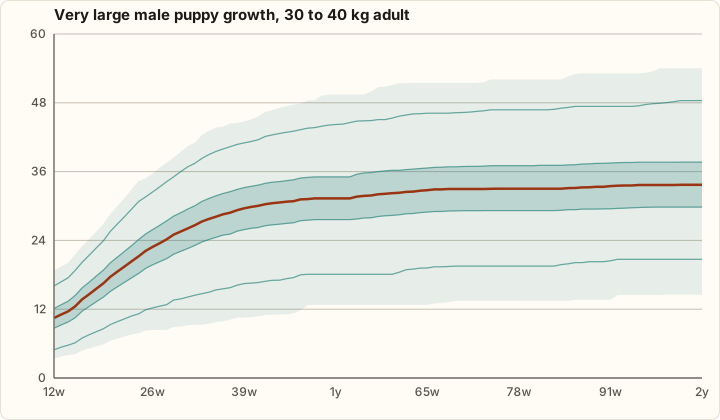
Judge by three things instead: body condition, a steady line on a growth chart, and normal energy levels. If all three look right, your puppy is being fed enough however convincing the display at the bowl.
Large breed puppies are a special case
If your puppy will finish over about 15 kg, it should be on a large breed puppy formula.
These control energy density and calcium deliberately to slow growth, because growing too fast is associated with developmental orthopaedic problems in bigger dogs. Do not add a calcium supplement on top of a complete food: puppies from weaning to about six months absorb calcium passively and cannot down-regulate it. There is more detail in calcium and large breed puppies.
What about treats?
Count them, and take them out of the total rather than adding them on top. The usual ceiling is about ten percent of daily calories.
Training treats add up much faster than people expect. Fifty small treats in a training-heavy day is easy to reach without noticing.
When to change the amount
- Every couple of weeks while your puppy is growing, because the figure rises with weight.
- At four months, when the multiplier steps down from three times RER to twice.
- When body condition drifts, in either direction.
- When switching food, since the energy density will be different.
- Around the switch to adult food, covered in switching from puppy to adult food.
The short version
Calculate from weight and age, convert using your own bag, split by age and size, then let body condition do the fine tuning. And put a note in your calendar for four months.
Related guides
- Puppy feeding chart by weight and age Daily calorie tables for puppies from 2 to 40 kg at every age, with meal counts and how to convert to cups from your own bag. Find your puppy's row.
- Calcium and large breed puppies Why large breed puppy food caps calcium, the AAFCO limits, and why supplementing a complete food is harmful rather than wasteful. Read before you buy.
- Switching from puppy food to adult food When to make the switch by size, how to transition over a week, and why timing it to growth beats timing it to a birthday. Plan the switch now.
Calculators for this
References
Every figure on this page comes from one of these. Full details, including what each source is used for, are on our sources page.
- Merck Veterinary Manual. Nutritional Requirements of Small Animals. Management and Nutrition.
- World Small Animal Veterinary Association. Global Nutrition Guidelines.
- Association of American Feed Control Officials. Dog and Cat Food Nutrient Profiles, growth and reproduction.
- American Animal Hospital Association. AAHA Canine Life Stage Guidelines.