Puppy exercise calculator
How much structured exercise is sensible while the growth plates are still open, and how much sleep to expect. Both numbers surprise people: the exercise figure is lower than most owners assume, and the sleep figure is far higher.
Safe exercise and expected sleep
Structured exercise
—
- Per session
- —
- Sessions a day
- —
- Sleep needed
- —
- Growth plates
- —
How to use the calculator
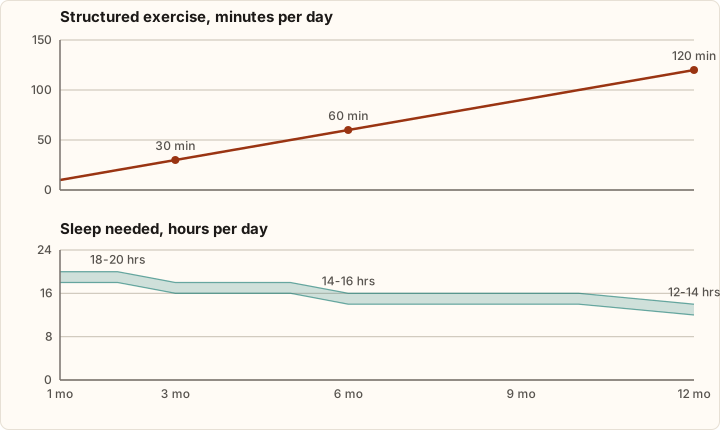
- Enter the age in months. The guideline is five minutes of structured exercise per month of age, twice a day.
- Pick the expected adult size. It changes when growth plates close, which is what the caution is actually about.
- Treat it as a ceiling, not a quota. You do not need to hit the number. It is an upper bound on structured exercise, not a target.
- Let free play sit outside the total. Garden pottering does not count, because a puppy self-regulates and stops when tired.
Reference values
| Age | Per session | Daily total | Sleep |
|---|---|---|---|
| 2 months | 10 min | 20 min | 18 to 20 hrs |
| 3 months | 15 min | 30 min | 16 to 18 hrs |
| 4 months | 20 min | 40 min | 16 to 18 hrs |
| 5 months | 25 min | 50 min | 16 to 18 hrs |
| 6 months | 30 min | 60 min | 14 to 16 hrs |
| 8 months | 40 min | 80 min | 14 to 16 hrs |
| 10 months | 50 min | 100 min | 14 to 16 hrs |
| 12 months | 60 min | 120 min | 12 to 14 hrs |
What each value means
- Minutes per session
- Five minutes for every month of age, which is the widely used guideline rather than a measured threshold. It covers structured exercise only.
- Sessions per day
- Two. The rule is stated as twice daily, so a single long outing is not the same thing as two short ones even when the minutes add up.
- Daily total
- Sessions multiplied out. Treat it as a ceiling for lead walks and directed play, not a target your puppy has to hit every day.
- Sleep needed
- Hours in a 24 hour day, including daytime naps. Puppies sleep far more than most people expect, and shortfall shows up as behaviour rather than as tiredness.
- What is not counted
- Free pottering in the garden, sniffing about, and gentle play the puppy starts and stops itself. A puppy self-regulates when it is left to, which is why this rule is about the exercise you impose rather than the exercise it chooses.
Example calculations
Three ages through the same two calls the calculator makes, with the sleep figure alongside because the two numbers only make sense together.
A 3 month old
3 months old
15 min × 2 a day
- 30 minutes of structured exercise a day
- Sleep needed: 16 to 18 hours
- That leaves about 6 to 8 waking hours
Fifteen minutes twice a day sounds absurdly little to anyone who has met a three month old puppy. The energy is real; the answer is short sessions and more sleep, not a longer walk.
A 6 month old
6 months old
30 min × 2 a day
- 60 minutes of structured exercise a day
- Sleep needed: 14 to 16 hours
- That leaves about 8 to 10 waking hours
Half an hour twice a day. This is the age the guideline starts getting ignored, because the puppy is now visibly capable of much more than its growth plates are ready for.
A 12 month old
12 months old
60 min × 2 a day
- 120 minutes of structured exercise a day
- Sleep needed: 12 to 14 hours
- That leaves about 10 to 12 waking hours
An hour twice a day, and the point at which most dogs can move to adult exercise. For a very large breed, check with your vet first: its plates may still be closing.
What counts as structured exercise
Counts: lead walks, jogging, repetitive fetch, agility equipment, stairs, anything you are directing and pacing.
Does not count: free play in the garden, mooching about the house, sniffing on a long line at the puppy’s own pace.
The distinction matters because a puppy left to self-regulate changes pace constantly and stops when it has had enough. A puppy following you on a lead will keep going well past that point, which is the actual risk.
Where this guideline comes from
The five minute rule is a widely used guideline rather than a finding from a specific study, and we would rather say so than dress it up.
The principle underneath it is well established: growth plates are cartilage while open, softer than surrounding bone, and repetitive high-impact loading is the thing to avoid. The five minute figure is a practical way of keeping that in proportion. Treat it as a sensible ceiling, not a validated threshold.
The sleep figure is the one people get wrong
Young puppies sleep eighteen to twenty hours a day. Most owners considerably underestimate this, and the consequence is a recurring misdiagnosis: an overtired puppy looks almost exactly like an under-exercised one. Frantic, mouthy, unable to settle.
Adding exercise to an overtired puppy makes it worse. Try enforced rest first. It is one of the most useful things a new owner can know, and one of the least obvious.
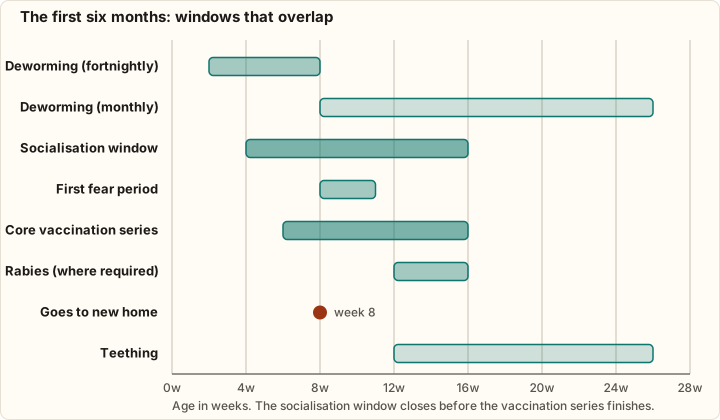
Where this figure stands. The sleep bands are consensus rather than a measured standard, the same as the five minute rule above them. They are the figures repeated across veterinary and behaviour advice, and we could not find a primary source that states them, so none is cited here rather than one being implied. That is why they are given as wide bands with no decimals: read them as "considerably more than you think", not as a target to hit. The energy, growth and vaccination figures elsewhere on this site do trace to published sources, and the difference is deliberate.
Accuracy and limits
- A ceiling, not a quota. There is no need to reach the number.
- Not from a specific study. Stated plainly above.
- Growth plate timings are typical ranges. Only radiographs confirm closure in an individual dog.
- Mental work substitutes well. Sniffing, training and chewing tire a puppy without loading joints.
- Any lameness is a vet visit, not something to walk off.
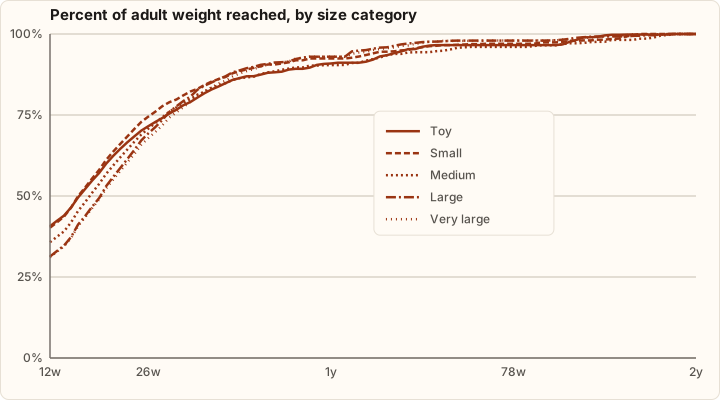
- Growing too fast raises the risk for large breeds, which is a feeding question as much as an exercise one. See calcium and large breed puppies and track weight on the growth curve.
Frequently asked questions
What is the five minute rule for puppies?
Five minutes of structured exercise per month of age, twice a day. A three month old puppy gets about fifteen minutes twice daily, a six month old about thirty.
“Structured” is doing the work in that sentence: lead walks, jogging, repetitive fetch, stairs, anything you are directing. Free play in the garden sits outside it, because a puppy left to its own devices changes pace constantly and stops when it has had enough.
Is the five minute rule based on research?
Not on a specific study, no, and it is worth being straight about that. It is a widely used veterinary and breeder guideline built on a sound principle rather than a measured threshold.
The principle behind it is well established: growth plates are cartilage while they are open, softer than the bone around them, and repetitive high-impact loading is the thing to avoid. The five minute figure is a practical way of keeping that in proportion, not a number anyone has validated in a trial.
How much exercise does my puppy actually need?
Less structured walking than most people assume, and more mental work than most people provide.
Sniffing, training and chewing tire a puppy out as effectively as walking, and put no load at all on growing joints. If you have a puppy with energy to burn, that is usually the better lever than adding distance.
Can I take my puppy running?
Not while the growth plates are open, and that means later than most people expect for a large breed: often twelve to eighteen months, and up to twenty for the biggest dogs.
Running is repetitive, high impact and paced by you rather than the dog, which is exactly the combination to avoid. Talk to your vet about timing rather than picking a birthday, since only radiographs confirm closure in an individual dog.
How much should my puppy sleep?
A great deal more than most owners expect. Young puppies typically sleep eighteen to twenty hours a day, dropping to fourteen to sixteen by six months and settling around twelve to fourteen as adults.
Most of it comes in short bursts rather than one long stretch, which is why it often does not feel like that much.
My puppy will not settle. Does it need more exercise?
Usually the opposite. An overtired puppy looks a great deal like an under-exercised one: frantic, mouthy, unable to switch off. Adding more exercise to that makes it worse.
Try enforced rest first, in a crate or a quiet pen, before concluding you need to walk further. It is one of the most common misreads in the first few months.
Are stairs really a problem?
Repeated stairs, especially descending, are worth limiting while plates are open. The concern is repetition and impact rather than any single flight.
Carrying a large breed puppy up and down for the first few months is a reasonable precaution. Nobody needs to seal off the house.
Does this apply to small breeds too?
The principle does, but the stakes are lower. Small dogs carry less weight on joints and their plates close sooner, often by eight to eleven months.
Large and giant breeds are where it matters most: the most weight, on the joints that stay open longest.
Related calculators
References
Every figure on this page comes from one of these. Full details, including what each source is used for, are on our sources page.
- American Animal Hospital Association. AAHA Canine Life Stage Guidelines.
- Salt C, Morris PJ, German AJ, Wilson D, Lund EM, Cole TJ, Butterwick RF. Growth standard charts for monitoring bodyweight in dogs of different sizes. PLOS ONE. 2017;12(9):e0182064. doi:10.1371/journal.pone.0182064
- American Kennel Club. Official Breed Standards.