Puppy vaccination schedule
Timing only. This page describes when vaccinations typically happen. It does not recommend products or doses, and it is not a substitute for your vet, who will adjust the plan for local disease risk and your individual puppy.
The core schedule
Following the AAHA canine vaccination guidelines:
| Age | What typically happens |
|---|---|
| 6 to 8 weeks | Core series begins |
| Every 2 to 4 weeks after | Repeat doses continue |
| 12 to 16 weeks | Rabies, as a single dose, where required by law |
| After 16 weeks | Final dose of the core series |
| 18 to 20 weeks | Preferred endpoint in some higher-risk areas |
| 1 year later | Booster |
What “core” means
Core vaccines are recommended for all dogs regardless of lifestyle, unless there is a specific medical reason not to vaccinate. They cover:
- Canine distemper virus
- Canine parvovirus
- Canine adenovirus
- Rabies, where local regulations require it
Non-core vaccines, such as those for leptospirosis, kennel cough or Lyme disease, depend on where you live and what your dog does. That is a genuine conversation with your vet rather than a universal recommendation.
Why the series runs past 16 weeks
This is the part worth understanding, because it explains why one shot is not enough.
Puppies receive antibodies from their mother’s milk. Those maternal antibodies protect the puppy early, but they also interfere with vaccination, effectively blocking the vaccine from taking. They fade at an unpredictable age, somewhere between roughly 8 and 16 weeks depending on the individual.
Nobody knows the exact day for a given puppy. So the series is repeated every two to four weeks, and the final dose is given after 16 weeks, once maternal antibodies have almost certainly gone. It is not that each shot is weak; it is that any individual shot might have been blocked.
This is also why “my puppy has had a vaccination” and “my puppy is protected” are not the same statement until the series is finished.
The collision with socialisation
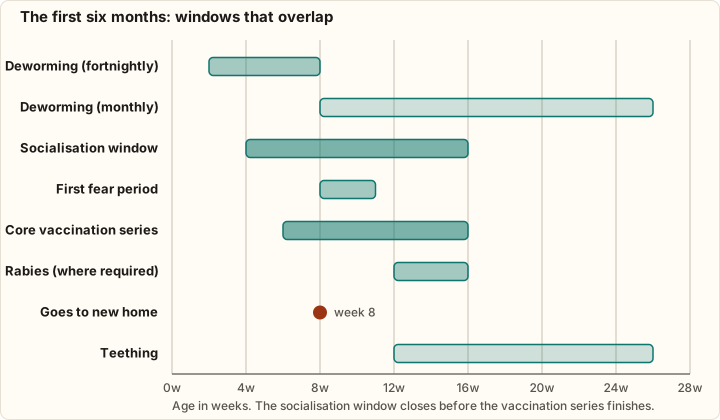
The socialisation window runs roughly 4 to 16 weeks. The core series does not finish until after 16 weeks. They overlap almost exactly.
Keeping a puppy entirely indoors until fully vaccinated eliminates one risk and creates another, and behavioural problems are a leading reason dogs are given up. Modern advice is to socialise deliberately and carefully during the gap rather than to wait it out.
Practical middle ground: carry your puppy in public, use known vaccinated healthy dogs in private gardens, choose puppy classes that require proof of vaccination, and avoid places where unknown dogs toilet. Ask your vet what is sensible where you live, because local parvovirus risk genuinely varies.
The booster at one year
A booster is recommended one year after the initial series, regardless of formulation or the age at which the series was completed.
Its purpose is partly to catch any animal that failed to respond to the earlier doses. After that, revaccination intervals for core vaccines are typically longer than annual, and your vet will set them.
What to bring to appointments
- Any vaccination record from the breeder or shelter, including dates.
- Your puppy’s current weight, since it gets recorded and is useful for growth tracking too.
- Questions about socialisation in your area.
- Any worming history, which pairs with the deworming schedule.
Common questions
Can my puppy go in the garden? Your own garden is usually considered lower risk if no unvaccinated dogs use it. Your vet can advise for your situation.
What if we missed a dose? Contact your vet rather than guessing. Depending on the gap they may resume or restart, and that judgement depends on the timings.
Does my rescue puppy need to start over? If records are missing, often yes. Titre testing is sometimes an option; your vet will say whether it is appropriate.
Are there side effects? Mild lethargy or soreness for a day is common. Facial swelling, vomiting, hives or collapse are not, and are an urgent call.
The short version
Start at 6 to 8 weeks, repeat every 2 to 4 weeks, finish after 16 weeks, booster at a year. The series is long because maternal antibodies block vaccines at an unpredictable age, and the overlap with socialisation is a real problem to plan around rather than ignore.
Related guides
- Puppy deworming schedule The CAPC-recommended worming timeline from two weeks, why puppies are wormed so early, and why we publish no doses. See the schedule here.
- The puppy socialisation window Why 4 to 16 weeks shapes a dog for life, how to socialise before vaccinations finish, and what to do if you started late. Check your puppy's window.
- Puppy age in weeks vs months, and dog years Why weeks matter more than months for a puppy, how to convert without drifting, and what dog years really mean. Convert your puppy's age now.
Calculators for this
References
Every figure on this page comes from one of these. Full details, including what each source is used for, are on our sources page.