Puppy age in weeks vs months, and dog years
Two small conversions that people get wrong constantly, and one piece of folklore that has been thoroughly superseded.
Divide by 4.348, not by 4
A calendar month averages 4.348 weeks. The habit of dividing by four is close enough for a fortnight and steadily wrong after that.
| Age in weeks | Actual months | Divide by 4 says |
|---|---|---|
| 8 weeks | 1.8 | 2.0 |
| 12 weeks | 2.8 | 3.0 |
| 16 weeks | 3.7 | 4.0 |
| 26 weeks | 6.0 | 6.5 |
| 39 weeks | 9.0 | 9.8 |
| 52 weeks | 12.0 | 13.0 |
By the end of the first year the two conventions disagree by a full month. This is why a 12 week old puppy is not quite three months old, and why a “16 week” vaccination appointment is not the same thing as a four month one.
The age calculator does this properly from a birth date, giving weeks and days.
Why weeks, though?
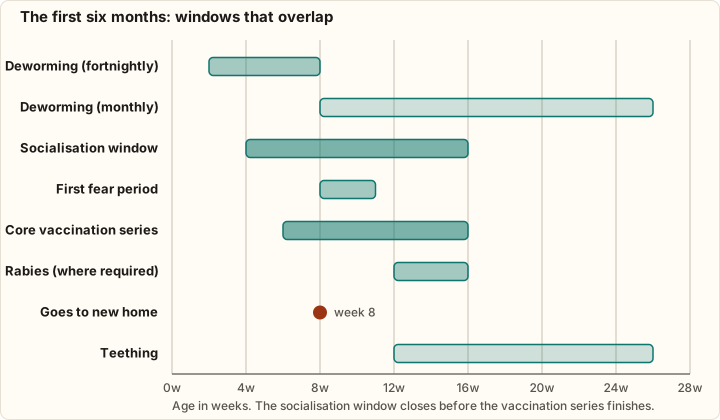
Because almost everything clinically important in the first year is keyed to weeks:
- 6 to 8 weeks: core vaccination series begins
- Every 2 to 4 weeks after: boosters until past 16 weeks
- 4 to 16 weeks: the socialisation window
- 12 weeks: where veterinary growth references begin
- 12 to 16 weeks: rabies vaccination where required
- 12 to 24 weeks: teething
Months are simply too coarse a unit for a period where a fortnight makes a visible difference. “Three months old” covers a puppy that has finished its vaccination series and one that has not.
Dog years: the seven times rule is dead
It was never based on anything. It appears to have come from a rough life-expectancy comparison and then survived on convenience.
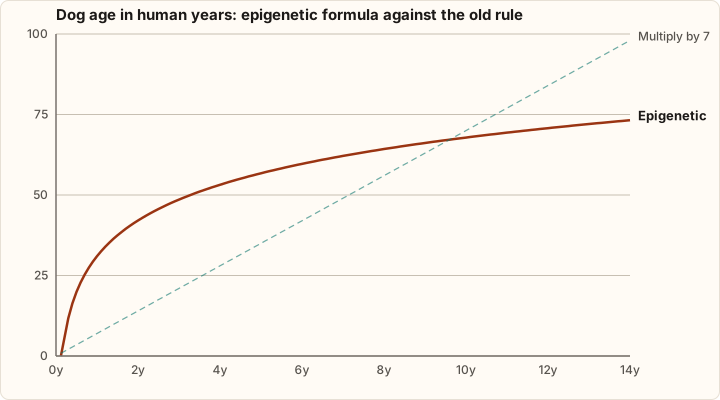
The modern replacement comes from Wang and colleagues, published in Cell Systems in 2020, derived from DNA methylation — chemical marks on DNA that change measurably with age:
human age = 16 × ln(dog age in years) + 31
| Dog age | Epigenetic formula | Old rule said |
|---|---|---|
| 6 months | 20 | 4 |
| 1 year | 31 | 7 |
| 2 years | 42 | 14 |
| 5 years | 57 | 35 |
| 10 years | 68 | 70 |
| 13 years | 72 | 91 |
The shape is the point. Ageing is fast early and slow later, which the straight line of the old rule flattens out entirely. A one year old dog is not a seven year old child; it is closer to a young adult, which matches what a one year old dog is actually like.
How accurate is it?
A much better rule, not a precise answer. It was derived from Labrador Retrievers, and breed size affects ageing considerably.
Its value is that it gets the curve right. Where it is weakest is exactly where the old rule was weakest too: it does not account for the fact that big dogs age faster than small ones.
Life stages depend on size
This is where size comes back in. AAHA guidance defines senior status by the proportion of expected lifespan rather than a fixed birthday.
| Size | Adult weight | Senior from about |
|---|---|---|
| Toy | Under 6.5 kg | 10 years |
| Small | 6.5 to 9 kg | 9.5 years |
| Medium | 9 to 15 kg | 8 years |
| Large | 15 to 30 kg | 7 years |
| Very large | 30 to 40 kg | 6.5 years |
Several years separate two dogs of identical chronological age. Any single “dog years” number that ignores size is misleading by construction.
When does a dog stop being a puppy?
Physically, it depends on size: small breeds by around 9 to 12 months, medium by 12 to 14, large and giant carrying on to 18 to 24.
Behaviourally, later than that. Adolescence commonly runs from about six months to eighteen months or beyond, and it catches owners off guard precisely because the puppy stage went well. The development timeline shows where a particular puppy sits.
Rescue puppies with estimated ages
Age drives a great deal, so an estimate matters most when the puppy is young. Two weeks of error at 12 weeks shifts growth predictions and vaccination timing noticeably; the same error at 40 weeks barely registers.
Vets estimate age reasonably well from teeth, which is one reason the teething timeline is genuinely useful information rather than trivia.
The short version
Use weeks while your puppy is a puppy. Divide by 4.348 when you need months. And if you want a human-years figure, use the logarithm rather than the seven.
Related guides
- The puppy socialisation window Why 4 to 16 weeks shapes a dog for life, how to socialise before vaccinations finish, and what to do if you started late. Check your puppy's window.
- Puppy teething timeline When baby teeth arrive and fall out, when adult teeth erupt, and what to check at seven months. See where your puppy is on the timeline.
- Puppy vaccination schedule The AAHA core vaccination timeline from 6 weeks, why the series runs past 16 weeks, and how it collides with socialisation. See the schedule.
Calculators for this
References
Every figure on this page comes from one of these. Full details, including what each source is used for, are on our sources page.
- Wang T, Ma J, Hogan AN, Fong S, et al. Quantitative Translation of Dog-to-Human Aging by Conserved Remodeling of the DNA Methylome. Cell Systems. 2020;11(2):176-185.e6. doi:10.1016/j.cels.2020.06.006
- American Animal Hospital Association. AAHA Canine Life Stage Guidelines.
- American Animal Hospital Association. 2022 AAHA Canine Vaccination Guidelines (2024 update).
- Salt C, Morris PJ, German AJ, Wilson D, Lund EM, Cole TJ, Butterwick RF. Growth standard charts for monitoring bodyweight in dogs of different sizes. PLOS ONE. 2017;12(9):e0182064. doi:10.1371/journal.pone.0182064