Puppy food brand feeding charts, compared
We are not affiliated with any pet food manufacturer. No brand is named here as a recommendation, and nothing on this site is sponsored. What follows explains how to read any brand’s chart, using the manufacturer’s own numbers from your own bag.
Search for a brand’s puppy feeding calculator and you will find plenty of third-party sites offering one. Almost none of them are run by the manufacturer, and almost all of them are guessing at the energy density of a food they have never seen.
Here is what is actually going on and how to reconcile it.
Why brand charts disagree with each other
Three reasons, and only one of them is about the food.
Different energy densities. This is the legitimate one. A calorie-dense food needs a smaller scoop for the same nutrition. Puppy foods commonly range from about 350 to over 500 kcal per cup, which changes the portion by nearly half for identical puppies.
Different assumed puppies. A chart keyed to “expected adult weight” and one keyed to “current weight” will give different answers for the same dog, and bags do not always make clear which they mean.
Different incentives. Bag charts tend to run generous. That is not a conspiracy, it is incentives: an underfed puppy generates a complaint, an overfed one generally does not.
Why they disagree with calorie maths
The veterinary calculation starts from your puppy’s actual weight and age:
RER = 70 × (bodyweight in kg)0.75, then × 3 under four months, × 2 after
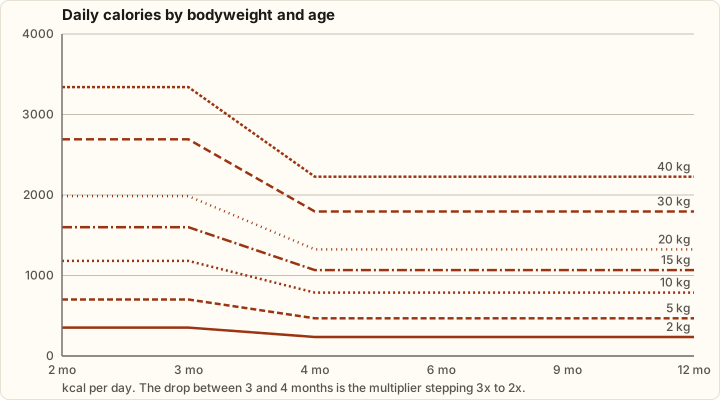
A brand chart starts from a population average at a given weight band. Both are reasonable; they answer slightly different questions. Expect them to land within maybe fifteen or twenty percent of each other, and treat a much larger gap as a sign that something has been misread, usually current weight versus expected adult weight.
How to read any brand’s chart properly
Everything you need is on the bag.
- Find the calorie content. Look for “kcal/cup” or “calorie content”, usually near the guaranteed analysis. Sometimes it is given per kilogram instead.
- Check what the chart is keyed to. Current weight or expected adult weight. This is the single most common misreading.
- Check the age bands. Some charts drop at four months, matching the growth multiplier. Many do not, which is a meaningful omission.
- Convert your own target.
cups per day = daily calories ÷ kcal per cup. - Compare, then split the difference and watch body condition.
Our feeding calculator takes the kcal per cup from your bag and does step four for you. It deliberately refuses to guess that number if you leave it blank, because a guessed density is worse than no answer at all.
The check almost every brand chart fails
Does it step down at four months?
The growth multiplier steps down from three times RER to twice RER at four months. It is a step, not a taper. A chart that changes smoothly across that boundary, or not at all, will overfeed an adolescent puppy.
If your bag’s chart does not have a visible discontinuity somewhere around four months, calculate the target yourself and use the chart only as a sanity check.
What actually matters more than the brand
For a large or very large breed puppy, one label detail matters more than any portion table: the food should be formulated for large breed growth, with controlled calcium. AAFCO caps calcium in those formulas at roughly 4.5 grams per 1,000 kcal for good reason, covered in calcium and large breed puppies.
For any puppy, check the AAFCO statement says the food is complete and balanced for growth or for all life stages, not for adult maintenance.
Reconciling the two numbers
When the bag and the calculation disagree:
- Within about 15 percent: either is fine. Start in the middle.
- Bag much higher: likely a generous chart, or you are reading an adult-weight row. Favour the calculated figure and watch condition.
- Bag much lower: check you have the right life stage chart, and that the food is actually a puppy formula.
- Either way: re-weigh in two weeks and let body condition decide. Ribs easily felt under a thin layer of fat, visible waist from above.
The short version
No third-party site knows what is in your bag. The manufacturer’s chart and the veterinary calculation are both starting points, they will disagree modestly, and the tiebreaker is your hands on your puppy’s ribs a fortnight from now.
Related guides
- How much to feed a puppy, by age and weight The veterinary formula behind puppy portions, why the amount drops at four months, and how to convert calories to cups. Work out your portions now.
- Puppy feeding chart by weight and age Daily calorie tables for puppies from 2 to 40 kg at every age, with meal counts and how to convert to cups from your own bag. Find your puppy's row.
- Switching from puppy food to adult food When to make the switch by size, how to transition over a week, and why timing it to growth beats timing it to a birthday. Plan the switch now.
Calculators for this
References
Every figure on this page comes from one of these. Full details, including what each source is used for, are on our sources page.