How much sleep do puppies need?
This is the number new owners underestimate most, and the misunderstanding causes a specific, very common problem.
Hours by age
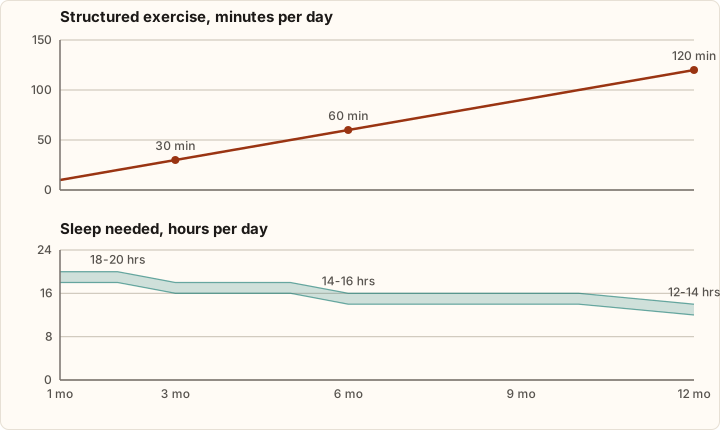
| Age | Sleep per day |
|---|---|
| Under 3 months | 18 to 20 hours |
| 3 to 6 months | 16 to 18 hours |
| 6 to 12 months | 14 to 16 hours |
| Adult | 12 to 14 hours |
Most of it comes in short bursts rather than one long stretch, which is why it rarely feels like eighteen hours. A puppy that plays hard for twenty minutes and collapses for ninety is behaving completely normally.
The mistake almost everyone makes
An overtired puppy looks almost exactly like an under-exercised one.
Both are frantic. Both are mouthy. Both cannot settle, pace, grab at ankles, and seem to have limitless energy. The instinctive response is to conclude the puppy needs a longer walk.
Adding exercise to an overtired puppy makes it worse. It is the equivalent of keeping an overtired toddler up later.
If your puppy is wild in the evening, try enforced rest first: a crate or a quiet pen, a chew, lights low, for an hour or two. A large share of “hyperactive” puppies are simply exhausted and have lost the ability to switch off, which is a skill they are still learning.
How to tell which one you are looking at
Overtired puppies tend to:
- get worse rather than better as the day goes on;
- become mouthier and harder specifically in the late afternoon and evening;
- struggle to settle even when physically tired;
- get frantic after excitement rather than winding down;
- sleep heavily as soon as they are confined.
An under-exercised puppy is more likely to be restless in a low-key way, and to settle readily once it has had something to do. Mental work counts: sniffing, training and chewing tire a puppy as effectively as walking, and put nothing on growing joints.
Teaching a puppy to settle
Settling is a learned skill, not a default state. It is worth teaching deliberately:
- A defined rest space. Crate or pen, associated with calm rather than punishment.
- A predictable rhythm. Activity, then rest, on a loop through the day.
- Enforced naps. Confine before the puppy hits the wall, not after.
- Reward calm. Quietly dropping a treat for a settled puppy teaches more than any correction.
- Do not rely on the puppy self-regulating. Very few will choose to stop.
Night waking
Puppies wake at night, largely because their bladders are small. Expect it early and expect it to improve.
Rough guidance is that a puppy can hold on for about one hour per month of age at night, so a three month old realistically needs one trip out. Take the puppy out calmly and boringly, with no play, and back to bed.
If a previously reliable puppy starts waking again, or having accidents in the day, that is worth mentioning to your vet rather than treating as a training regression.
Where sleep and exercise meet
The five minute rule caps structured exercise at five minutes per month of age, twice a day. The exercise calculator works out both numbers together, which is the more useful pairing: they move in opposite directions as a puppy grows.
The important bit is that the exercise figure is a ceiling, not a target. Nobody needs to reach it, and a puppy that has not had its full allocation is not being deprived.
When sleep is a red flag
Sleeping a lot is normal. What is not:
- Unable to be roused, or wobbly and disoriented when woken.
- A sudden change in a puppy that was previously energetic.
- Sleeping through meals, or losing interest in food.
- Lethargy alongside vomiting, diarrhoea, pale gums or laboured breathing.
Any of those is a call to your vet rather than something to sleep off.
The short version
Eighteen to twenty hours for a young puppy, in short bursts. When your puppy is wild and unmanageable in the evening, the answer is usually a nap, not a walk.
Related guides
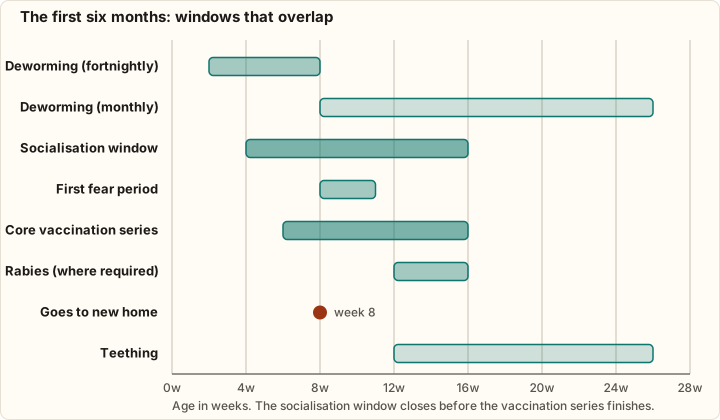
- The puppy socialisation window Why 4 to 16 weeks shapes a dog for life, how to socialise before vaccinations finish, and what to do if you started late. Check your puppy's window.
- Puppy teething timeline When baby teeth arrive and fall out, when adult teeth erupt, and what to check at seven months. See where your puppy is on the timeline.
- Puppy age in weeks vs months, and dog years Why weeks matter more than months for a puppy, how to convert without drifting, and what dog years really mean. Convert your puppy's age now.
Calculators for this
References
Every figure on this page comes from one of these. Full details, including what each source is used for, are on our sources page.